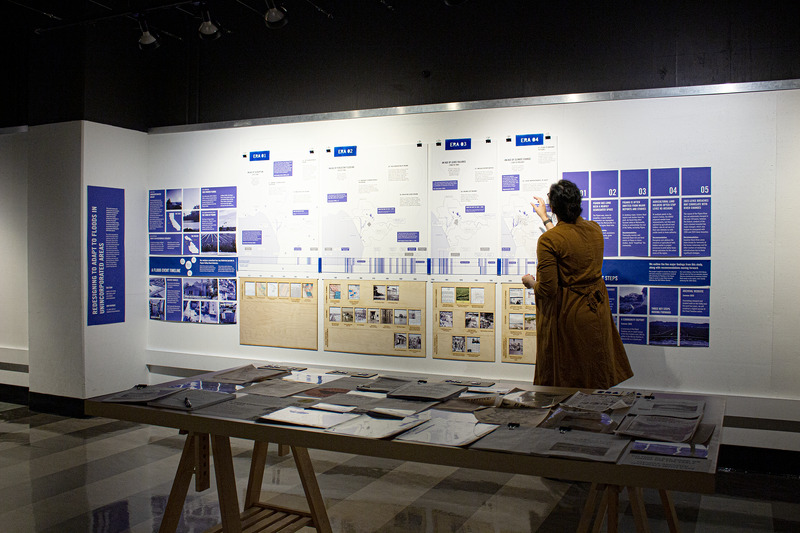
A research and design lab in Landscape Architecture and Environmental Planning at UC Berkeley's College of Environmental Design that works on policy and design for just environments before and after disasters. Directed by Danielle Zoe Rivera, the lab centers hazard mitigation for under-resourced communities and co-produces research with them. In California it has studied the flood history of the Pájaro Valley with the U.S. Army Corps of Engineers, shown in an April 2025 exhibit at Bauer Wurster Hall that combined archival research, a flood timeline and maps, and it has worked on recovery after the Los Angeles fires. The lab began in 2018 at the University of Colorado Boulder under the name Comunidad and took its current name after moving to Berkeley in 2021.
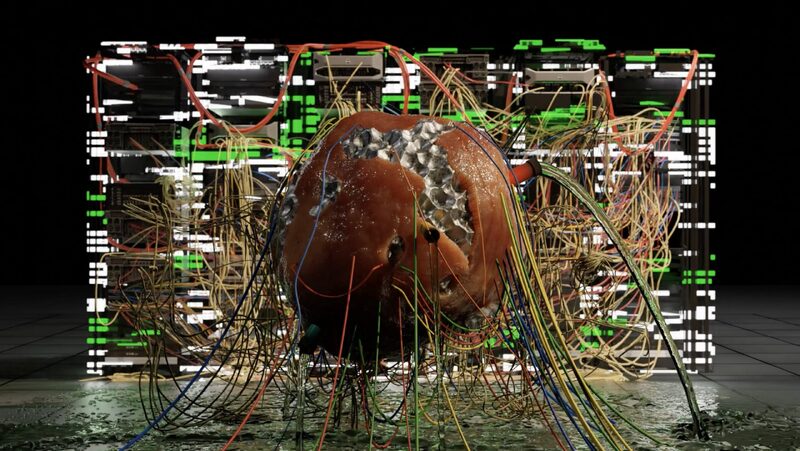
A speculative hybrid creature built from roughly 2,000 pounds of e-waste gathered around the Bay Area, staged by Jill Miller and Asma Kazmi, who work together as the Missing Object Library. Cables, server racks, monitors and cooling units recreate the look of a server farm, while animated video traces the materials back to the rare earth mines they came from; smaller 'offspring' forms made of lithium, cobalt and silicon appeared on lobby monitors. The work pushes back on the idea that the cloud, big data and AI are weightless, pointing to their energy demands, extraction and labor. A first version was installed in October 2023; the full installation filled the Gray Area Gallery in San Francisco from April 22 to July 20, 2025, commissioned through Gray Area's C/Change program with Goethe-Institut San Francisco and supported in part by the UC Berkeley Center for New Media and UC Berkeley Surplus.
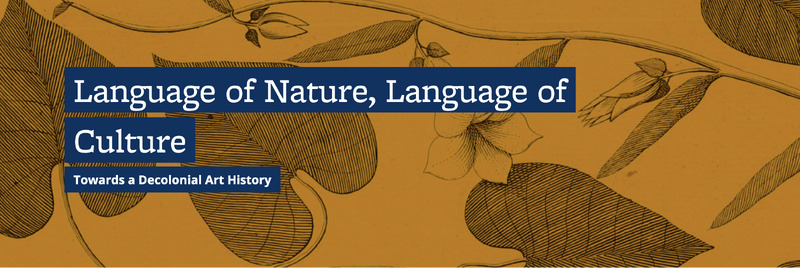
A three-year research and pedagogical project of the South Asia Art Initiative at the Institute for South Asia Studies, UC Berkeley, supported by the Getty Foundation's Connecting Art Histories initiative. It reconsiders the relation between nature and culture in art history, treating them not as opposing domains but as categories produced together through histories of matter, mobility, imagination and power. Through public programs, field-based workshops and collaborative research with a global cohort of scholars and practitioners, it aims to build a lexicon for South Asian art histories grounded in climate, decolonization and planetary thought.
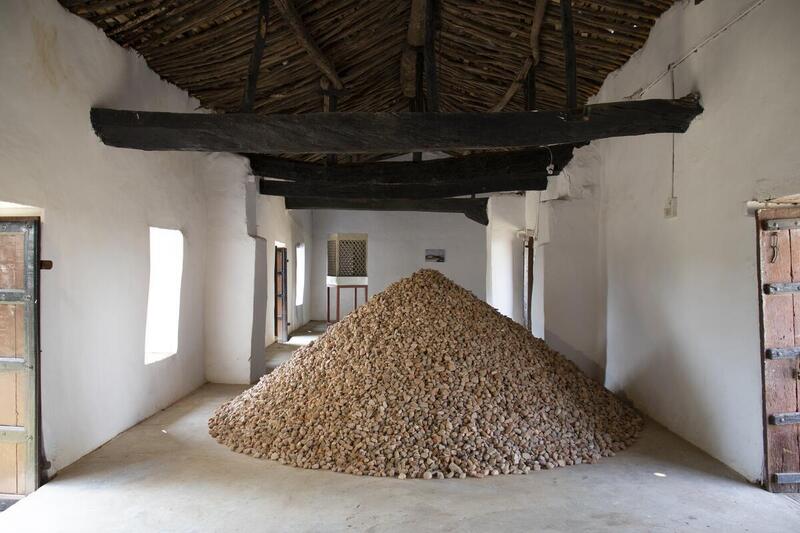
A floor sculpture by Anirudh Shaktawat, a heap of rubble (brick, concrete and lime) measuring 66 × 150 inches, from his series Chaumasa: Four Months of Monsoon. It is the featured image of Language of Nature, Language of Culture: Towards a Decolonial Art History, the South Asia Art Initiative's research project at UC Berkeley.
The eighth Human Impacts Salon, an evening of multimedia conversation and live art on new approaches to climate change, from decision-making apps and video games to algae fuel, organized by the Human Impacts Institute with the Transatlantic Climate Bridge of the German Embassy.
Panelists included Greg Niemeyer, Program Director of the Berkeley Center for New Media, a sponsor of the event; Georg Maue of the German Embassy; artist and educator Zakiya Harris; Joshua Sheridan Fouts of Bioneers; Jason Rissman of OpenIDEO; and Ashel Eldridge of Earth Amplified, who also performed live art with Helen Wicks.
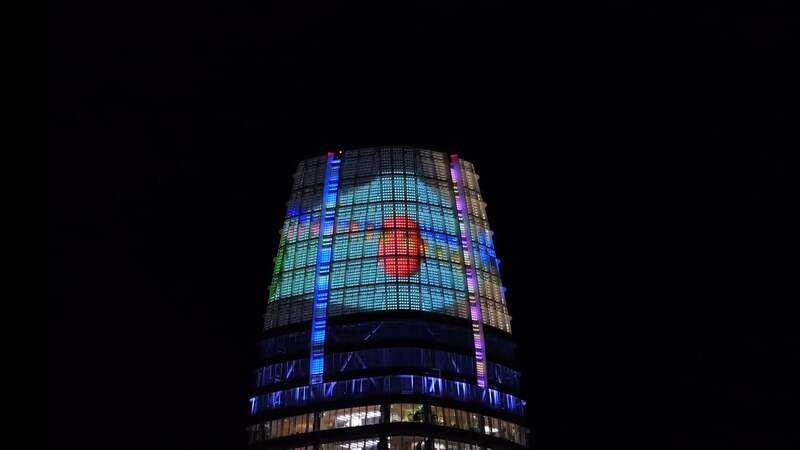
A data animation by UC Berkeley artist and professor Greg Niemeyer, shown nightly on the crown screen of Salesforce Tower, San Francisco, throughout December 2024, and all night around the winter solstice.
Built in Blender with Python, it condenses a year of open data, from the summer solstice of 2023 to that of 2024, into rhythms of the Bay Area: rainfall, wind, tides, sea surface temperature, air quality, foliage, seismic activity, solar radiation and BART ridership.
The data came from NASA, NOAA, the Bay Area Air Quality Management District and the Berkeley Seismology Lab, among others, and NASA program scientist Chelle Gentemann advised on the satellite data. The work was invited through the Day for Night Monthly Artist Program.
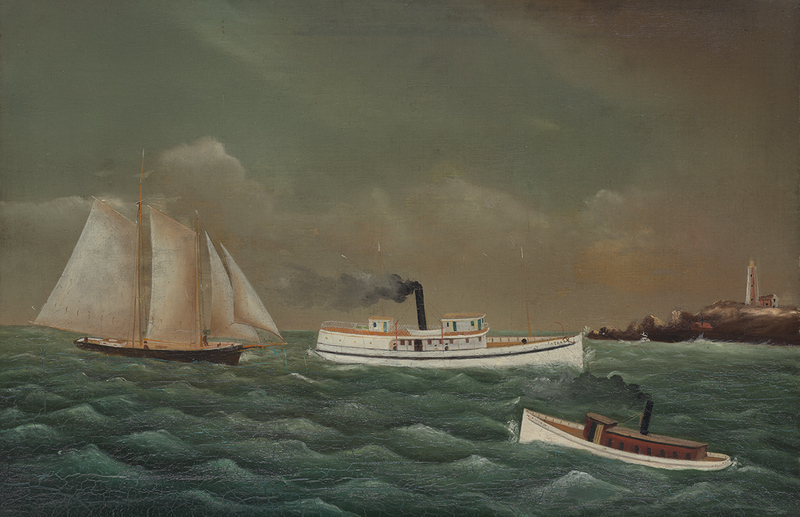
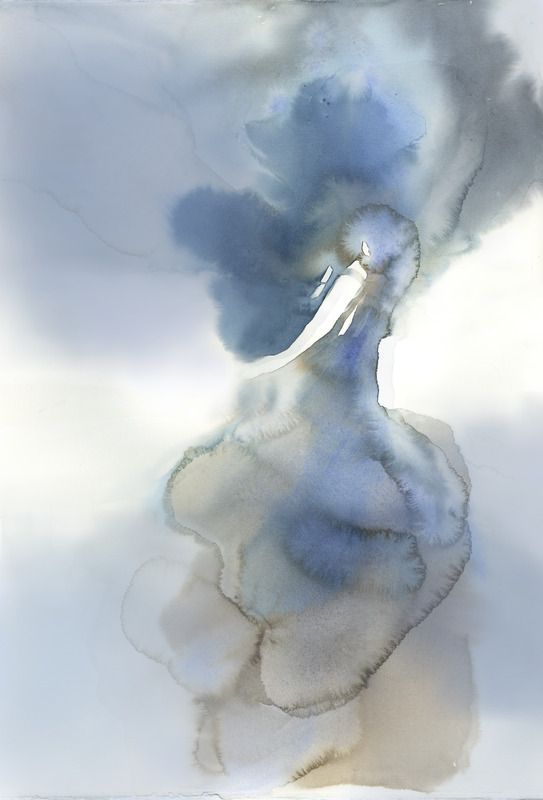
A one-afternoon presentation at BAMPFA curated by first-year students in UC Berkeley Professor Sugata Ray's Fall 2023 College of Letters & Science First-Year Pathways course, Art and Climate Change. Using the museum's Five Tables format, the students set out works from the BAMPFA collection that reflect, mediate, and delve into the interconnected ecologies of life, asking what art, architecture, design, and performance can offer to debates on climate change and environmental justice in a time of nuclear disasters, acid rain, and mass extinction. Moving from early modern landscapes and colonial photography to contemporary art and eco-activism, the selection explored decolonial histories and radical futures attentive to Indigenous epistemologies, interspecies friendships, the desires of nonhuman life forms, and other ways of being marginalized by colonialism, capitalism, and the economies of natural resource extraction. Among the works was Marine Scene (1840), an oil painting by an unknown artist of sailing ships and steamships together on a rough sea.
The Los Angeles River is one of the most threatened rivers in the United States, much of it confined to a concrete channel in the name of flood control and progress. Juniper Harrower’s LA River Project draws on more than 2,000 environmental DNA experiments and long conversations with people who care for the river, an approach the artist describes as listening more than collecting. Working with museum-held specimens, Harrower took only minimal samples and imaged them under an electron microscope. Those images, gilded and drawn, wind through a 14-foot painted riverscape in which water, willow, and coyote merge into a single body. The work proposes a science practiced in relation to the river rather than through extraction, and gestures toward the rematriation movements of the Gabrielino/Tongva and Tataviam peoples. Two works from the project were shown in the Fifty-Third Annual UC Berkeley Master of Fine Arts Graduate Exhibition at BAMPFA (May 10 – July 23, 2023): the painting Resting and raging through histories of containment, made with Los Angeles River water, watercolor, ink, graphite, California-sourced gold dust, and scanning electron imagery in research collaboration with CALeDNA; and Necklace for a River, a necklace made with Savannah Hunter Jewelry whose beads hold specimens of the river's animals and plants, from red-eared slider turtle and western toad to great blue heron, red willow, and Pacific salmon, strung with Los Angeles River concrete and steel beads used in DNA extraction. The necklace specimens were ethically sourced from the Norris Center for Natural History at UC Santa Cruz, with support from OpenLab and the UC Santa Cruz Genomics Institute.
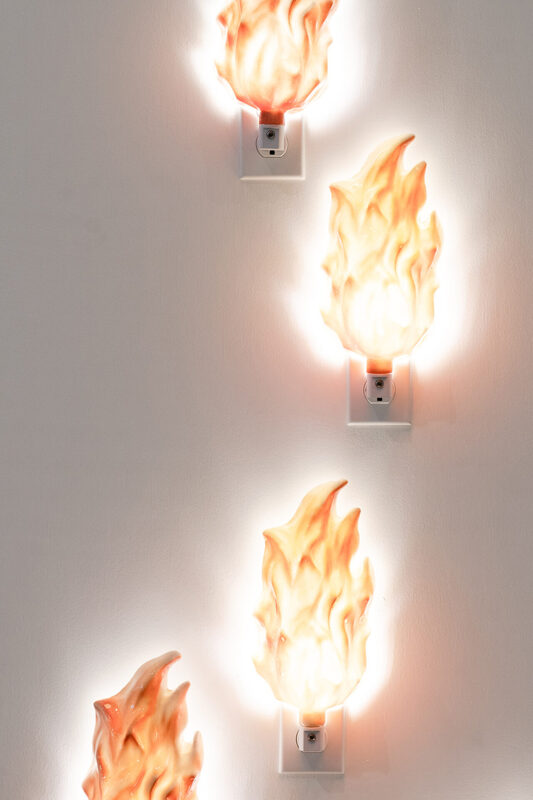
An installation by Samuel Wildman that covers a gallery wall with nightlights, each topped with a cast porcelain flame, arranged in the pattern of a map of major California wildfires. Turning a familiar object of comfort into a warning, the work is what Wildman calls an expression of “the affective experience of climate change.” It was shown in the Fifty-Third Annual UC Berkeley Master of Fine Arts Graduate Exhibition at BAMPFA (May 10 – July 23, 2023), alongside his altered tiles and soap dishes on the ties between consumption, comfort, and the policies that govern water and waste.
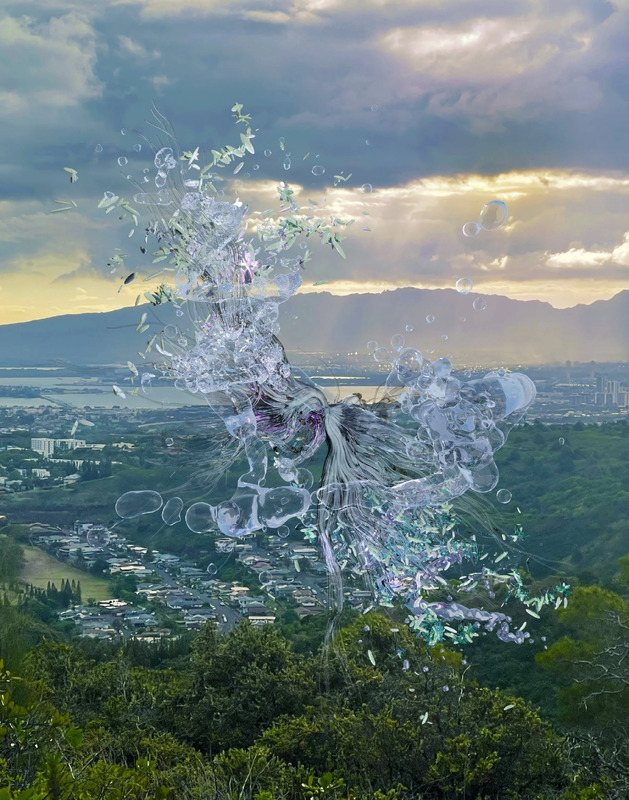
An augmented reality work by Tiare Ribeaux and Qianqian Ye, part of their ongoing Kai-Hai series, that imagines the remediation and restoration of water and soil at Kapūkakī (Red Hill) and Pu‘uloa (Pearl Harbor) on O‘ahu as a hopeful alternative to the story of fuel contamination. Made of digital images with 3D renders, it was shown in the Fifty-Third Annual UC Berkeley Master of Fine Arts Graduate Exhibition at BAMPFA (May 10 – July 23, 2023).
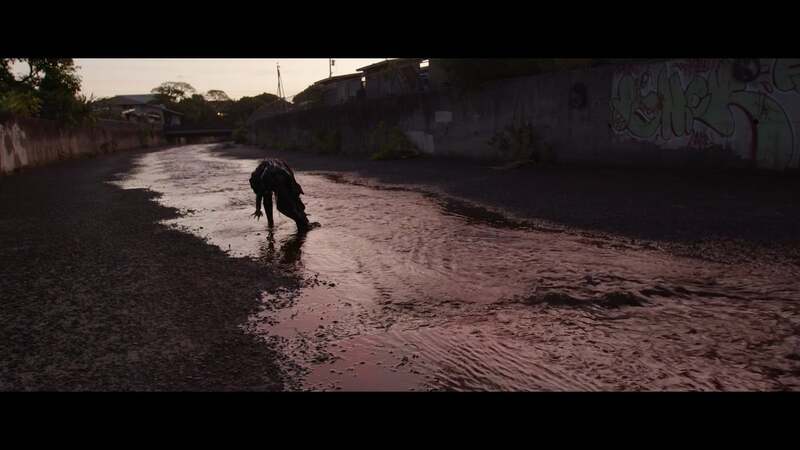
A short fiction film by Tiare Ribeaux, a moving-image artist of Indigenous Hawaiian ancestry, about a weaver who slowly realizes her drinking water has been poisoned after a fuel spill at Kapūkakī (Red Hill) on O‘ahu. Drawing on Indigenous weaving and creation stories, the twelve-minute video traces the interconnectedness of water, bodies, and ancestral land. It was shown in the Fifty-Third Annual UC Berkeley Master of Fine Arts Graduate Exhibition at BAMPFA (May 10 – July 23, 2023).
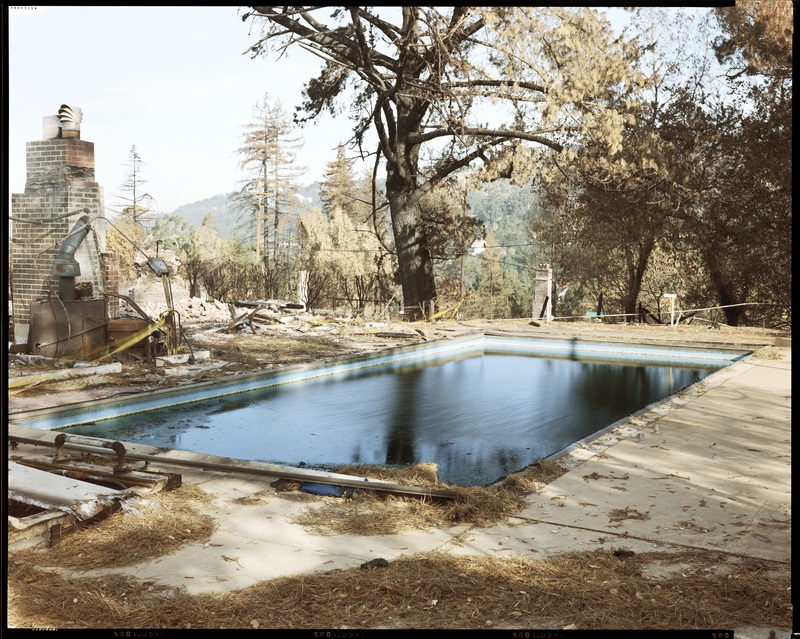
Photographs Richard Misrach made in the days after the October 1991 firestorm that swept through the Oakland and Berkeley hills, shown at BAM/PFA to mark the fire's twentieth anniversary. The Bay Area photographer entered the fire zone with an eight-by-ten-inch view camera, recording both stark vistas and intimate details of destroyed homes: a melted refrigerator, a mailbox, a stairway, a swimming pool among scorched trees. The forty photographs, unseen in the twenty years since the fire, included fourteen large-scale prints whose immense scale invites viewers into Misrach's quiet elegies, and a grid of twenty-six smaller prints forming an elegy wall. The Oakland Museum of California presented its own forty-photograph selection at the same time, and many of the prints entered BAM/PFA's collection as gifts of the artist. A companion exhibition, Richard Misrach: Photographs from the Collection, drew on series such as Desert Cantos and Bravo 20 Bombing Range that explore the complex relationship between humans and nature.
A collaborative artist residency and exhibition project that sent eight leading artists to eight threatened UNESCO World Heritage sites to make new work about the relationships between fragile natural environments and the human communities that depend on them. Co-organized by the Berkeley Art Museum and Pacific Film Archive and the Museum of Contemporary Art San Diego with the international conservation organization Rare, it opened in San Diego in 2008 before coming to Berkeley, and each artist completed two or more residencies between 2005 and 2008. Mark Dion built a supply cart for the under-resourced rangers of Komodo National Park in Indonesia. Ann Hamilton created a poetic text performed by Galápagos schoolchildren, heard against footage of a wavering ocean horizon. Iñigo Manglano-Ovalle filmed in Baja California's El Vizcaíno Biosphere Reserve, a gray whale breeding ground threatened by industrial development. Marcos Ramírez ERRE built a wall with residents of Yunnan's Three Parallel Rivers using regional methods, set with video windows onto their lives. Rigo 23 worked with artisans in Brazil's Atlantic Forest to remake a cluster bomb and a nuclear submarine in traditional materials as celebrations of life. Dario Robleto joined a glacier measuring expedition in Waterton Glacier International Peace Park and made sculptures about the disappearance of species and collective mourning. Diana Thater filmed wildlife in South Africa's iSimangaliso Wetland Park, and Xu Bing worked with schoolchildren near Mount Kenya's receding glaciers on artworks built from the Chinese characters for trees, with proceeds supporting reforestation.
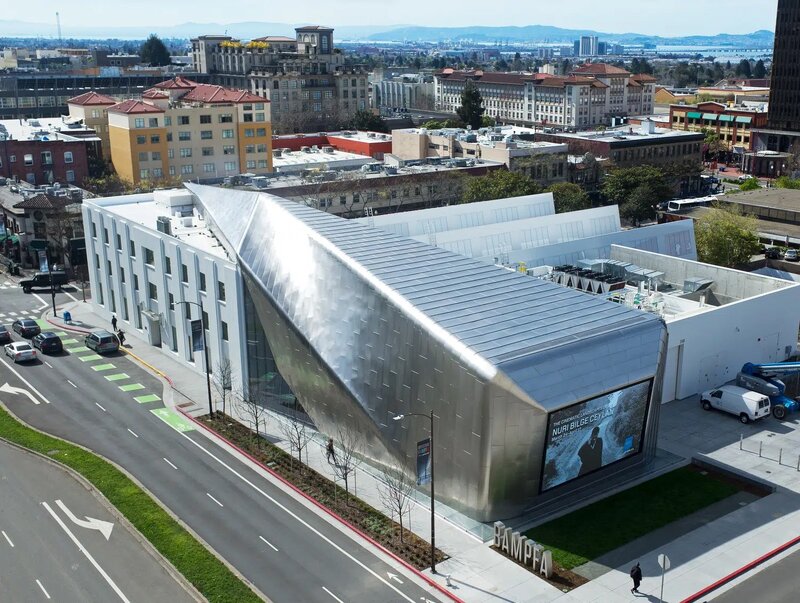
Founded in 1970, UC Berkeley’s art museum and film archive holds more than 25,000 artworks and 18,000 films and videos, including the world’s largest collection of African American quilts. It presents exhibitions, screenings, talks, and performances at the edge of campus and downtown Berkeley.
Described as a think tank for the arts, this UC Berkeley center brings artists, scholars, curators, and civic arts leaders into dialogue across fields from visual art and dance to architecture and social practice. Its programs also examine the economic and institutional structures that support, or constrain, cross-disciplinary work.
Faculty, curators, staff, and students in the arts and humanities come together through this initiative to study the environment. Part of UC Berkeley’s Center for Interdisciplinary Critical Inquiry, it focuses on critical histories, ethical futures, and the narrative, visual, media, and performance practices that advance environmental justice.
Lectures, conferences, and residencies at this UC Berkeley initiative support research on the arts of South Asia and its diasporas, from antiquity to the present. It also awards an annual dissertation prize and an artist prize.
Its Getty Foundation–supported project Language of Nature, Language of Culture: Towards a Decolonial Art History reconsiders the relation between nature and culture in art history through climate, decolonization and planetary thought.
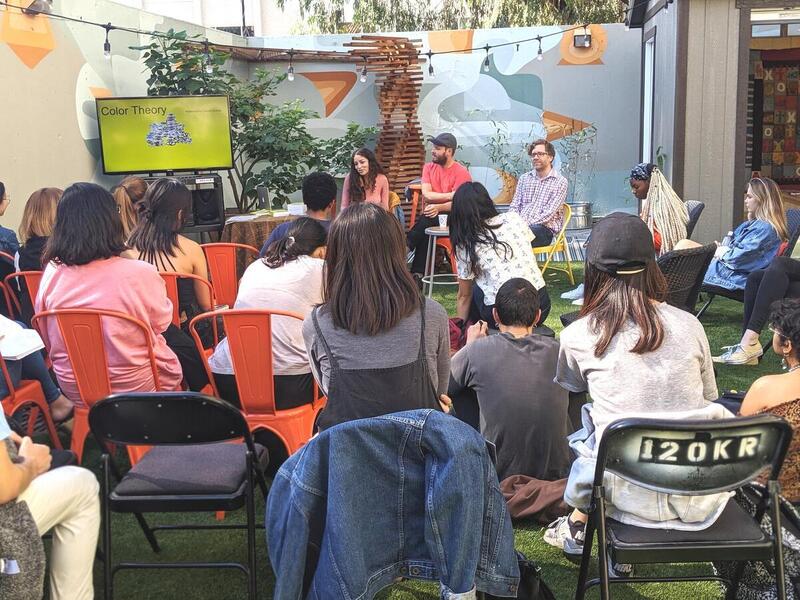
An art venue that features collaborative, participatory art projects and pop up exhibitions. In addition to these programs, public practices courses are also taught at Platform. Platform Artspace features a large projection screen, two studios for exhibitions and workshops, a large area with artificial turf, and café tables for workshops and gatherings.
The space is run collaboratively a faculty director, a student Community Engagement Liaison, and a group of student leaders. Student interns also participate in curating exhibitions and programming events. Platform hosts an internship program where students earn credit while gaining experience planning, curating, maintaining, and publicizing exhibitions and workshops.
Drawing on faculty from dozens of UC Berkeley departments, this center studies the intersection of new media, technology, and culture.
Its programs recorded in the archive include Maya Lin's 2014 Art, Technology and Culture Colloquium lecture What is Missing? and the 2014 Human Impacts Bay Area salon, which the center sponsored, along with Synchronicity (2024), a data animation by its program director Greg Niemeyer.