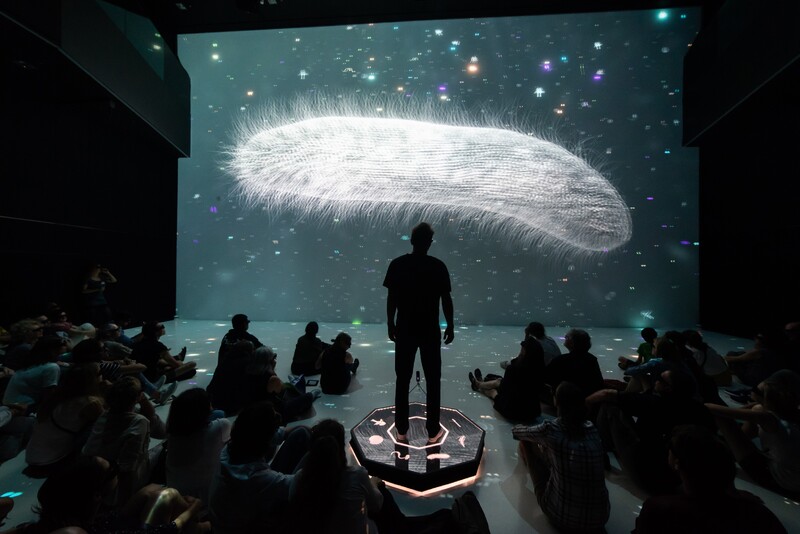
Led by UCLA artist Victoria Vesna in collaboration with the Science Visualization Lab at the University of Applied Arts Vienna, this immersive art–science installation explores the effects of human activity on marine ecosystems. Drawing on 3D imaging of plankton and underwater sound recordings, the work transforms microscopic organisms into monumental forms while revealing the acoustic disturbances caused by ships, sonar, and offshore extraction. An interactive balance board allows visitors to influence the underwater environment through their movements, connecting physical balance to ecological vulnerability. First developed as a video in 2017, the project evolved into interactive 3D and virtual reality experiences and was presented at the 2019 SIGGRAPH Art Gallery in Los Angeles, among other international venues.
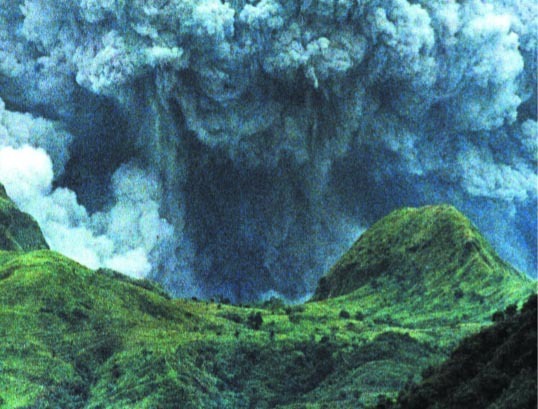
A seven-channel video installation by Latipa, then working as Michelle Dizon, from her ongoing series on imperialism, neocolonialism and globalization in the Philippines. Footage shot over four years in the Philippines is combined with archival film, philosophical, political and literary texts and field recordings, moving through sites near former U.S. military bases, multinational resource extraction, with chapters on mining, fishing and banana plantation labor, and war-torn regions of the southern Philippines.
Developed as a Lab Artist project at 18th Street Arts Center, Santa Monica, and curated there by Pilar Tompkins Rivas, it was shown from June 18 to September 7, 2012, and was also presented as a live performance with narration and a live score at the Hammer Museum during Made in L.A. 2012. The artist later founded the Memory and Resistance Laboratory at UC Riverside.
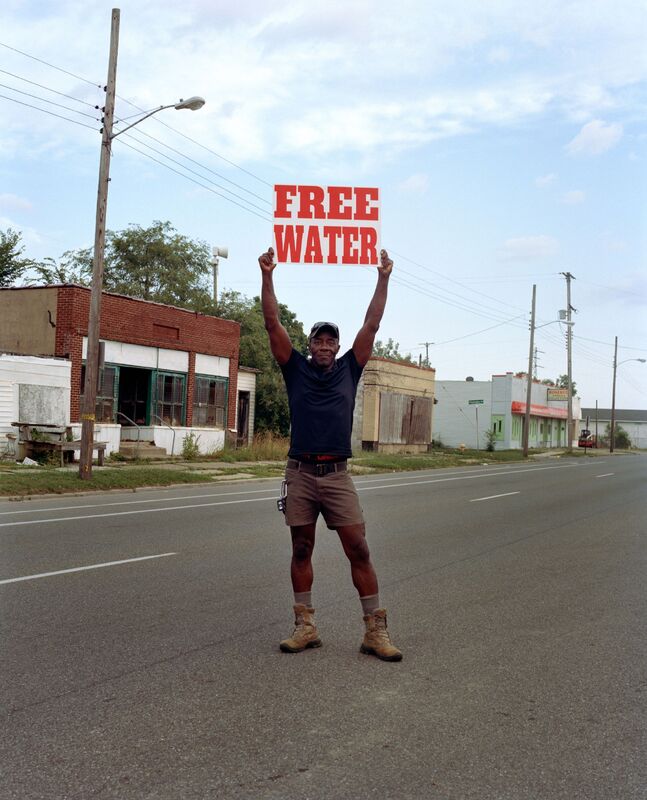
A photograph from LaToya Ruby Frazier's series Flint is Family, which documents the water crisis in Flint, Michigan, a predominantly Black city whose residents were exposed to lead-contaminated water. It shows Moses West, a retired Army captain and engineer who builds atmospheric water generators that pull drinking water from the air, holding a “Free Water” sign on North Saginaw Street. Following Flint is Family, Frazier partnered with West and AWG Contracting to bring one of his generators to Flint so residents could make their own clean water. The work is an archival pigment print on Hahnemühle FineArt Baryta, 40 × 30 in. It was shown in Breath(e): Toward Climate and Social Justice at the Hammer Museum, UCLA (2024–25), as an example of what scholar Rob Nixon calls slow violence.
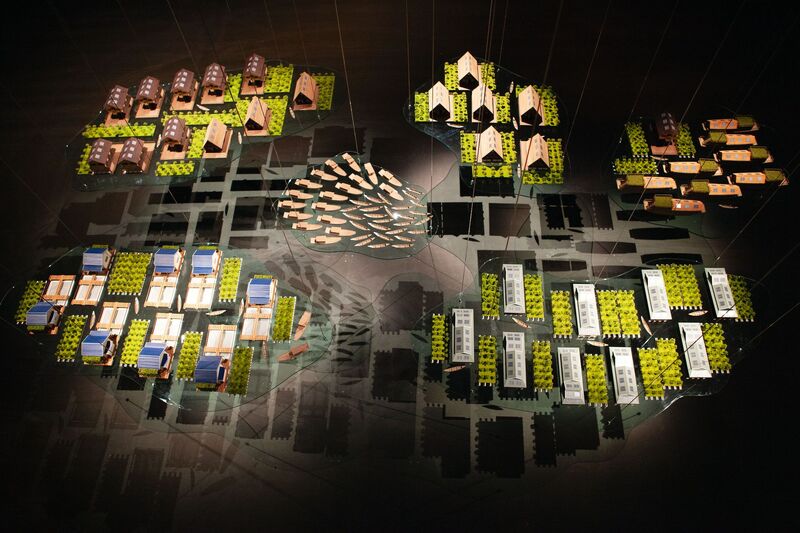
A large-scale architectural model of a floating settlement by Vietnamese American artist Tiffany Chung, herself a political and climate refugee. Built from Plexiglas, wood veneer, plastic, aluminum, paint, steel, cable, foam, and copper wire, and measuring nearly twenty by ten feet, the work imagines vernacular stilt houses and floating communities as a way to consider forced migration and displacement caused by climate change, including projections that parts of Vietnam will be consumed by rising seas by 2050. It was shown in Breath(e): Toward Climate and Social Justice at the Hammer Museum, UCLA (2024–25).
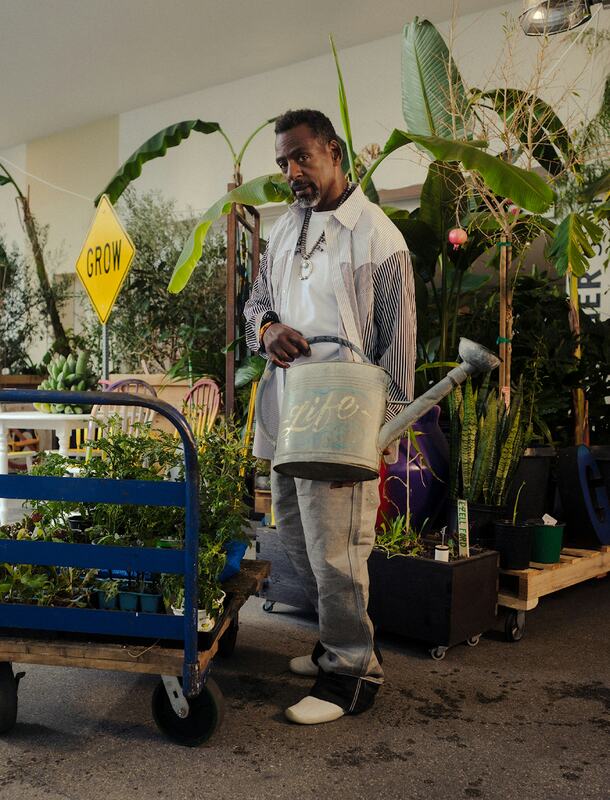
A large-scale garden installation commissioned for the Hammer Museum exhibition Breath(e): Toward Climate and Social Justice (2024–25), the largest work in the show. South Los Angeles environmental activist Ron Finley, known as the “Gangsta Gardener,” planted a terrace outside the museum's bookstore and galleries with fruit trees, vegetables, and herbs, some growing in salvaged bathtubs and sinks, and set out about two dozen chairs for visitors. A “Redline Realty” sign recalls the housing discrimination that shaped Los Angeles neighborhoods, and plant markers carry the names of people killed by police. The work extends Finley's practice of turning neglected urban ground into food gardens as an act of community care and self-determination. After the exhibition, its soil and materials were returned to the artist.
A major exhibition at the Hammer Museum, UCLA, that centered environmental art addressing the climate crisis and human-caused disasters, and their inescapable intersection with equity and social justice. Curated by artist Glenn Kaino and guest curator Mika Yoshitake, with PST fellow Jennifer Buonocore-Nedrelow, it brought together more than 100 works by 25 intergenerational artists working in photography, multimedia, augmented reality, painting, living organisms, and more, and filled most of the Hammer's galleries and outdoor spaces. Conceived during the COVID-19 pandemic and the racial reckoning of 2020, the exhibition drew on ancestral Indigenous knowledge that treats all elements of nature as one family rather than as resources for human use.
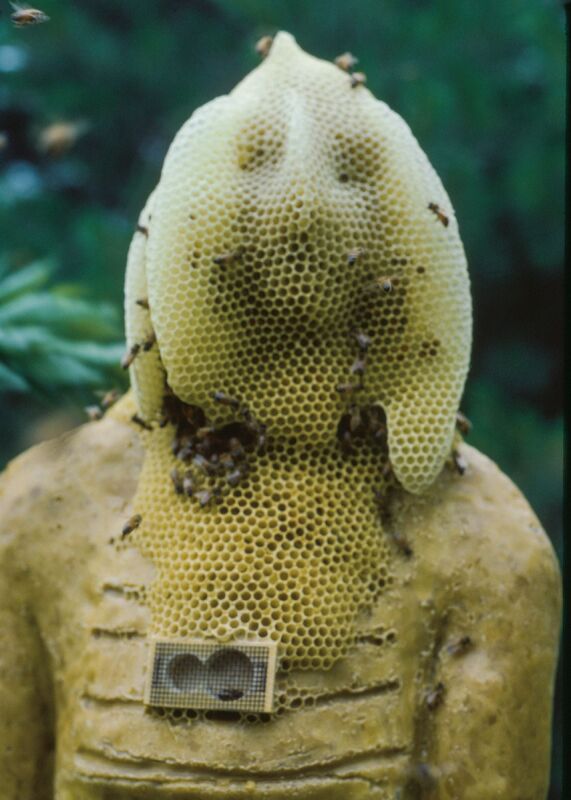
New commissions included Cannupa Hanska Luger's multi-part installation Sovereign, a Garnett Puett Apisculpture made in collaboration with a living bee colony, Lan Tuazon's outdoor installation built from plastic waste donated by visitors, Ron Finley's garden installation Grounded, and Mel Chin's IOV (Interpretation of Vision), developed from stories gathered through an open call. Other works traced the slow violence of environmental harm, from LaToya Ruby Frazier's photographs of the Flint water crisis to Tiffany Chung's architectural models of climate displacement in Vietnam. Part of Getty's PST ART: Art & Science Collide and presented in partnership with Conservation International, the exhibition was also documented as a Getty case study in measuring and reducing an exhibition's carbon footprint. After its Los Angeles presentation, the exhibition traveled to the Moody Center for the Arts at Rice University in Houston and to the Jan Shrem and Maria Manetti Shrem Museum of Art at UC Davis (August 7 – November 29, 2025), where a version with fourteen of the artists hosted UC Davis classes in the galleries, including a course whose students created the performance Breath, Soil, Water, Life in response to LaToya Ruby Frazier's Flint is Family in Three Acts.
UCLA faculty and students from across disciplines come together here to study how storytelling, communications, and media can support sustainability and environmental justice. The lab starts from the premise that environmental challenges are cultural and political as well as scientific. It supports research, teaching, and public engagement around the narratives communities use to understand environmental crisis and possibility.
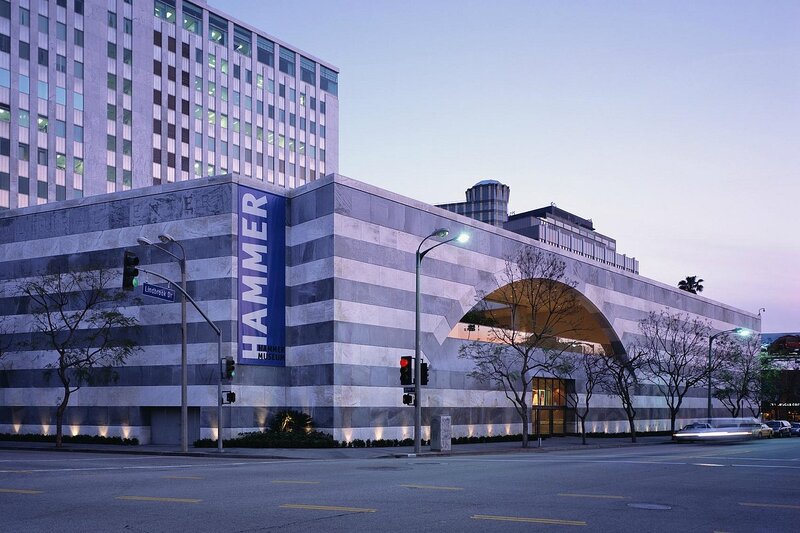
Combining historical collections, contemporary art exhibitions, and public programs, the Hammer Museum at UCLA emphasizes artist-centered practices and engagement with pressing social and environmental issues. Free and open to the public, its collections span international contemporary art, works on paper, and sculpture, with a particular focus on Los Angeles artists. Exhibitions such as Breath(e): Toward Climate and Social Justice (2024–25) explore connections between art, environmental change, and social justice while advancing sustainable exhibition practices. The museum also supports artistic research and collaboration through residencies that connect artists with UCLA faculty, students, collections, and the broader Los Angeles arts community.
The Conditional Studio at UCLA Arts investigates the physical infrastructure of digital technologies and their connections to environmental, economic, and social systems. Challenging the idea that computation exists primarily as abstract code or software, the studio examines the material resources, labor, and power structures that sustain technological systems. Through artistic research, exhibitions, workshops, and public dialogue, it makes visible the often-overlooked ecological and political consequences of digital technologies while fostering collaborative learning, critical inquiry, and commitments to social, technological, and climate justice.
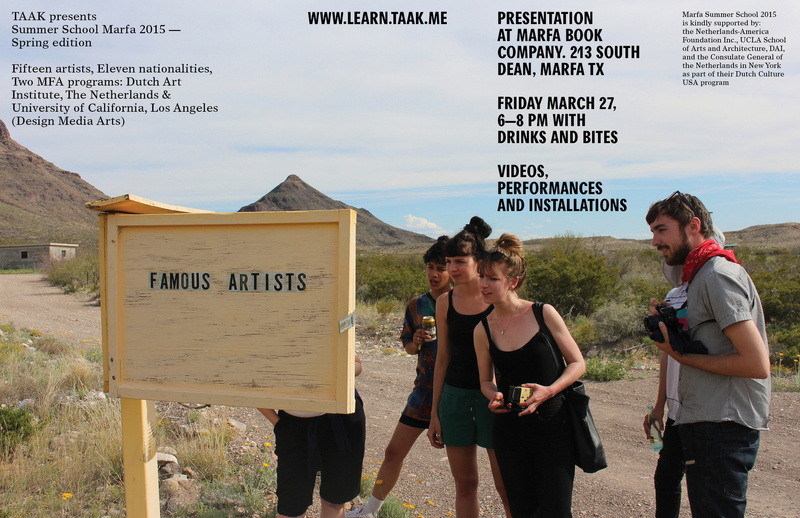
Organized by curator Theo Tegelaers of TAAK Amsterdam, this fieldwork program in Marfa, Texas, was a joint project of art schools including the Sandberg Institute, Amsterdam; the Dutch Art Institute, Arnhem; the Cooper Union School of Art, New York; and UCLA Design Media Arts, Los Angeles.
Artists, designers, scientists, and community partners collaborate in this research studio on place-based fieldwork and storytelling that address the ecological crisis and its links to environmental injustice. Founded by professor rebeca méndez, the studio is part of UCLA’s Design Media Arts department.
Media artists and bio- and nanoscientists work together through this center, based in UCLA’s Design Media Arts department and the California NanoSystems Institute. It hosts visiting scholars and artists-in-residence, public lectures and symposia, and the Sci|Art NanoLab Summer Institute for high school students. It is also home to the Art|Sci Collective, an international group making projects about the social, ethical, and environmental questions raised by scientific innovation.