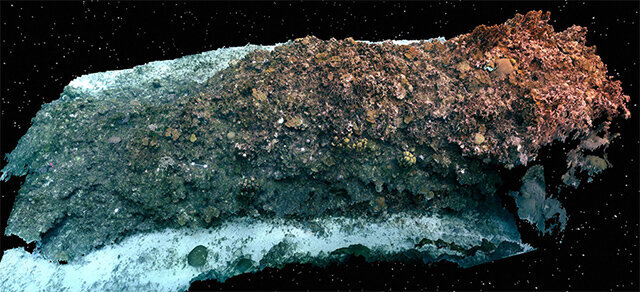
Led by UC San Diego composer Lei Liang and Qualcomm Institute engineer Falko Kuester, this interdisciplinary initiative brings together music composition students and researchers from Scripps Institution of Oceanography to explore the creative possibilities of marine science. Through a collaborative seminar, participants translate underwater recordings and scientific imaging—including Arctic ice formations, whale echolocation, and coral reef scans—into original musical compositions and immersive experiences. Projects include a virtual reality sound installation presented at the Qualcomm Institute’s SunCAVE in 2018 and a 2019 performance by the Mivos Quartet and students featuring compositions informed by Arctic field recordings.
Spread across the San Diego–Tijuana border region, this UC San Diego network of community-based sites combines research, teaching, and service. Working with communities of color, it supports research and practice on poverty, along with educational experimentation and shared learning. Support has come from the late UC Regent Richard C. Blum and the Andrew W. Mellon Foundation.
Interdisciplinary research on poverty and global development, with an emphasis on community-scale collective action, has been the focus of this UC San Diego center since 2012. Most of its initiatives are local, carried out with nonprofits, government agencies, and civic partners.
The work redesigns the final 18,000 square feet of Pico Boulevard to echo a California coastal wash, with a serpentine ramp and stairway winding through plantings that recall the wash ecologies from Mandeville Canyon to the sea. The path crosses the beach promenade and continues onto the Pico-Kentner outfall cover, where a drainshed mural maps today’s settlement pattern and inset bronze plaques depict the area’s original fauna; at its far edge, Wave Fence mirrors the outfall itself. The cover also created beach access for people with disabilities and a new public space at the intersection. Some critics argued the work aestheticized a polluting outfall, but by making visitors aware of the pollution, it helped build the public pressure that led the city to install a purification system.
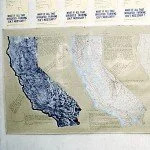
The work’s nine texts and a series of mappings of California, combining drawings, satellite photos, political boundaries, water resources, irrigable land, and topography, were shown at the San Francisco Museum of Modern Art in 1977. Around the city, the artists and San Francisco Art Institute students posted eleven street posters asking “What if all that irrigated farming isn’t necessary?”, alongside two large “Water” billboards, sidewalk chalk texts, performances, radio spots, and newspaper personal ads offering water officials advice drawn from the Buddha’s eightfold path. The project grew out of six months of research at the Berkeley Water Resources Library. A revised version was later shown at Ronald Feldman Fine Arts in New York and traveled to the Museum of Contemporary Art Chicago in 1980.