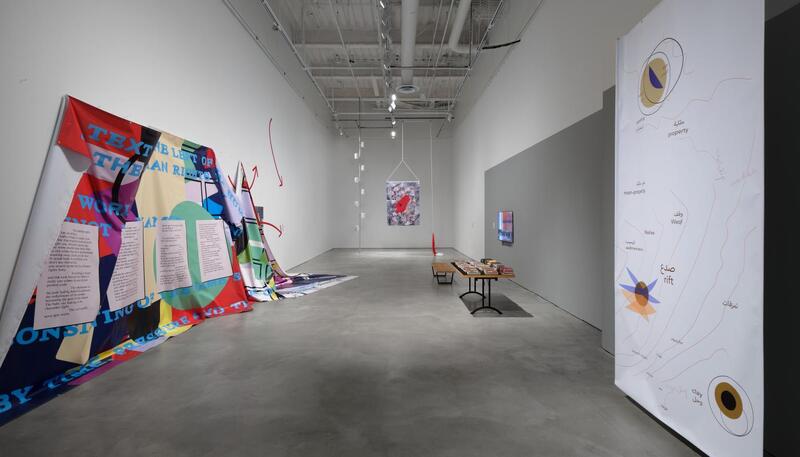
A group exhibition at UC Irvine's University Art Galleries that treats climate change as an interlocking crisis bound up with economic and social justice, from extraction presented as green transition to the forced migration, detention and deportation of people displaced by rising seas and neo-colonial regimes. Curated by Juli Carson, Annika Haas and Sasha Ussef, it drew on Jack Halberstam's idea of 'unworlding' and Bernard Stiegler's notion of the neganthropocene to ask how a livable life might be imagined within present conditions of collapse. Works by Marwa Arsanios, Ashley Hunt, Natascha Sadr Haghighian and virgil b/g taylor were installed in the Contemporary Arts Center Gallery, accompanied by an opening reception and a day-long workshop, 'Collapse as a Condition of (Un)Knowing.' The show launched the first phase of The Neganthropocene, a three-part research project led by Carson under the UC Climate Action Arts Network.
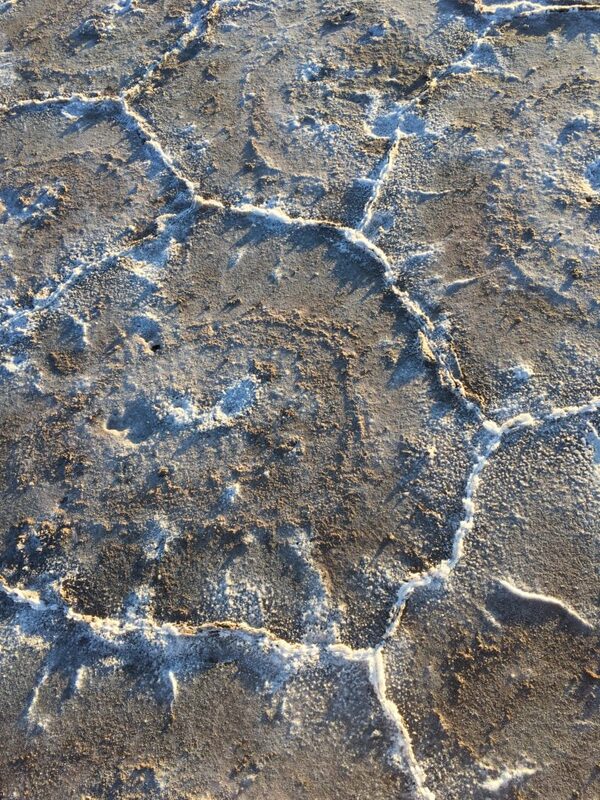
A long-term art research project that has worked since 2017 in the industrialized high-altitude deserts of northern Chile's Atacama. There, copper and lithium mining for global supply chains reshapes a former seabed with rare geologic and living systems. Drawing on intensive fieldwork, the artists build multichannel sound, video, photography, live audiovisual performance and installation, and use mirage and perceptual distortion rather than documentary to question the idea of the desert as wasteland. They also note that the region has served as a Mars-analog test site. Works include Salar: Evaporation (2020), shown in the group exhibition Against Outer Space at UC Irvine's Beall Center for Art + Technology, and Salar: Adaptation, presented at the Santa Cruz Museum of Art & History in 2024. A feature film and an artist book are in progress.
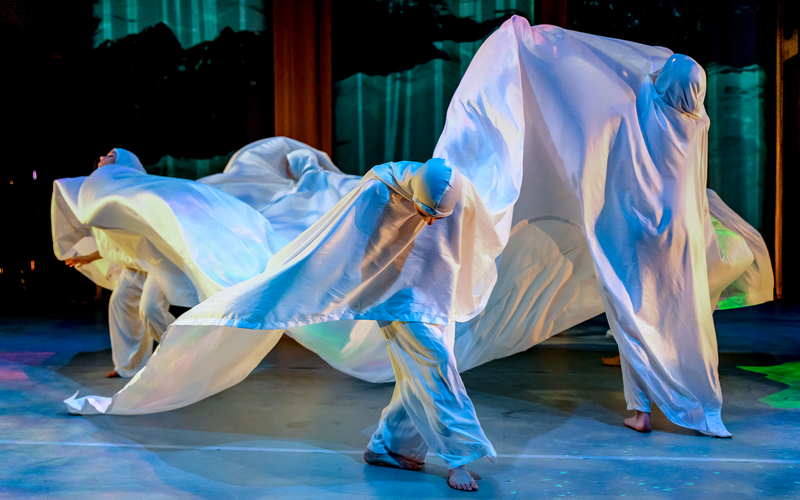
An experimental intermedia performance combining dance, live music, projected media and visual design, created in response to the beauty of oceans and coastlines and to the damage human activity does to marine ecosystems. Directed by John Crawford with composer and violinist Mari Kimura and four choreographers, the roughly 80-minute work set live dancers and musicians against processed video shot at ocean and coastal sites, in four sections titled Emergence, Gyre, Oil Slick and Refuge. It premiered at the Experimental Media Performance Lab (xMPL) in UC Irvine's Contemporary Arts Center and was produced by the Institute for 21st Century Creativity, with scenic elements and animations developed in a UCI/RISD collaboratory course. An expanded version was presented at Brown University's Granoff Center in April 2019, and the project frames its aims around climate justice and the inclusion of diverse voices.
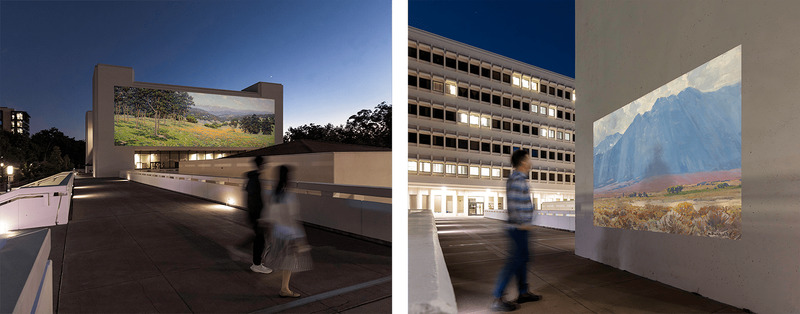
This work is an outdoor projection-mapping installation commissioned by the UCI Jack and Shanaz Langson Institute and Museum of California Art. Over two nights in April 2024, images of late 19th- and early 20th-century California landscape paintings from the museum's collection, among them Granville Redmond's California Landscape with Flowers and Hanson Duvall Puthuff's Mystical Hills, were projected onto the buildings of UC Irvine's School of Social Sciences, setting painted light against dusk and night and building to a finale overlooking Aldrich Park. The French title means "outdoors in the outdoors"; the project was presented with the Claire Trevor School of the Arts and the School of Social Sciences. Plein-Air en Plein Air builds on the curatorial activities of another project commissioned by Langson IMCA, Beyond the Frame: Impressions of California, created by the design studio Imaginary Places. This immersive virtual presentation features images of the same 28 California Impressionist paintings and sets them in a stylized digital landscape with associated artists’ biographies, literary and historical texts, archival images, and environmental sound elements. Together, these two very different projects work to catalyze curiosity and foster conversation and exploration of California Art in the public realm.
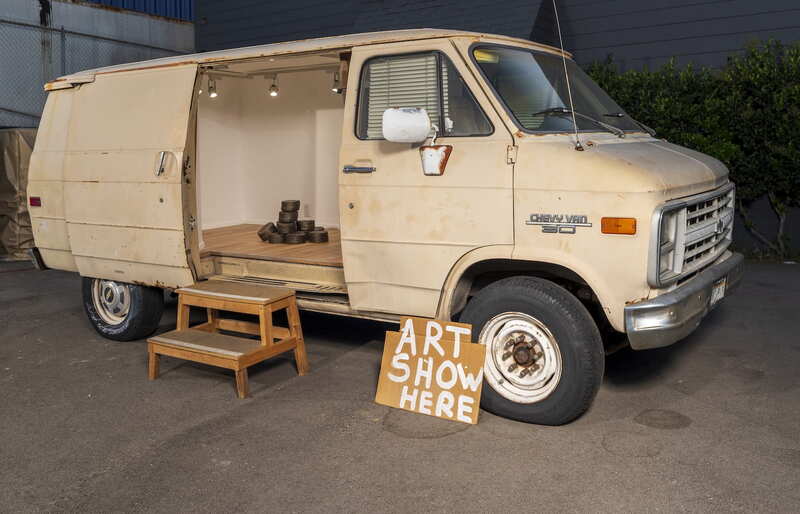
A two-part group exhibition at the UC Irvine Langson Orange County Museum of Art, curated by Michaëla Mohrmann, on Southern California's built environment and the policies and power dynamics that shape how the public experiences it, from urban neglect in Los Angeles and freeways that divide neighborhoods to the environmental cost of UC Irvine's Brutalist architecture. Part one paired newly acquired photographs from Ruben Ochoa's ficus series (2007) with works by Carlos Almaraz and Pat Gomez from the museum's collection, tracing how generations of Chicano artists have shown the harm California's infrastructure and urban policies cause to communities of color. Part two, in April 2026, was a pop-up of Ochoa's Class: C (2001), a Chevy van converted into a mobile gallery, showing work by UC Irvine artists Sean Duffy, Beatrice von Rague Schleyer and André Woodward at the Irvine Barclay Theatre Plaza.
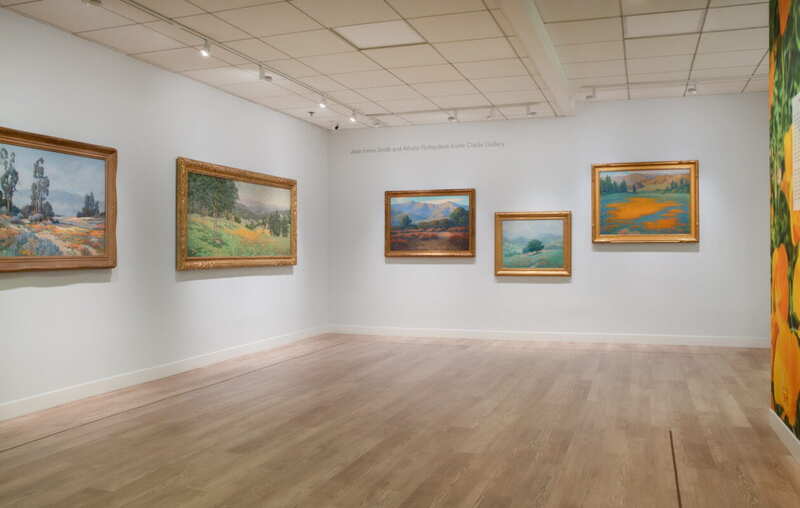
Curated by James Nisbet at UC Irvine’s Langson Orange County Museum of Art, this exhibition examines California’s changing ecosystems through plein-air landscape paintings from the late nineteenth and early twentieth centuries. Featuring more than 40 works drawn from the museum’s holdings and the James Irvine Swinden Family Collection, the exhibition considers how artists documented landscapes during a period preceding widespread urbanization and environmental transformation. Organized around native wildflowers, Orange County landscapes, California missions, mountain environments, and trees, the exhibition connects historical representations of place with contemporary concerns about invasive species, biodiversity, and habitat loss. California Certified Field Botanist Justin Felder contributed botanical identifications and ecological perspectives, while a newly commissioned sound installation, Landscape Hocket (Orange County) (2025), by Andrew Weathers extends the exhibition’s exploration of landscape through sound.
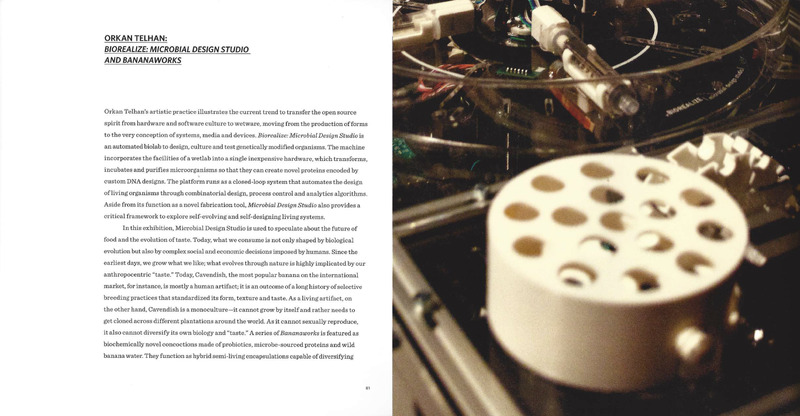
An exhibition at the Beall Center for Art + Technology, UC Irvine, curated by David Familian and Jens Hauser, on synthetic biology and wetware, in which artists use laboratory methods to come close to life. The works included synthetic amino acid necklaces, protocells that mimic the movement of phytoplankton, bacteria that generate power for a synthesizer, a desktop gene machine, and an artificially grown brain in a vat, and Evelina Domnitch and Dmitry Gelfand and Anna Dumitriu made new works in residencies developed with UC Irvine research centers. Questioning human-centered views of engineered artificial life and the responsibilities they carry, the show asked how aliveness is defined in terms of components, circuits, and systems.
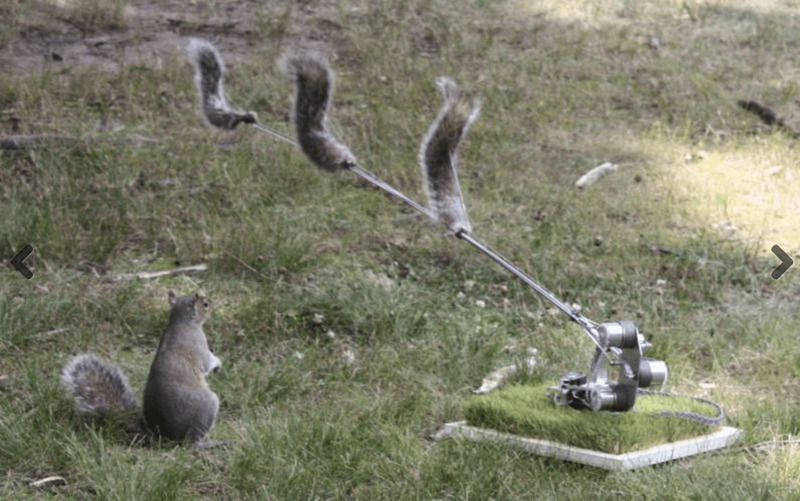
A mid-career survey at the Beall Center for Art + Technology, UC Irvine, curated by David Familian, of Ian Ingram's robotic objects from 1998 to 2021, which borrow the forms and behaviors of animals and are often made to live alongside them and speak with them in their own habitats, from earlier robots built for a raven, a lizard, or a worm to Danger, Squirrel Nutkin! (2009) and Duck, Duck, Goose (2007). New work made during his residency at the Beall's Black Box Projects turned to synanthropic animals, especially rats, that live closest to people, and to how they use built environments in search of facsimiles of ancestral landscapes, probing the boundary between constructed and grown places and the possibilities of interspecies communication and coexistence. During the run, the Beall's 2022 Art + Ecology series brought Ingram into conversation with collaborators Steve Mahler and Charissa Terranova in Just Your Garden Variety Robots, alongside talks by Carolina Caycedo and land artist Hans Baumann.
An exhibition at the Beall Center for Art + Technology, UC Irvine, co-curated by Antoinette LaFarge and Jesse Colin Jackson, presenting artists who experiment in the marginal areas where art-making, practice-based research, and scholarship meet. Some stage their work in laboratories, some in studios, and some in wild or abandoned landscapes, and together they question how culture continues to marginalize artists who work across disciplines. Their subjects range across glacial ice, fungal life, nuclear waste, genetics, and settler colonialism. Krista-Leigh Davis's performance video No Claim to the Blue-Green Bloom (2023) follows life-size microbes through the wilderness as they adapt to a toxic environment, and Jennifer Willet's Gentleman Scientist: Microecologies (2023–25) turns to microbial ecologies. The artists were featured in LaFarge and Jackson's anthology Experimental Practices in Interdisciplinary Art: Engaging the Margins (Brill, 2024), which launched with the exhibition.
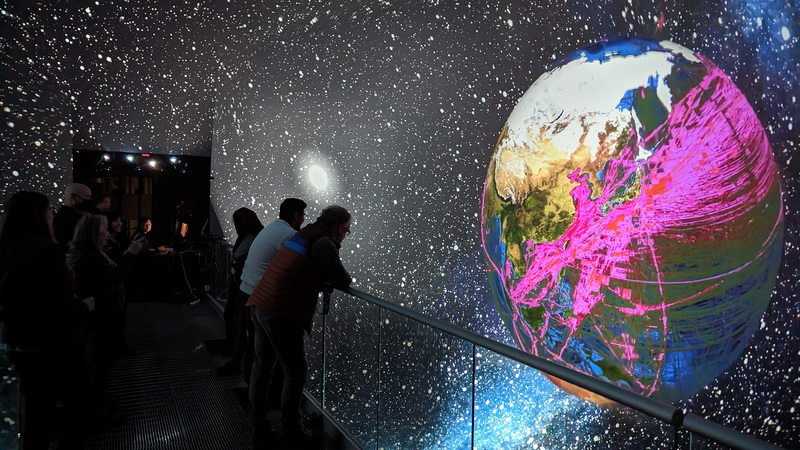
An immersive installation built from core elements of Sensorium for the World Ocean, the long-term project of the late environmental artist Newton Harrison (1932–2022), directed by Joshua Harrison with Dr. JoAnn Kuchera-Morin. It premiered in 2024 at the AlloSphere, a three-story spherical research instrument in the California NanoSystems Institute at UC Santa Barbara, as a satellite to the UC Irvine Beall Center's Getty PST ART exhibition Future Tense: Art, Complexity, and Uncertainty, and ran by reservation into April 2025. With an original spatialized composition and an interactive data world, it turns climate and ocean-health data from the Ocean Health Index of the Halpern Lab at UCSB's Bren School of Environmental Science & Management into a multisensory experience, modeling how deepwater fishing, atmospheric particulates, weather, and other natural and human forces interact to shape the ocean, along with the political, economic, and social pressures upon it. True to Harrison's intent, it aims to leave audiences with a sense of hope. A project of the Center for the Study of the Force Majeure with Virtual Planet Technologies, Almost Human Media, and the AlloSphere Research Group.
The Beall Center for Art + Technology's exhibition for Getty's PST ART: Art & Science Collide, curated by David Familian, offering artistic frameworks for understanding complex systems, which churn between order and chaos and generate feedback loops, self-organization, and uncertain behavior. From climate change and global warming to evolutionary biology, bacterial intelligence, data surveillance, financial collapse, and immigration politics, the works considered phenomena too entwined to be observed individually. Gail Wight explored how ocean acidification drives rapid evolution in aquatic microbial communities, and Theresa Schubert examined how the expansion of digital infrastructure feeds global temperature rise. Laura Splan, Chico MacMurtrie, Hege Tapio, Gail Wight, and the collective Cesar & Lois created new commissions through the Beall's Black Box Projects residency, which pairs visiting artists with UC Irvine researchers. A satellite installation, Sketches of Sensorium, drawn from Newton Harrison's Sensorium for the World Ocean, was presented at the AlloSphere at UC Santa Barbara.
An exhibition at the Beall Center for Art + Technology, UC Irvine, curated by Zachary Korol Gold, that traces a sensibility among contemporary artists who treat ecology not as a settled set of facts but as a system of images. Eleven artists, among them Lauren Bon, Maru García, Sean Raspet, Jeffrey Stuker, and Diana Thater, take divergent paths through the technologies, histories, and fictions by which environments and organisms are known. By turning the technical images and devices used to measure environments back on themselves, their works picture how contemporary society produces its ecological view, and the exhibition asks how people, through technology and as technical beings, sense and represent the living world.