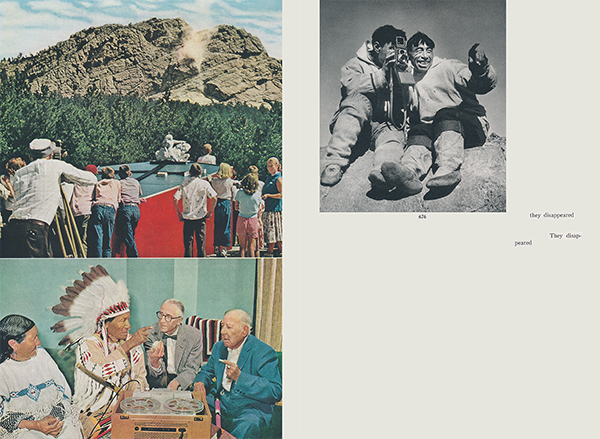
An artist's book and photographic installation by Latipa (Michelle Dizon), with poetry by Việt Lê, made from an archive of National Geographic magazines from the 1960s and earlier. Dizon erased most of the text on each page, leaving fragments that form a decolonial counterpoint to the magazine's imperialist, Western-centric images of people and lands, and Lê added original poetry and a text on the legacies of war and empire. The book was published in 2018 by at land's edge (Los Angeles), Candor Arts (Chicago) and Sming Sming Books (Bay Area), and the work was exhibited at the California Institute of Integral Studies, San Francisco, from March 20 to July 31, 2018.
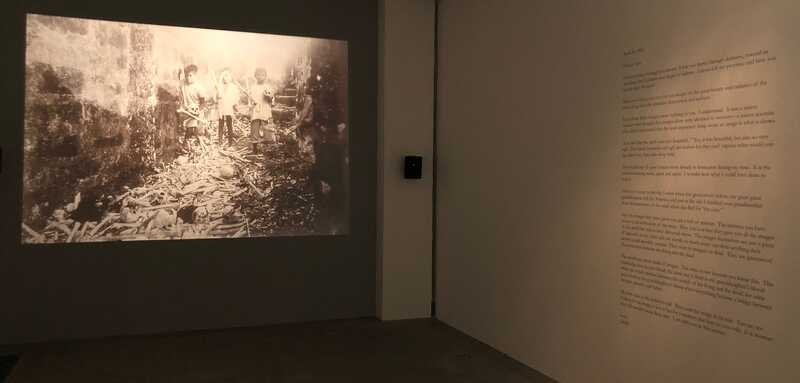
A multi-image slide installation by Latipa (Michelle Dizon) built from photographs of the U.S. colonial and postcolonial Philippines, drawn from archives in the Philippines and the United States, the artist's family albums and the internet. It takes the form of a conversation between the artist's great-great-grandmother in 1905 and a descendant in 2123, both named Latipa; the future Latipa lives after climate catastrophe has made Earth uninhabitable and is traveling to Proxima B. Setting official archival photographs against intimate family images, the work links colonial harm to people and to the environment and traces how its effects outlast colonial rule. It was shown in the City of Los Angeles (COLA) Individual Artist Fellowships exhibition at the Los Angeles Municipal Art Gallery in 2018 and at the Gothenburg International Biennial for Contemporary Art in 2019.
A seven-channel video installation by Latipa, then working as Michelle Dizon, from her ongoing series on imperialism, neocolonialism and globalization in the Philippines. Footage shot over four years in the Philippines is combined with archival film, philosophical, political and literary texts and field recordings, moving through sites near former U.S. military bases, multinational resource extraction, with chapters on mining, fishing and banana plantation labor, and war-torn regions of the southern Philippines.
Developed as a Lab Artist project at 18th Street Arts Center, Santa Monica, and curated there by Pilar Tompkins Rivas, it was shown from June 18 to September 7, 2012, and was also presented as a live performance with narration and a live score at the Hammer Museum during Made in L.A. 2012. The artist later founded the Memory and Resistance Laboratory at UC Riverside.
Bridging the University of California and California’s Tribal Nations, this UC Riverside center works alongside American Indian communities on research for, with, by, and about them. Through reciprocal partnership, it supports Tribal histories, cultures, languages, and sovereignty.
Lake ecology, air and water quality, human health, policy, and community education all fall within this multidisciplinary UC Riverside team’s research on the changing Salton Sea. Its goal is to provide the science needed for sustainable, equitable mitigation in the region and in similarly threatened places.
The Memory and Resistance Laboratory (MEM-RES) at UC Riverside is a hub for antiracist, decolonial, and feminist of color artistic research.
The lab was founded in 2019 by artist Latipa (Michelle Dizon), whose works recorded in the archive include Perpetual Peace (2012), The Archive's Fold (2018) and White Gaze (2018, with Việt Lê).