Demo Content Page

Assets Blocks

Image + text with bg

Imperdiet ex platea habitasse efficitur gravida egestas mollis nascetur. Morbi duis id consequat phasellus cursus massa condimentum ridiculus hendrerit. Etiam fringilla consectetuer consectetur ullamcorper dis ornare letius dui. 
Efficitur hendrerit bibendum purus dictum neque magnis aliquet condimentum. Velit himenaeos bibendum ultrices eros sit auctor lobortis in tempor luctus nunc. Himenaeos netus sollicitudin facilisi mi vulputate vitae ridiculus auctor tristique curae cursus.

Text left + Image right

Tincidunt maximus phasellus curabitur nulla eros lobortis diam. Luctus nisi diam consequat blandit litora dictumst mus ultricies sapien mollis iaculis. Fames nam penatibus venenatis ligula nulla arcu morbi. Et ad accumsan diam malesuada vivamus dictum consectetur eu semper. Potenti euismod nullam aliquam blandit taciti erat dolor habitasse maecenas. Platea lorem purus mattis duis fermentum vivamus mollis ante enim ultricies tellus. Fermentum mauris rhoncus ligula nisl praesent dignissim. Sodales rhoncus vestibulum adipiscing leo si viverra.
Mi cursus duis efficitur integer sapien. Consequat etiam rhoncus accumsan nunc fames hendrerit placerat vestibulum cras adipiscing. Duis consequat velit pulvinar letius quisque libero. At pulvinar consectetur eros fusce vulputate cubilia fringilla turpis quisque libero.
Link title Mi cursus duis efficitur integer sapien. Consequat etiam rhoncus accumsan nunc fames hendrerit placerat vestibulum cras adipiscing. Duis consequat velit pulvinar letius quisque libero.
Mi cursus duis efficitur integer sapien. Consequat etiam rhoncus accumsan nunc fames hendrerit placerat vestibulum cras adipiscing. Duis consequat velit pulvinar letius quisque libero. At pulvinar consectetur eros fusce vulputate cubilia fringilla turpis quisque libero.
Lorem ipsum dolor sit amet, consectetur adipiscing elit. Suspendisse ut sollicitudin massa. Cras mattis nisi sed posuere venenatis. Vivamus eu varius felis. Phasellus vitae sollicitudin ipsum, nec efficitur velit.

HTML Blocks

Welcome to your new site. This is an example page.

Lorem ipsum dolor sit amet, consectetur adipiscing elit, sed do eiusmod tempor in cididunt ut labore et dolore magna aliqua. Gravida in fermentum et sollicitudin ac orci phasellus egestas. Risus pretium quam vulputate dignissim suspendisse in est ante in. Vel orci porta non pulvinar neque laoreet suspendisse. Vitae suscipit tellus mauris a. Aliquet nibh praesent tristique magna sit amet purus. Aenean euismod elementum nisi quis eleifend quam adipiscing vitae proin. Tincidunt eget nullam non nisi est sit. Odio euismod lacinia at quis risus sed. Diam sit amet nisl suscipit adipiscing bibendum est.

Augue lacus viverra vitae congue. Quis auctor elit sed vulputate. Sed risus ultricies tristique nulla aliquet enim tortor at. Duis at tellus at urna condimentum mattis. Maecenas sed enim ut sem viverra. Orci eu lobortis elementum nibh tellus. Nisl pretium fusce id velit ut. Aenean euismod elementum nisi quis eleifend quam adipiscing vitae proin. Aliquet nibh praesent tristique magna sit amet purus.

Nunc faucibus a pellentesque sit amet porttit eget dolor

Lacinia quis vel eros donec ac odio tempor orci. Ut morbi tincidunt augue interdum. At erat pellentesque adipiscing commo    do elit. Ipsum nunc aliquet bibendum enim facilisis gravida neque convallis a. Sociis natoque penatibus et malesuada proin libero nunc consequat interdum varius sit. Luctus accumsan tortor posuere ac ut consequat semper. Sit amet consectetur adipiscing elit ut aliquam. Feugiat scelerisque varius morbi enim nunc faucibus. Diam phasellus vestibulum lorem sed risus ultricies. Morbi non arcu risus quis. Tortor id aliquet lectus proin nibh nisl condimentum id venenatis. Feugiat pretium nibh ipsum consequat magnis. Enim ut tellus elementum sagittis vitae et. Diam maecenas sed enim ut sem viverra aliquet eget.  

This is a bullet list

  • Suspendisse lacus dapibus auctor commodo purus aliquet neque efficitur sit.
    • Nisi amet lacus sit semper justo arcu conubia accumsan convallis maximus.
    • Class lacus porttitor sociosqu nascetur ornare accumsan.
  • Turpis efficitur natoque vivamus consectetur vehicula nostra hendrerit vitae  praes.
  • Nisi donec congue sagittis in ac semper ullamcorper finibus.
  • Pellentesque potenti tristique nostra vulputate orci consectetuer felis mi magnis.

This is an ordered list

  1. First entry.
  2. Second entry.
  3. Third entry.

Blockquote

We cannot seek achievement for ourselves and forget about progress and prosperity for our community. Our ambitions must be broad enough to include the aspirations and needs of others, for their sakes and for our own.

Other text styles

This text is a link, which currently points to nothing.

This text is bold, in a <strong> tag.

This text is italicized, in an <em> tag.

This text is underlined, in a <u> tag.

This text has a strikethrough, in a <s> tag.

This text is subscript and superscript using <sub> and <sup>, which can be used for adding notes and citations.


This is an H1 title.

This is an H2 header, the same size as the Page Title.

This is an H3 subheader.

This is an H4 subheader.

This is an H5 subheader.
This is an H6 subheader.

Browse Preview Block
View as:
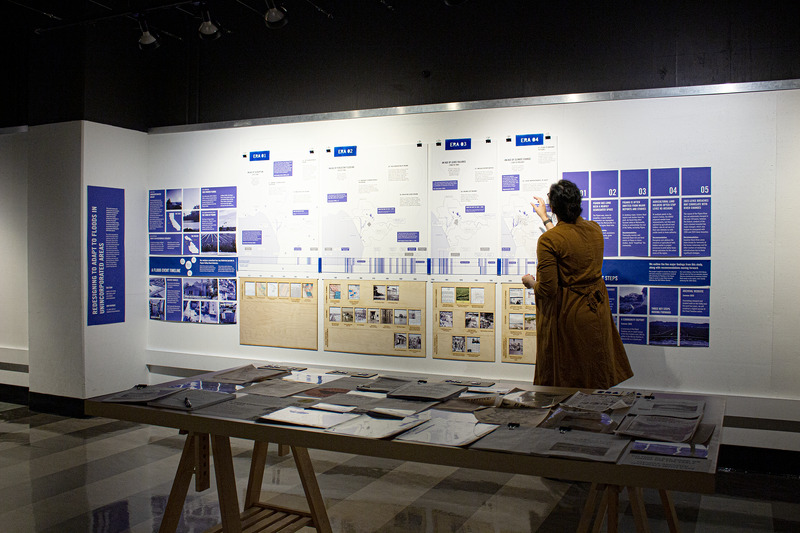
A white gallery corner lined with deep blue panels of photographs, maps and text runs above a long trestle table strewn with papers. A tall blue banner reads "REDESIGNING TO ADAPT TO FLOODS IN UNINCORPORATED AREAS," and a timeline marked ERA 01, ERA 02, ERA 03 and ERA 04 stretches across the wall, where a woman in a rust-colored dress reaches up to touch a map beside five numbered blue squares, 01 to 05.
Item
Organization
Just Environments Lab
A research and design lab in Landscape Architecture and Environmental Planning at UC Berkeley's College of Environmental Design that works on policy and design for just environments before and after disasters. Directed by Danielle Zoe Rivera, the lab centers hazard mitigation for under-resourced communities and co-produces research with them. In California it has studied the flood history of the Pájaro Valley with the U.S. Army Corps of Engineers, shown in an April 2025 exhibit at Bauer Wurster Hall that combined archival research, a flood timeline and maps, and it has worked on recovery after the Los Angeles fires. The lab began in 2018 at the University of Colorado Boulder under the name Comunidad and took its current name after moving to Berkeley in 2021.
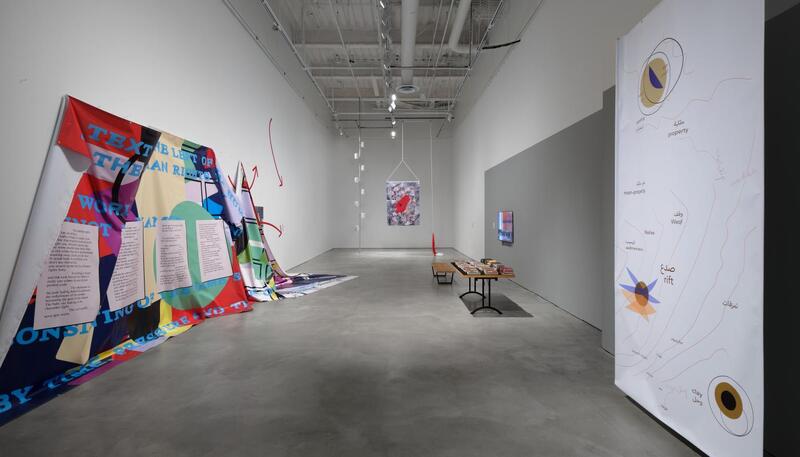
A long white gallery with a pale concrete floor runs toward a single banner hanging in the distance. At left, a vast sheet of red, blue, green and black fabric slumps against the wall and spills across the floor, stamped with words in bright blue and pinned with pages of text; at right, a tall white banner holds a hand-drawn map of fine lines, circles and a blue-orange star, labeled in Arabic and English: property, non-property, Waqf, rift, clay.
Item
Event
The Unworld to Come. Imagining an Otherwise…
A group exhibition at UC Irvine's University Art Galleries that treats climate change as an interlocking crisis bound up with economic and social justice, from extraction presented as green transition to the forced migration, detention and deportation of people displaced by rising seas and neo-colonial regimes. Curated by Juli Carson, Annika Haas and Sasha Ussef, it drew on Jack Halberstam's idea of 'unworlding' and Bernard Stiegler's notion of the neganthropocene to ask how a livable life might be imagined within present conditions of collapse. Works by Marwa Arsanios, Ashley Hunt, Natascha Sadr Haghighian and virgil b/g taylor were installed in the Contemporary Arts Center Gallery, accompanied by an opening reception and a day-long workshop, 'Collapse as a Condition of (Un)Knowing.' The show launched the first phase of The Neganthropocene, a three-part research project led by Carson under the UC Climate Action Arts Network.
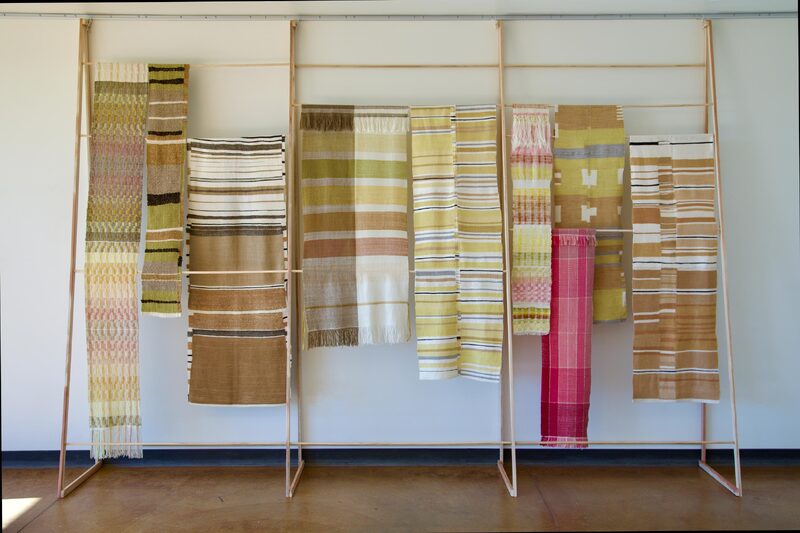
A row of handwoven shawls hangs from tall pale-wood ladders against a white wall, falling in stripes of mustard, ochre, cream, tan, chartreuse and blush, with one deep raspberry check. Fringes trail at their ends; the colors are soft and earthen, like dry grass and sun-faded bark.
Item
Project
Interlopings: Invasive Species / Endemic Breeds
Artist Statement: We are dyeing wool with dyestuff from invasive and non-native plants growing on Santa Cruz Island in the Channel Islands archipelago in California, investigating the complex and intertwined influence humans have on our ecosystems, and the aesthetic, emotional, magical, and medicinal interrelationships between humans, plants and color. The wool is spun into yarn, the yarn woven into shawls. In addition, we are constructing a database of natural dye colors and various methods for visualizing and organizing that data, using a wide range of systematics, from scientific to alchemical. The organisms (many plants and one insect, cochineal) we are working with, were brought to the island over an extended period of time, starting when it was first colonized by Europeans. New organisms were still consciously introduced in the late 20th century. For example, cochineal (coincidentally a very important source of red dye) was brought to the island in the late sixties to help kill off the cactuses which were considered a hazard to the cows grazing on the island. The human immigrants had a relationship to these organisms in their home lands for millennia, many of these plants have been used for food, medicine, magic and dyes. Just as with humans, some behave better than others when arriving in a new land. Robin Wall Kimmerer, botanist and member of the Citizen Potawatomi Nation, writes about Broadleaf plantain with affection in “Braiding Sweetgrass: Indigenous Wisdom, Scientific Knowledge and the Teachings of Plants.” To her, plantain is a model citizen, a foreign-born who is not colonizing. It’s a generous and healing newcomer, who is truly listening to the new environment. Other plants are infamous for wreaking havoc in the eco-systems they “invade”. On Santa Cruz Island, fennel, a sweet smelling, delicious plant, which is highly medicinal, traditionally used for protection magic and yields a magical yellow color, has taken over large swaths of land to the detriment of the native flora. It is now one of the many plants targeted for eradication from the island in a major conservation effort aiming to restore it to a more (real or perceived) natural state. The sheep breeds producing the wool and yarns we are working with have an historical connection to Santa Cruz Island. It’s believed that the Santa Cruz Island sheep breed stems from sheep of several breeds, potentially including Merino, Rambouillet (a French version of Merino), and English Leicester, brought to Santa Cruz Island in the mid 19th century for wool and meat production. Over the years, the sheep increased in numbers and became feral, causing massive erosion to the landscape. In the nineties, consistent with restoration efforts on the island, the sheep, then in the tens of thousands, were eradicated. Due to the methods used (very few sheep were brought to the mainland, most were shot on the island) the endemic Santa Cruz Island breed has ironically become one of the five most critically endangered breeds on the Livestock Conservancy's conservation priority list. The wool from these sheep speaks about the landscape where the individual sheep lead their lives and the breed emerged. Its staple length and crimp, the soil and vegetable matter trapped in it, reveals something about the sheep, the breed and their environment (craftspeople now speak of the 'terroir' of wool.) Interlopings: Invasive Species / Endemic Breeds is a process-based collaborative art project combining traditional techniques such as dyeing, spinning and weaving, with data visualization and ‘performative science’ and ‘relational aesthetics’ strategies. The public is invited to participate in the process through workshops and exhibitions and to have a direct visual, olfactory and tactile experience with animals and plants that have been introduced to the island. By smelling and touching the wool, inspecting the insects and vegetable matter stuck to it, getting dazzled by rich and subtle colors given to us by the plants and sensing the warmth from the finished shawls, the audience-participants inadvertently explore a wide array of topics. They might gain insights into issues ranging from aspects of the natural and cultural history of the Channel Islands and conservation, to topics related to the Anthropocene and chemistry. Some of the questions this project evoke are: How do we define what a “native” species is? When was 'wild'? How do we decide where species belong? What animals 'deserve' our protection? What is the goal with conservation? What ends justifies what means? (Growing up in Sweden in the seventies, we marched to the catchy chant “sluta spruta” - stop spraying, while the children today learn that one of the most significant dangers to our natural environment are alien species.) While these issues will be discussed in the workshops and exhibitions, this is an art project relying on visual, tactile, and olfactory modalities of generating meaning. As such the most important questions will be asked, and maybe answered, in the direct experiences of hands, noses, and eyes and in the relationships created between people and between people, processes and materials.
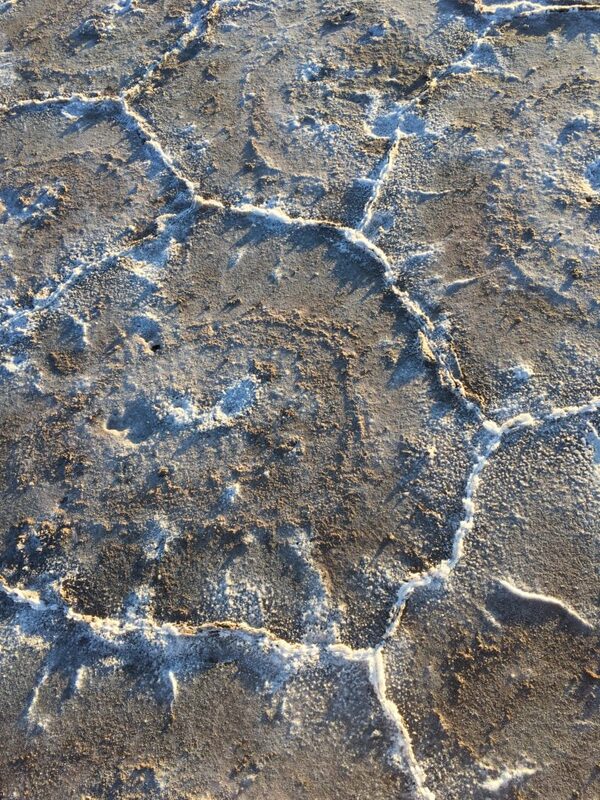
Seen from above, a cracked crust of salt and mud spreads in gray-brown plates, their seams traced with raised white mineral ridges. Low sun picks out every grain and fold, so the ground reads like a map of roads or rivers.
Item
Project
We Build Ruins
A long-term art research project that has worked since 2017 in the industrialized high-altitude deserts of northern Chile's Atacama. There, copper and lithium mining for global supply chains reshapes a former seabed with rare geologic and living systems. Drawing on intensive fieldwork, the artists build multichannel sound, video, photography, live audiovisual performance and installation, and use mirage and perceptual distortion rather than documentary to question the idea of the desert as wasteland. They also note that the region has served as a Mars-analog test site. Works include Salar: Evaporation (2020), shown in the group exhibition Against Outer Space at UC Irvine's Beall Center for Art + Technology, and Salar: Adaptation, presented at the Santa Cruz Museum of Art & History in 2024. A feature film and an artist book are in progress.
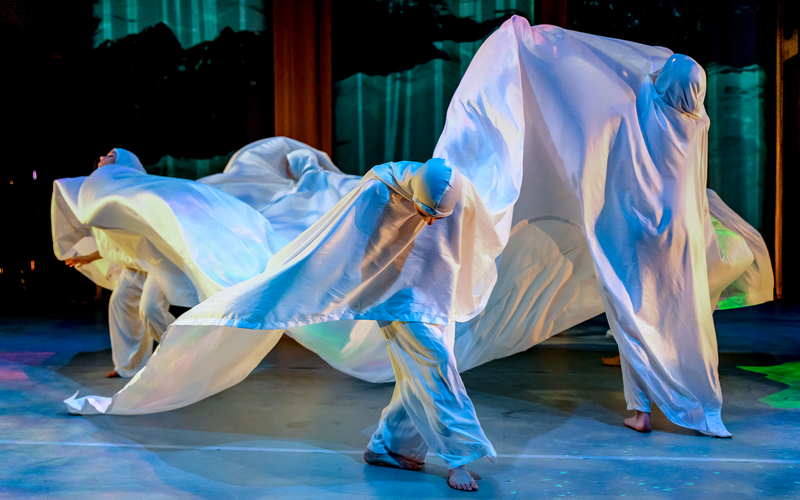
Three dancers wrapped head to foot in pale satin lean and sweep across a gray stage, their billowing cloth catching blue and gold light like a breaking wave. Behind them, teal shapes ripple across dark curtains, and bare feet press into a floor washed with faint green.
Item
Event
Your Ocean, My Ocean (YOMO: Intermedia)
An experimental intermedia performance combining dance, live music, projected media and visual design, created in response to the beauty of oceans and coastlines and to the damage human activity does to marine ecosystems. Directed by John Crawford with composer and violinist Mari Kimura and four choreographers, the roughly 80-minute work set live dancers and musicians against processed video shot at ocean and coastal sites, in four sections titled Emergence, Gyre, Oil Slick and Refuge. It premiered at the Experimental Media Performance Lab (xMPL) in UC Irvine's Contemporary Arts Center and was produced by the Institute for 21st Century Creativity, with scenic elements and animations developed in a UCI/RISD collaboratory course. An expanded version was presented at Brown University's Granoff Center in April 2019, and the project frames its aims around climate justice and the inclusion of diverse voices.
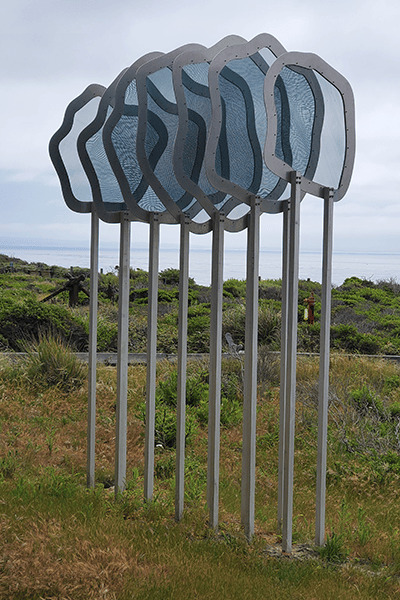
Five wavy, cloud-shaped panels of fine blue mesh, framed in gray metal, stand on slender poles above green coastal scrub. Behind them a pale ocean meets an overcast sky.
Item
Project
Gathering Cloud
A public sculpture and working fog catcher made of eight amorphous, cloud-like rings, each strung with copper mesh that weathers to a sky-blue color. Coastal fog condenses on the mesh, and the water drips into the soil below to nourish the surrounding wetland plantings. The sculpture was made by artist Anja Ulfeldt for UC Santa Cruz's Art+Fog Collective, and microbiologist and environmental toxicologist Peter Weiss-Penzias tested the water it gathered. It was installed in December 2024 in the marshlands around Younger Lagoon, just west of the Seymour Marine Discovery Center, as part of restoration efforts there.
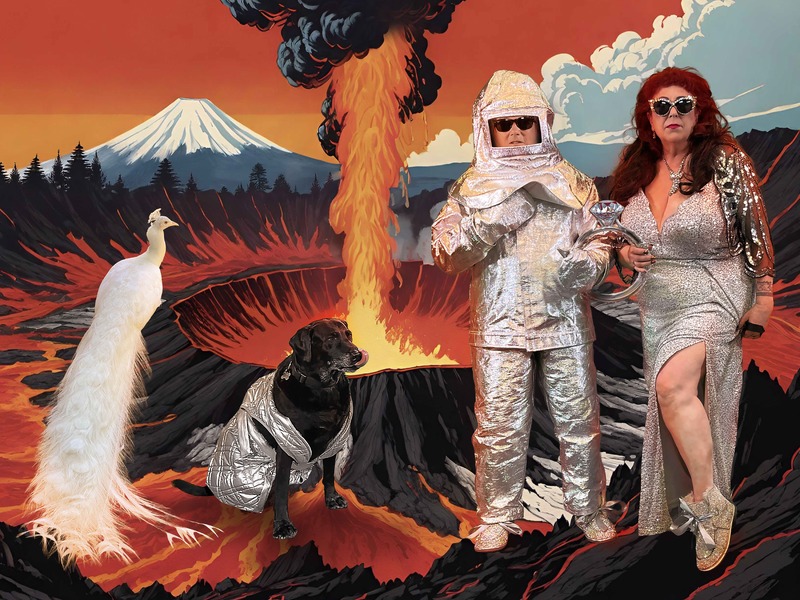
Against a painted sky of orange and black smoke, lava pours down a volcano below a snow-capped peak. In front, a white peacock with a long shaggy tail stands beside a black dog in a silver puffer coat, and two people in shining silver, one in a hooded fire suit holding an oversized diamond ring, the other in a sequined gown and dark glasses, pose amid glowing red lava fields.
Item
Project
Playing with Fire: An Ecosexual Emergency
A 71-minute documentary that begins when the 2020 CZU Lightning Complex fires force Annie Sprinkle and Beth Stephens to evacuate their home in the Boulder Creek redwoods. From there, the artists approach fire as an element to relate to and care for rather than only fight. Mixing humor, grief and performance art, the film draws on firefighters (including formerly incarcerated firefighters), Indigenous scholars, ecologists, artists and a witch therapist, and part of the narration is voiced by a mythical white peacock named Albert. It connects California's wildfires and climate change to questions of social justice and ends with a ceremonial wedding to fire in the redwoods. It is the third film in the pair's ecosexual series, after Goodbye Gauley Mountain (2014) and Water Makes Us Wet (2019). It premiered at Frameline49 at the Roxie Theater in San Francisco on June 20, 2025.
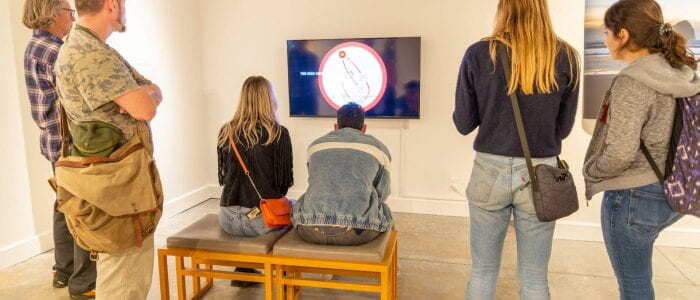
Visitors stand and sit on low wooden benches in a white gallery, their backs to the camera, facing two wall-mounted screens. On each screen a pale circle edged in red holds a faint drawing; a woman in a navy sweater and another with a patterned backpack lean in to look.
Item
Event
Beyond the World’s End
A group exhibition that treated apocalypse as something many communities have already lived through, by way of colonialism, displacement and genocide, rather than as a coming event. It brought together artists whose work traces the roots of present social and environmental injustice and imagines just, ecologically sustainable alternatives. Works included Amy Balkin's People's Archive of Sinking and Melting, Teddy Cruz and Fonna Forman's video proposal for a cross-border environmental commons at the Tijuana River estuary, Laurie Palmer's solar-powered discussion table Public Sun / Arendt's Table, and Newton Harrison's maps of Mediterranean pollution. The exhibition was guest curated by T. J. Demos at the Santa Cruz Museum of Art & History. It was the culminating exhibition of UC Santa Cruz's year-long, Mellon-funded Beyond the End of the World project, organized with The Humanities Institute and the Center for Creative Ecologies.
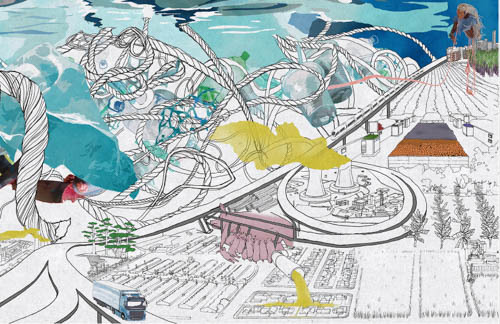
A crowded collage drawn in fine black line and washed with teal, mustard and rose: giant twisted ropes coil through a sky of torn blue paper above a gridded landscape of highways, plantations and fenced fields. A truck rolls along a road, cooling towers stand in a ring, a bucket tips yellow liquid onto rooftops, and a towering figure wades in from the far horizon.
Item
Project
Feral Atlas: The More-than-Human Anthropocene
A free, interactive online atlas that traces the ecologies that arise when nonhuman beings become entangled with human infrastructures, which its editors argue are the substance of the Anthropocene. Readers move through the atlas along routes of "detonators," "tippers" and "feral qualities." Along the way they find nearly 80 field reports by scientists and humanists alongside video, artwork, poetry and music, as well as a reading room and curriculum suggestions. The project was curated and edited by UC Santa Cruz anthropologist Anna Tsing with Jennifer Deger, Alder Keleman Saxena and Feifei Zhou, and published as a digital book by Stanford University Press. ArtReview ranked it 15th on its 2020 Power 100 list.
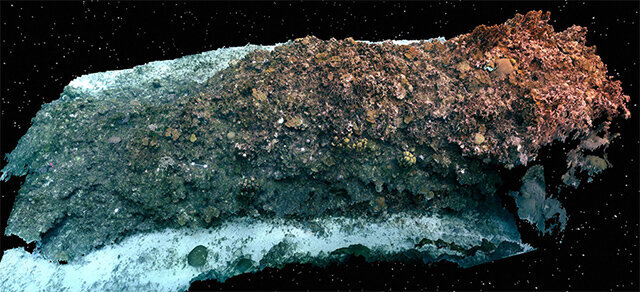
A slab of coral reef floats in black space speckled with tiny white points, as if in a field of stars. Its crusted surface shifts from slate blue to rust and coral pink, rough with knobs and branches, and a pale band of sand runs along its base.
Item
Project
Hearing Seascapes
Led by UC San Diego composer Lei Liang and Qualcomm Institute engineer Falko Kuester, this interdisciplinary initiative brings together music composition students and researchers from Scripps Institution of Oceanography to explore the creative possibilities of marine science. Through a collaborative seminar, participants translate underwater recordings and scientific imaging—including Arctic ice formations, whale echolocation, and coral reef scans—into original musical compositions and immersive experiences. Projects include a virtual reality sound installation presented at the Qualcomm Institute’s SunCAVE in 2018 and a 2019 performance by the Mivos Quartet and students featuring compositions informed by Arctic field recordings.
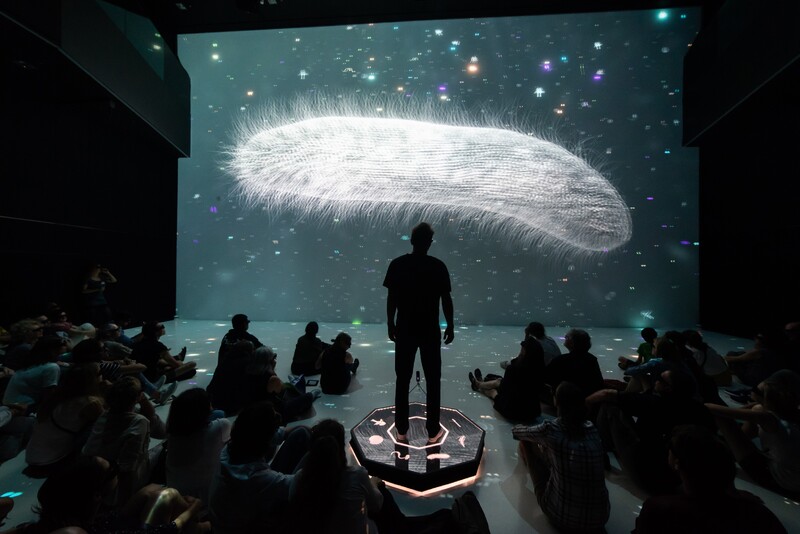
In a dark room a vast screen glows teal and star-flecked, and a pale plankton the size of a whale drifts across it, its body bristling with fine white hairs. A lone figure stands on a lit octagonal platform below, while a crowd sits on the floor in shadow, faces turned up to the light.
Item
Project
Noise Aquarium
Led by UCLA artist Victoria Vesna in collaboration with the Science Visualization Lab at the University of Applied Arts Vienna, this immersive art–science installation explores the effects of human activity on marine ecosystems. Drawing on 3D imaging of plankton and underwater sound recordings, the work transforms microscopic organisms into monumental forms while revealing the acoustic disturbances caused by ships, sonar, and offshore extraction. An interactive balance board allows visitors to influence the underwater environment through their movements, connecting physical balance to ecological vulnerability. First developed as a video in 2017, the project evolved into interactive 3D and virtual reality experiences and was presented at the 2019 SIGGRAPH Art Gallery in Los Angeles, among other international venues.
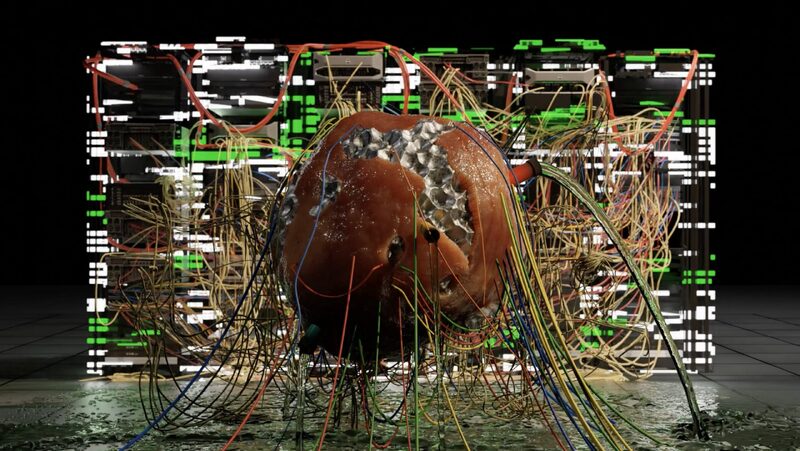
A tower of server racks flickers with white and green bars of light in a dark room. Tangled cables in red, blue, yellow and green spill from it like roots or veins and wrap around a glossy, rust-colored mass studded with silver crystals, all pooled in a glistening slick on the floor.
Item
Project
Carbonivore
A speculative hybrid creature built from roughly 2,000 pounds of e-waste gathered around the Bay Area, staged by Jill Miller and Asma Kazmi, who work together as the Missing Object Library. Cables, server racks, monitors and cooling units recreate the look of a server farm, while animated video traces the materials back to the rare earth mines they came from; smaller 'offspring' forms made of lithium, cobalt and silicon appeared on lobby monitors. The work pushes back on the idea that the cloud, big data and AI are weightless, pointing to their energy demands, extraction and labor. A first version was installed in October 2023; the full installation filled the Gray Area Gallery in San Francisco from April 22 to July 20, 2025, commissioned through Gray Area's C/Change program with Goethe-Institut San Francisco and supported in part by the UC Berkeley Center for New Media and UC Berkeley Surplus.
Browse all

Collecting Form Block

Tell us a little about yourself. Your name and email are used only for archival contact purposes and will not be published without your consent. You may choose to contribute anonymously.

Please describe the item you are contributing. The more detail you provide, the richer the archive record will be.

Submit files associated with your item. For video and audio, paste your YouTube (or other hosted) link below and submit 1–3 representative still images so the archive has a visual record. A transcript is strongly encouraged for audio and video items.


Accepted formats: images (JPG, PNG, TIFF, GIF), documents (PDF).


For image submissions — submit the highest-resolution file you have. If submitting a scan of a physical original, the minimum is 3,000 pixels on the long edge. If your image is a born-digital file created for screen (web graphics, digital art, net art, UI design, generative work), submit the native file at its original resolution — do not upsample. See guidance below."
Image file guidance (for developer reference — display relevant portions to contributor based on item type):


DIGITIZED PHYSICAL ORIGINALS (scans of photographs, prints, drawings, physical artworks, archival documents):
• Minimum: 3,000 pixels on the long edge. This is the NARA/FADGI archival floor and the CDL/Calisphere submission standard.
• Recommended: 4,000 pixels on the long edge — FADGI 3-star aim point for photographic prints (FADGI Technical Guidelines for Digitizing Cultural Heritage Materials, 3rd ed., 2023).
• Format: Uncompressed TIFF preferred for scanned archival masters. High-quality JPEG (minimal compression) acceptable for access copies.
• PPI applies only to scanning: 400 ppi at the original’s physical dimensions will typically meet the pixel minimum for standard-sized originals.


BORN-DIGITAL SCREEN FILES (web graphics, digital illustration, net art, GIF, generative art, UI/UX design, data visualisations, screen captures):
• Submit the native file at its original pixel dimensions. Do not upsample — interpolated pixels degrade rather than preserve the work.
• PPI is not meaningful for born-digital screen files and should be disregarded. A 1920 × 1080px PNG at 72 ppi is a complete, archivally valid file if that is the native resolution.
• The pixel minimum does not apply. The native resolution is the authoritative file.
• In the caption field, note: “Born-digital screen file — native resolution [W × H px].” Staff will record this in the item record during metadata enrichment.
• Format: PNG preferred for lossless colour. High-quality JPEG acceptable for photographic-style born-digital images. GIF for animated works.


BOTH TYPES:
• No maximum pixel dimension is enforced, but files over 100MB may be slow to upload. Use the URL field to link to a hosted copy if needed.
 

Help us connect your work to the right themes and communities. Select the terms that best describe your item — you do not need to fill every field.

Please indicate who holds rights to this item and how it may be used. If you are unsure, select 'All rights reserved' — our team can help clarify rights during review. For works with Indigenous cultural protocols, please select the relevant option and we will follow up before any publication

Data visualization Block

Count of items with properties

Etiam posuere quam ac quam. Maecenas aliquet accumsan leo. Nullam dapibus fermentum ipsum. Etiam quis quam. Integer lacinia.

Faceted Browse Preview Block

Title Description
Zooniverse Biodiversity; Climate Communication; Environmental Research
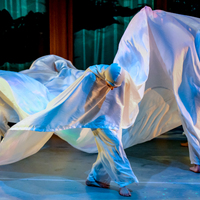
Three dancers wrapped head to foot in pale satin lean and sweep across a gray stage, their billowing cloth catching blue and gold light like a breaking wave. Behind them, teal shapes ripple across dark curtains, and bare feet press into a floor washed with faint green.Your Ocean, My Ocean (YOMO: Intermedia) An experimental intermedia performance combining dance, live music, projected media and visual design, created in response to the beauty of oceans and coastlines and to the damage human activity does to marine ecosystems. Directed by John Crawford with composer and violinist Mari Kimura and four choreographers, the roughly 80-minute work set live dancers and musicians against processed video shot at ocean and coastal sites, in four sections titled Emergence, Gyre, Oil Slick and Refuge. It premiered at the Experimental Media Performance Lab (xMPL) in UC Irvine's Contemporary Arts Center and was produced by the Institute for 21st Century Creativity, with scenic elements and animations developed in a UCI/RISD collaboratory course. An expanded version was presented at Brown University's Granoff Center in April 2019, and the project frames its aims around climate justice and the inclusion of diverse voices.
Writing Academic Texts Differently: Intersectional Feminist Methodologies and the Playful Art of Writing Art, Culture & Climate; Climate Justice; Indigenous Knowledge; Land Use; Biodiversity
Why the impacts of climate change may make us less likely to reduce emissions Climate Impacts; Mitigation; Political Economy
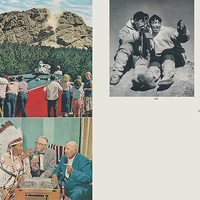
An open book. On the left, a summer crowd gathers by a red-draped platform below a granite mountain where pale dust plumes from a carved slope, and beneath it a man in a feathered headdress sits at a table with men in suits. On the right, two people in fur parkas grin on a rocky slope beside a camera, and the sparse words read: they disappeared / They disap- / peared.White Gaze An artist's book and photographic installation by Latipa (Michelle Dizon), with poetry by Việt Lê, made from an archive of National Geographic magazines from the 1960s and earlier. Dizon erased most of the text on each page, leaving fragments that form a decolonial counterpoint to the magazine's imperialist, Western-centric images of people and lands, and Lê added original poetry and a text on the legacies of war and empire. The book was published in 2018 by at land's edge (Los Angeles), Candor Arts (Chicago) and Sming Sming Books (Bay Area), and the work was exhibited at the California Institute of Integral Studies, San Francisco, from March 20 to July 31, 2018.
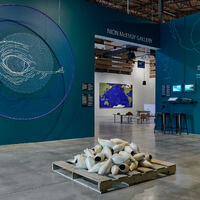
A great circle of netting hangs on a deep teal wall, a whale’s eye stitched into it in fine pale thread, watching. Below, on a shipping pallet, sixty pale ceramic teeth lie heaped like a jaw let go. Beyond the doorway, an ocean map glows blue.When Whale looks at Human A handmade fishing net embroidered with the eye of a humpback whale, made by artist Carolina Caycedo for Weather and the Whale at the Institute of the Arts and Sciences, UC Santa Cruz. The net turns the whale’s gaze back on the viewer, pointing to how commercial fishing gear entangles and kills whales while honoring small-scale subsistence fishing as a more sustainable way of living with the sea.
When Species Meet Art, Culture & Climate; Biodiversity; Indigenous Knowledge; Climate Justice; Land Use
What is the role of universities at a time of ecological and social crisis? Higher Education; Climate Action
In a darkened hall, a pale screen glows with a drawing of contour lines folding like a landscape, while below it a small figure stands at a lectern washed in red light.What is Missing? A lecture by artist and architectural designer Maya Lin in the Berkeley Center for New Media's Art, Technology and Culture Colloquium, held at the David Brower Center, Berkeley. Lin discussed her large-scale environmental installations, studio works, architecture and memorials, and her final memorial, What is Missing?, which addresses biodiversity and habitat loss and asks viewers to rethink their relationship to the natural world. Attendees were invited to add their own environmental memories to the project's archive in the Brower Center gallery.
What If We Get It Right? Visions of Climate Futures Climate Futures; Climate Justice; Art, Culture & Climate
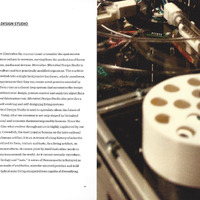
An open catalogue spread. On the left, a page of text headed “Orkan Telhan, Biorealize: Microbial Design Studio and Bananaworks.” On the right, a close photograph of a lab machine glinting in dim light, a nest of clear tubing, clamps, and glass vessels where microbes are grown.WETWARE: art | agency | animation An exhibition at the Beall Center for Art + Technology, UC Irvine, curated by David Familian and Jens Hauser, on synthetic biology and wetware, in which artists use laboratory methods to come close to life. The works included synthetic amino acid necklaces, protocells that mimic the movement of phytoplankton, bacteria that generate power for a synthesizer, a desktop gene machine, and an artificially grown brain in a vat, and Evelina Domnitch and Dmitry Gelfand and Anna Dumitriu made new works in residencies developed with UC Irvine research centers. Questioning human-centered views of engineered artificial life and the responsibilities they carry, the show asked how aliveness is defined in terms of components, circuits, and systems.
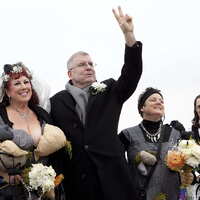
 A group of people gathered outdoors for a theatrical wedding-like ceremony, wearing elaborate costumes and holding bouquets of flowers. A smiling man in a black coat raises his hand in a peace sign while two costumed participants beside him smile against an overcast sky.Wedding to the Sun Guests carried a long silk ribbon in a procession around the hill, and the ceremony included live music, performances, and a homily by theater director Rudy Ramirez, with Katy Bell as production manager. The work belongs to the artists’ series of weddings to elements of the natural world, including the earth, the moon, and the fog.
Browse all

Item Carousel Block

Ticker variation

Item With Metadata Block

Media Embed Block