
Recent Submissions
View as:
Just Environments Lab
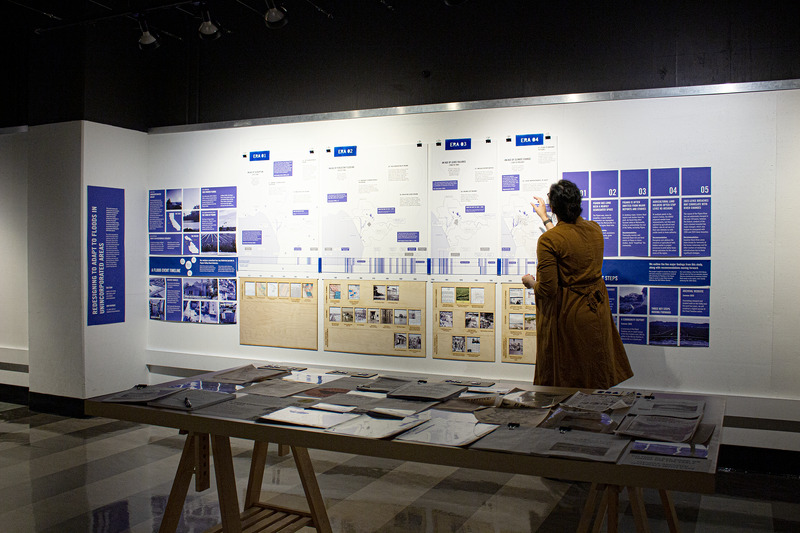
A research and design lab in Landscape Architecture and Environmental Planning at UC Berkeley's College of Environmental Design that works on policy and design for just environments before and after disasters. Directed by Danielle Zoe Rivera, the lab centers hazard mitigation for under-resourced communities and co-produces research with them. In California it has studied the flood history of the Pájaro Valley with the U.S. Army Corps of Engineers, shown in an April 2025 exhibit at Bauer Wurster Hall that combined archival research, a flood timeline and maps, and it has worked on recovery after the Los Angeles fires. The lab began in 2018 at the University of Colorado Boulder under the name Comunidad and took its current name after moving to Berkeley in 2021.
The Unworld to Come. Imagining an Otherwise…
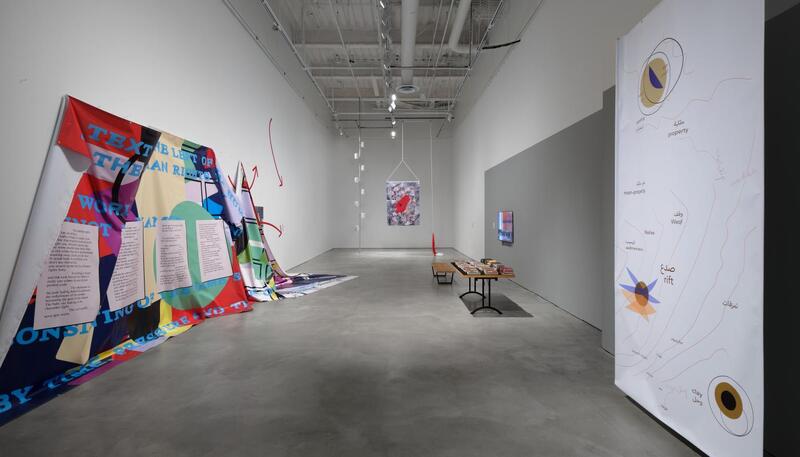
A group exhibition at UC Irvine's University Art Galleries that treats climate change as an interlocking crisis bound up with economic and social justice, from extraction presented as green transition to the forced migration, detention and deportation of people displaced by rising seas and neo-colonial regimes. Curated by Juli Carson, Annika Haas and Sasha Ussef, it drew on Jack Halberstam's idea of 'unworlding' and Bernard Stiegler's notion of the neganthropocene to ask how a livable life might be imagined within present conditions of collapse. Works by Marwa Arsanios, Ashley Hunt, Natascha Sadr Haghighian and virgil b/g taylor were installed in the Contemporary Arts Center Gallery, accompanied by an opening reception and a day-long workshop, 'Collapse as a Condition of (Un)Knowing.' The show launched the first phase of The Neganthropocene, a three-part research project led by Carson under the UC Climate Action Arts Network.
Interlopings: Invasive Species / Endemic Breeds
Artist Statement:
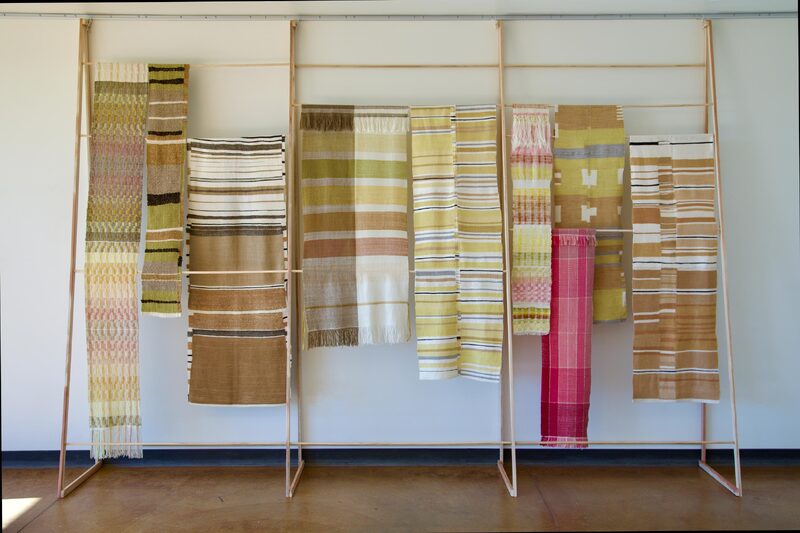
We are dyeing wool with dyestuff from invasive and non-native plants growing on Santa Cruz Island in the Channel Islands archipelago in California, investigating the complex and intertwined influence humans have on our ecosystems, and the aesthetic, emotional, magical, and medicinal interrelationships between humans, plants and color. The wool is spun into yarn, the yarn woven into shawls. In addition, we are constructing a database of natural dye colors and various methods for visualizing and organizing that data, using a wide range of systematics, from scientific to alchemical.
The organisms (many plants and one insect, cochineal) we are working with, were brought to the island over an extended period of time, starting when it was first colonized by Europeans. New organisms were still consciously introduced in the late 20th century. For example, cochineal (coincidentally a very important source of red dye) was brought to the island in the late sixties to help kill off the cactuses which were considered a hazard to the cows grazing on the island.
The human immigrants had a relationship to these organisms in their home lands for millennia, many of these plants have been used for food, medicine, magic and dyes. Just as with humans, some behave better than others when arriving in a new land. Robin Wall Kimmerer, botanist and member of the Citizen Potawatomi Nation, writes about Broadleaf plantain with affection in “Braiding Sweetgrass: Indigenous Wisdom, Scientific Knowledge and the Teachings of Plants.” To her, plantain is a model citizen, a foreign-born who is not colonizing. It’s a generous and healing newcomer, who is truly listening to the new environment. Other plants are infamous for wreaking havoc in the eco-systems they “invade”. On Santa Cruz Island, fennel, a sweet smelling, delicious plant, which is highly medicinal, traditionally used for protection magic and yields a magical yellow color, has taken over large swaths of land to the detriment of the native flora. It is now one of the many plants targeted for eradication from the island in a major conservation effort aiming to restore it to a more (real or perceived) natural state.
The sheep breeds producing the wool and yarns we are working with have an historical connection to Santa Cruz Island. It’s believed that the Santa Cruz Island sheep breed stems from sheep of several breeds, potentially including Merino, Rambouillet (a French version of Merino), and English Leicester, brought to Santa Cruz Island in the mid 19th century for wool and meat production. Over the years, the sheep increased in numbers and became feral, causing massive erosion to the landscape. In the nineties, consistent with restoration efforts on the island, the sheep, then in the tens of thousands, were eradicated. Due to the methods used (very few sheep were brought to the mainland, most were shot on the island) the endemic Santa Cruz Island breed has ironically become one of the five most critically endangered breeds on the Livestock Conservancy's conservation priority list.
The wool from these sheep speaks about the landscape where the individual sheep lead their lives and the breed emerged. Its staple length and crimp, the soil and vegetable matter trapped in it, reveals something about the sheep, the breed and their environment (craftspeople now speak of the 'terroir' of wool.)
Interlopings: Invasive Species / Endemic Breeds is a process-based collaborative art project combining traditional techniques such as dyeing, spinning and weaving, with data visualization and ‘performative science’ and ‘relational aesthetics’ strategies. The public is invited to participate in the process through workshops and exhibitions and to have a direct visual, olfactory and tactile experience with animals and plants that have been introduced to the island. By smelling and touching the wool, inspecting the insects and vegetable matter stuck to it, getting dazzled by rich and subtle colors given to us by the plants and sensing the warmth from the finished shawls, the audience-participants inadvertently explore a wide array of topics. They might gain insights into issues ranging from aspects of the natural and cultural history of the Channel Islands and conservation, to topics related to the Anthropocene and chemistry. Some of the questions this project evoke are: How do we define what a “native” species is? When was 'wild'? How do we decide where species belong? What animals 'deserve' our protection? What is the goal with conservation? What ends justifies what means? (Growing up in Sweden in the seventies, we marched to the catchy chant “sluta spruta” - stop spraying, while the children today learn that one of the most significant dangers to our natural environment are alien species.)
While these issues will be discussed in the workshops and exhibitions, this is an art project relying on visual, tactile, and olfactory modalities of generating meaning. As such the most important questions will be asked, and maybe answered, in the direct experiences of hands, noses, and eyes and in the relationships created between people and between people, processes and materials.
We Build Ruins
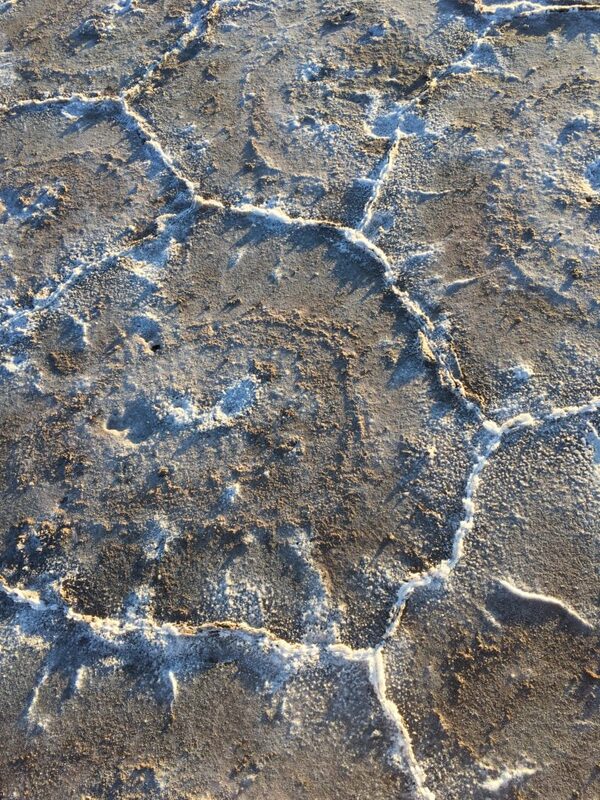
A long-term art research project that has worked since 2017 in the industrialized high-altitude deserts of northern Chile's Atacama. There, copper and lithium mining for global supply chains reshapes a former seabed with rare geologic and living systems. Drawing on intensive fieldwork, the artists build multichannel sound, video, photography, live audiovisual performance and installation, and use mirage and perceptual distortion rather than documentary to question the idea of the desert as wasteland. They also note that the region has served as a Mars-analog test site. Works include Salar: Evaporation (2020), shown in the group exhibition Against Outer Space at UC Irvine's Beall Center for Art + Technology, and Salar: Adaptation, presented at the Santa Cruz Museum of Art & History in 2024. A feature film and an artist book are in progress.
Your Ocean, My Ocean (YOMO: Intermedia)
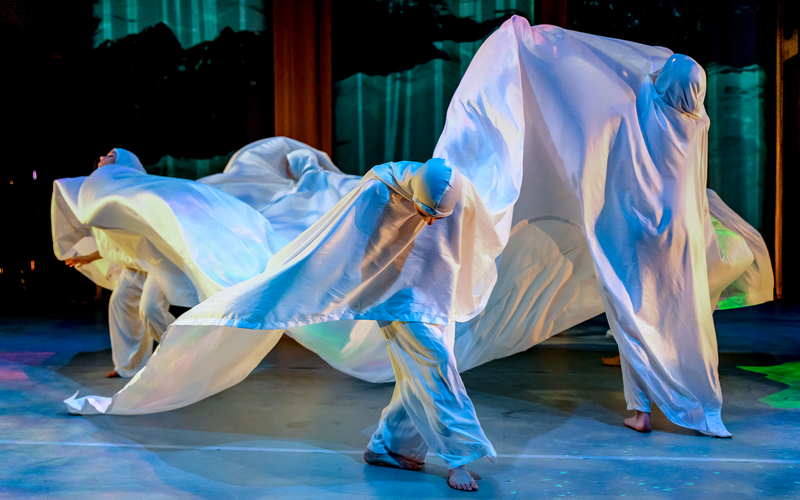
An experimental intermedia performance combining dance, live music, projected media and visual design, created in response to the beauty of oceans and coastlines and to the damage human activity does to marine ecosystems. Directed by John Crawford with composer and violinist Mari Kimura and four choreographers, the roughly 80-minute work set live dancers and musicians against processed video shot at ocean and coastal sites, in four sections titled Emergence, Gyre, Oil Slick and Refuge. It premiered at the Experimental Media Performance Lab (xMPL) in UC Irvine's Contemporary Arts Center and was produced by the Institute for 21st Century Creativity, with scenic elements and animations developed in a UCI/RISD collaboratory course. An expanded version was presented at Brown University's Granoff Center in April 2019, and the project frames its aims around climate justice and the inclusion of diverse voices.
Gathering Cloud
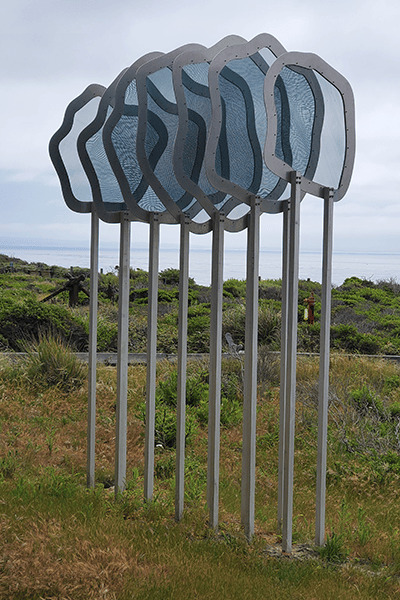
A public sculpture and working fog catcher made of eight amorphous, cloud-like rings, each strung with copper mesh that weathers to a sky-blue color. Coastal fog condenses on the mesh, and the water drips into the soil below to nourish the surrounding wetland plantings. The sculpture was made by artist Anja Ulfeldt for UC Santa Cruz's Art+Fog Collective, and microbiologist and environmental toxicologist Peter Weiss-Penzias tested the water it gathered. It was installed in December 2024 in the marshlands around Younger Lagoon, just west of the Seymour Marine Discovery Center, as part of restoration efforts there.
Playing with Fire: An Ecosexual Emergency
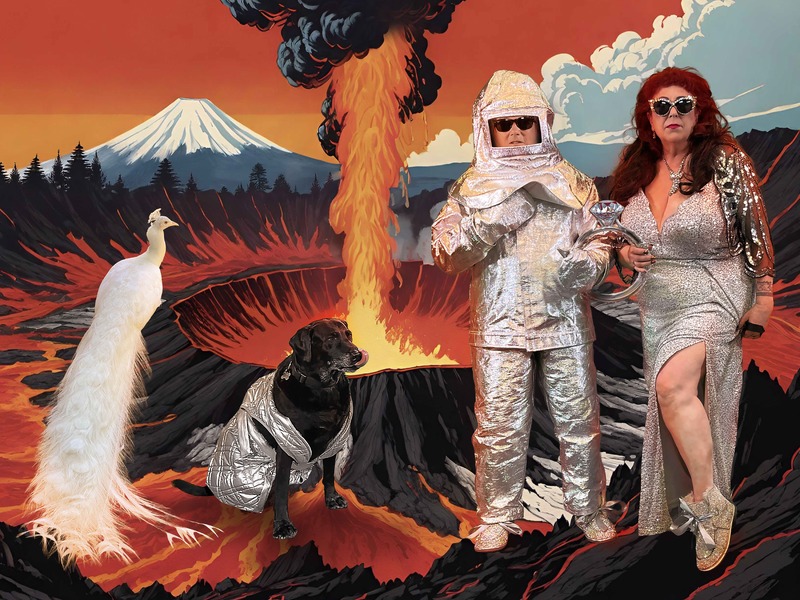
A 71-minute documentary that begins when the 2020 CZU Lightning Complex fires force Annie Sprinkle and Beth Stephens to evacuate their home in the Boulder Creek redwoods. From there, the artists approach fire as an element to relate to and care for rather than only fight. Mixing humor, grief and performance art, the film draws on firefighters (including formerly incarcerated firefighters), Indigenous scholars, ecologists, artists and a witch therapist, and part of the narration is voiced by a mythical white peacock named Albert. It connects California's wildfires and climate change to questions of social justice and ends with a ceremonial wedding to fire in the redwoods. It is the third film in the pair's ecosexual series, after Goodbye Gauley Mountain (2014) and Water Makes Us Wet (2019). It premiered at Frameline49 at the Roxie Theater in San Francisco on June 20, 2025.
Beyond the World’s End
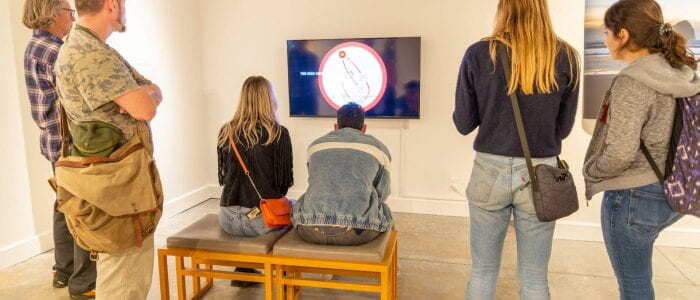
A group exhibition that treated apocalypse as something many communities have already lived through, by way of colonialism, displacement and genocide, rather than as a coming event. It brought together artists whose work traces the roots of present social and environmental injustice and imagines just, ecologically sustainable alternatives. Works included Amy Balkin's People's Archive of Sinking and Melting, Teddy Cruz and Fonna Forman's video proposal for a cross-border environmental commons at the Tijuana River estuary, Laurie Palmer's solar-powered discussion table Public Sun / Arendt's Table, and Newton Harrison's maps of Mediterranean pollution. The exhibition was guest curated by T. J. Demos at the Santa Cruz Museum of Art & History. It was the culminating exhibition of UC Santa Cruz's year-long, Mellon-funded Beyond the End of the World project, organized with The Humanities Institute and the Center for Creative Ecologies.
Feral Atlas: The More-than-Human Anthropocene
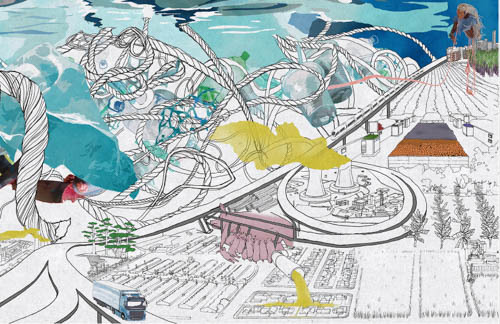
A free, interactive online atlas that traces the ecologies that arise when nonhuman beings become entangled with human infrastructures, which its editors argue are the substance of the Anthropocene. Readers move through the atlas along routes of "detonators," "tippers" and "feral qualities." Along the way they find nearly 80 field reports by scientists and humanists alongside video, artwork, poetry and music, as well as a reading room and curriculum suggestions. The project was curated and edited by UC Santa Cruz anthropologist Anna Tsing with Jennifer Deger, Alder Keleman Saxena and Feifei Zhou, and published as a digital book by Stanford University Press. ArtReview ranked it 15th on its 2020 Power 100 list.
Hearing Seascapes
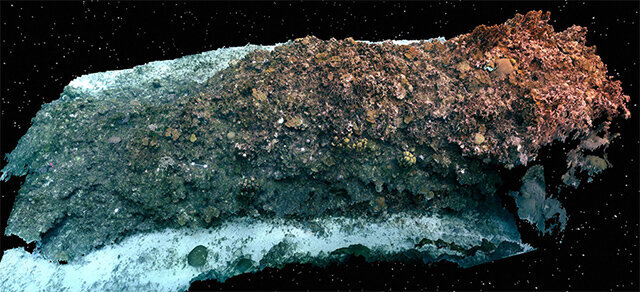
Led by UC San Diego composer Lei Liang and Qualcomm Institute engineer Falko Kuester, this interdisciplinary initiative brings together music composition students and researchers from Scripps Institution of Oceanography to explore the creative possibilities of marine science. Through a collaborative seminar, participants translate underwater recordings and scientific imaging—including Arctic ice formations, whale echolocation, and coral reef scans—into original musical compositions and immersive experiences. Projects include a virtual reality sound installation presented at the Qualcomm Institute’s SunCAVE in 2018 and a 2019 performance by the Mivos Quartet and students featuring compositions informed by Arctic field recordings.
Noise Aquarium
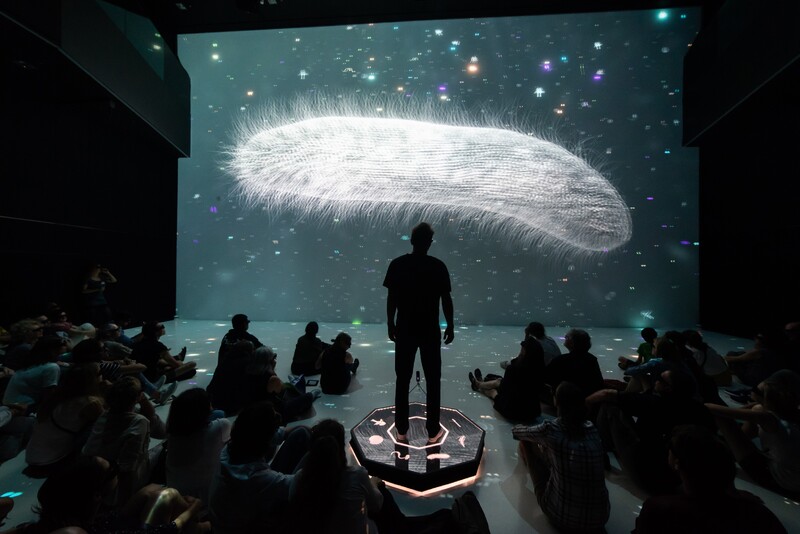
Led by UCLA artist Victoria Vesna in collaboration with the Science Visualization Lab at the University of Applied Arts Vienna, this immersive art–science installation explores the effects of human activity on marine ecosystems. Drawing on 3D imaging of plankton and underwater sound recordings, the work transforms microscopic organisms into monumental forms while revealing the acoustic disturbances caused by ships, sonar, and offshore extraction. An interactive balance board allows visitors to influence the underwater environment through their movements, connecting physical balance to ecological vulnerability. First developed as a video in 2017, the project evolved into interactive 3D and virtual reality experiences and was presented at the 2019 SIGGRAPH Art Gallery in Los Angeles, among other international venues.
Carbonivore
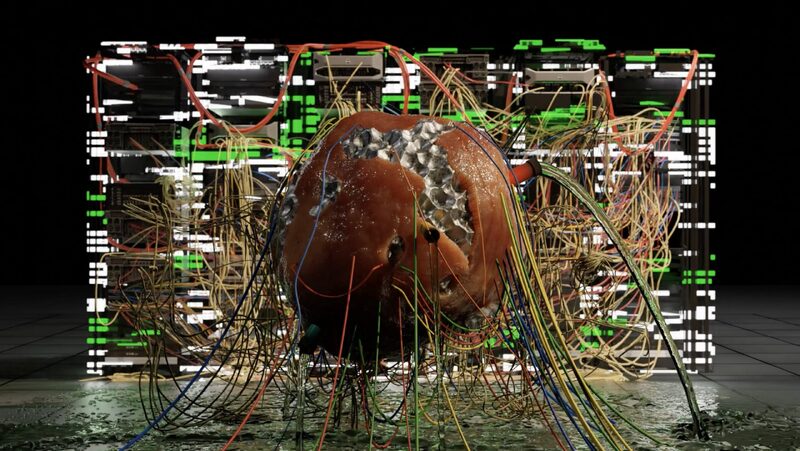
A speculative hybrid creature built from roughly 2,000 pounds of e-waste gathered around the Bay Area, staged by Jill Miller and Asma Kazmi, who work together as the Missing Object Library. Cables, server racks, monitors and cooling units recreate the look of a server farm, while animated video traces the materials back to the rare earth mines they came from; smaller 'offspring' forms made of lithium, cobalt and silicon appeared on lobby monitors. The work pushes back on the idea that the cloud, big data and AI are weightless, pointing to their energy demands, extraction and labor. A first version was installed in October 2023; the full installation filled the Gray Area Gallery in San Francisco from April 22 to July 20, 2025, commissioned through Gray Area's C/Change program with Goethe-Institut San Francisco and supported in part by the UC Berkeley Center for New Media and UC Berkeley Surplus.