Items

View as:
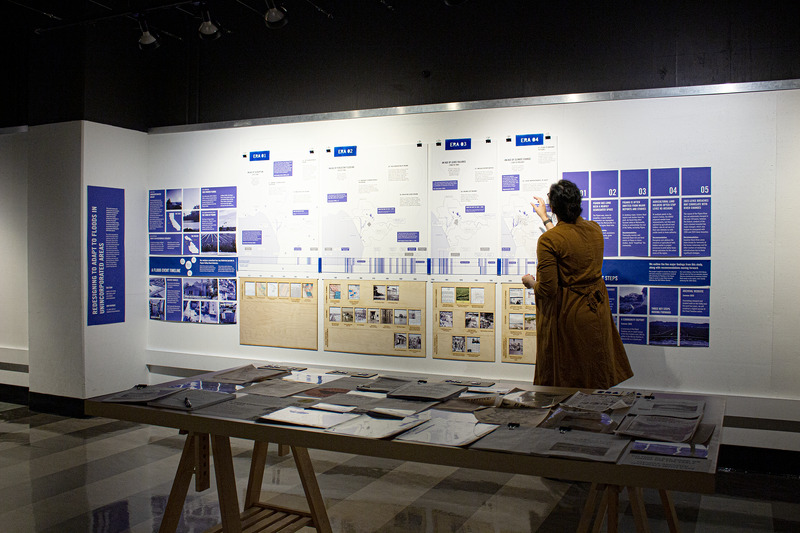
A white gallery corner lined with deep blue panels of photographs, maps and text runs above a long trestle table strewn with papers. A tall blue banner reads "REDESIGNING TO ADAPT TO FLOODS IN UNINCORPORATED AREAS," and a timeline marked ERA 01, ERA 02, ERA 03 and ERA 04 stretches across the wall, where a woman in a rust-colored dress reaches up to touch a map beside five numbered blue squares, 01 to 05.
Item
Organization
Just Environments Lab
A research and design lab in Landscape Architecture and Environmental Planning at UC Berkeley's College of Environmental Design that works on policy and design for just environments before and after disasters. Directed by Danielle Zoe Rivera, the lab centers hazard mitigation for under-resourced communities and co-produces research with them. In California it has studied the flood history of the Pájaro Valley with the U.S. Army Corps of Engineers, shown in an April 2025 exhibit at Bauer Wurster Hall that combined archival research, a flood timeline and maps, and it has worked on recovery after the Los Angeles fires. The lab began in 2018 at the University of Colorado Boulder under the name Comunidad and took its current name after moving to Berkeley in 2021.
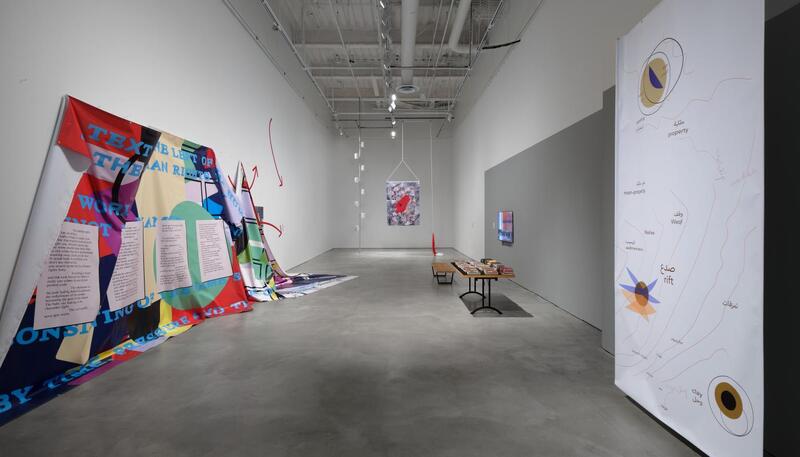
A long white gallery with a pale concrete floor runs toward a single banner hanging in the distance. At left, a vast sheet of red, blue, green and black fabric slumps against the wall and spills across the floor, stamped with words in bright blue and pinned with pages of text; at right, a tall white banner holds a hand-drawn map of fine lines, circles and a blue-orange star, labeled in Arabic and English: property, non-property, Waqf, rift, clay.
Item
Event
The Unworld to Come. Imagining an Otherwise…
A group exhibition at UC Irvine's University Art Galleries that treats climate change as an interlocking crisis bound up with economic and social justice, from extraction presented as green transition to the forced migration, detention and deportation of people displaced by rising seas and neo-colonial regimes. Curated by Juli Carson, Annika Haas and Sasha Ussef, it drew on Jack Halberstam's idea of 'unworlding' and Bernard Stiegler's notion of the neganthropocene to ask how a livable life might be imagined within present conditions of collapse. Works by Marwa Arsanios, Ashley Hunt, Natascha Sadr Haghighian and virgil b/g taylor were installed in the Contemporary Arts Center Gallery, accompanied by an opening reception and a day-long workshop, 'Collapse as a Condition of (Un)Knowing.' The show launched the first phase of The Neganthropocene, a three-part research project led by Carson under the UC Climate Action Arts Network.
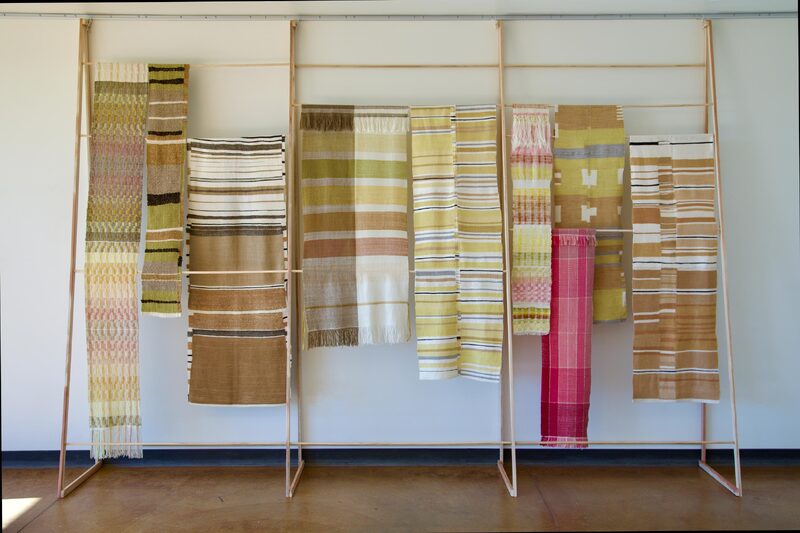
A row of handwoven shawls hangs from tall pale-wood ladders against a white wall, falling in stripes of mustard, ochre, cream, tan, chartreuse and blush, with one deep raspberry check. Fringes trail at their ends; the colors are soft and earthen, like dry grass and sun-faded bark.
Item
Project
Interlopings: Invasive Species / Endemic Breeds
Artist Statement: We are dyeing wool with dyestuff from invasive and non-native plants growing on Santa Cruz Island in the Channel Islands archipelago in California, investigating the complex and intertwined influence humans have on our ecosystems, and the aesthetic, emotional, magical, and medicinal interrelationships between humans, plants and color. The wool is spun into yarn, the yarn woven into shawls. In addition, we are constructing a database of natural dye colors and various methods for visualizing and organizing that data, using a wide range of systematics, from scientific to alchemical. The organisms (many plants and one insect, cochineal) we are working with, were brought to the island over an extended period of time, starting when it was first colonized by Europeans. New organisms were still consciously introduced in the late 20th century. For example, cochineal (coincidentally a very important source of red dye) was brought to the island in the late sixties to help kill off the cactuses which were considered a hazard to the cows grazing on the island. The human immigrants had a relationship to these organisms in their home lands for millennia, many of these plants have been used for food, medicine, magic and dyes. Just as with humans, some behave better than others when arriving in a new land. Robin Wall Kimmerer, botanist and member of the Citizen Potawatomi Nation, writes about Broadleaf plantain with affection in “Braiding Sweetgrass: Indigenous Wisdom, Scientific Knowledge and the Teachings of Plants.” To her, plantain is a model citizen, a foreign-born who is not colonizing. It’s a generous and healing newcomer, who is truly listening to the new environment. Other plants are infamous for wreaking havoc in the eco-systems they “invade”. On Santa Cruz Island, fennel, a sweet smelling, delicious plant, which is highly medicinal, traditionally used for protection magic and yields a magical yellow color, has taken over large swaths of land to the detriment of the native flora. It is now one of the many plants targeted for eradication from the island in a major conservation effort aiming to restore it to a more (real or perceived) natural state. The sheep breeds producing the wool and yarns we are working with have an historical connection to Santa Cruz Island. It’s believed that the Santa Cruz Island sheep breed stems from sheep of several breeds, potentially including Merino, Rambouillet (a French version of Merino), and English Leicester, brought to Santa Cruz Island in the mid 19th century for wool and meat production. Over the years, the sheep increased in numbers and became feral, causing massive erosion to the landscape. In the nineties, consistent with restoration efforts on the island, the sheep, then in the tens of thousands, were eradicated. Due to the methods used (very few sheep were brought to the mainland, most were shot on the island) the endemic Santa Cruz Island breed has ironically become one of the five most critically endangered breeds on the Livestock Conservancy's conservation priority list. The wool from these sheep speaks about the landscape where the individual sheep lead their lives and the breed emerged. Its staple length and crimp, the soil and vegetable matter trapped in it, reveals something about the sheep, the breed and their environment (craftspeople now speak of the 'terroir' of wool.) Interlopings: Invasive Species / Endemic Breeds is a process-based collaborative art project combining traditional techniques such as dyeing, spinning and weaving, with data visualization and ‘performative science’ and ‘relational aesthetics’ strategies. The public is invited to participate in the process through workshops and exhibitions and to have a direct visual, olfactory and tactile experience with animals and plants that have been introduced to the island. By smelling and touching the wool, inspecting the insects and vegetable matter stuck to it, getting dazzled by rich and subtle colors given to us by the plants and sensing the warmth from the finished shawls, the audience-participants inadvertently explore a wide array of topics. They might gain insights into issues ranging from aspects of the natural and cultural history of the Channel Islands and conservation, to topics related to the Anthropocene and chemistry. Some of the questions this project evoke are: How do we define what a “native” species is? When was 'wild'? How do we decide where species belong? What animals 'deserve' our protection? What is the goal with conservation? What ends justifies what means? (Growing up in Sweden in the seventies, we marched to the catchy chant “sluta spruta” - stop spraying, while the children today learn that one of the most significant dangers to our natural environment are alien species.) While these issues will be discussed in the workshops and exhibitions, this is an art project relying on visual, tactile, and olfactory modalities of generating meaning. As such the most important questions will be asked, and maybe answered, in the direct experiences of hands, noses, and eyes and in the relationships created between people and between people, processes and materials.
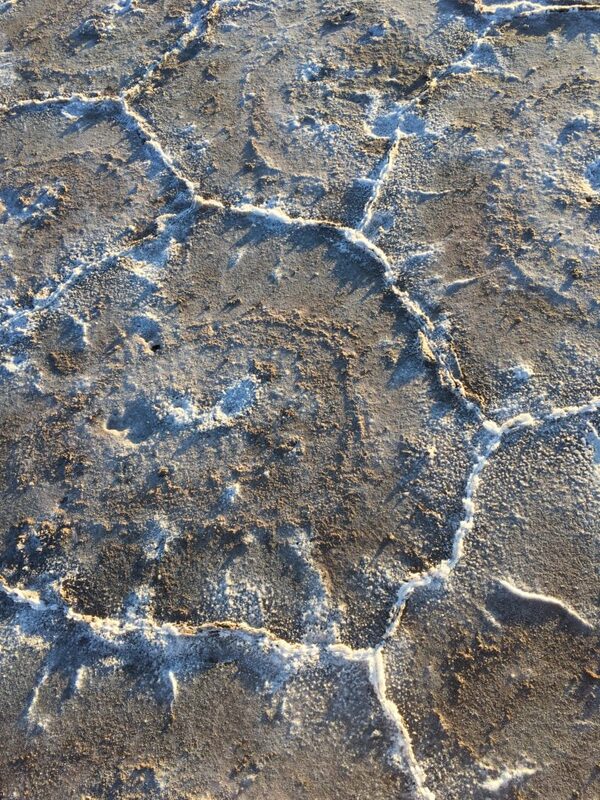
Seen from above, a cracked crust of salt and mud spreads in gray-brown plates, their seams traced with raised white mineral ridges. Low sun picks out every grain and fold, so the ground reads like a map of roads or rivers.
Item
Project
We Build Ruins
A long-term art research project that has worked since 2017 in the industrialized high-altitude deserts of northern Chile's Atacama. There, copper and lithium mining for global supply chains reshapes a former seabed with rare geologic and living systems. Drawing on intensive fieldwork, the artists build multichannel sound, video, photography, live audiovisual performance and installation, and use mirage and perceptual distortion rather than documentary to question the idea of the desert as wasteland. They also note that the region has served as a Mars-analog test site. Works include Salar: Evaporation (2020), shown in the group exhibition Against Outer Space at UC Irvine's Beall Center for Art + Technology, and Salar: Adaptation, presented at the Santa Cruz Museum of Art & History in 2024. A feature film and an artist book are in progress.
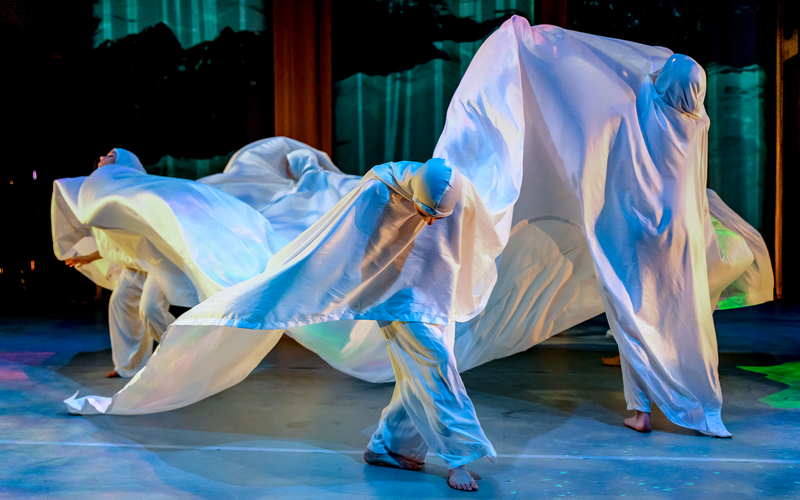
Three dancers wrapped head to foot in pale satin lean and sweep across a gray stage, their billowing cloth catching blue and gold light like a breaking wave. Behind them, teal shapes ripple across dark curtains, and bare feet press into a floor washed with faint green.
Item
Event
Your Ocean, My Ocean (YOMO: Intermedia)
An experimental intermedia performance combining dance, live music, projected media and visual design, created in response to the beauty of oceans and coastlines and to the damage human activity does to marine ecosystems. Directed by John Crawford with composer and violinist Mari Kimura and four choreographers, the roughly 80-minute work set live dancers and musicians against processed video shot at ocean and coastal sites, in four sections titled Emergence, Gyre, Oil Slick and Refuge. It premiered at the Experimental Media Performance Lab (xMPL) in UC Irvine's Contemporary Arts Center and was produced by the Institute for 21st Century Creativity, with scenic elements and animations developed in a UCI/RISD collaboratory course. An expanded version was presented at Brown University's Granoff Center in April 2019, and the project frames its aims around climate justice and the inclusion of diverse voices.
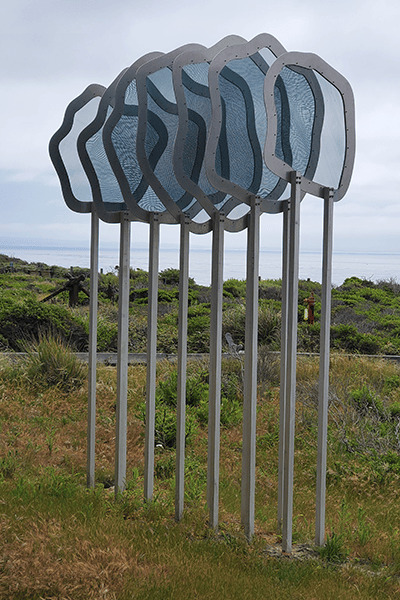
Five wavy, cloud-shaped panels of fine blue mesh, framed in gray metal, stand on slender poles above green coastal scrub. Behind them a pale ocean meets an overcast sky.
Item
Project
Gathering Cloud
A public sculpture and working fog catcher made of eight amorphous, cloud-like rings, each strung with copper mesh that weathers to a sky-blue color. Coastal fog condenses on the mesh, and the water drips into the soil below to nourish the surrounding wetland plantings. The sculpture was made by artist Anja Ulfeldt for UC Santa Cruz's Art+Fog Collective, and microbiologist and environmental toxicologist Peter Weiss-Penzias tested the water it gathered. It was installed in December 2024 in the marshlands around Younger Lagoon, just west of the Seymour Marine Discovery Center, as part of restoration efforts there.
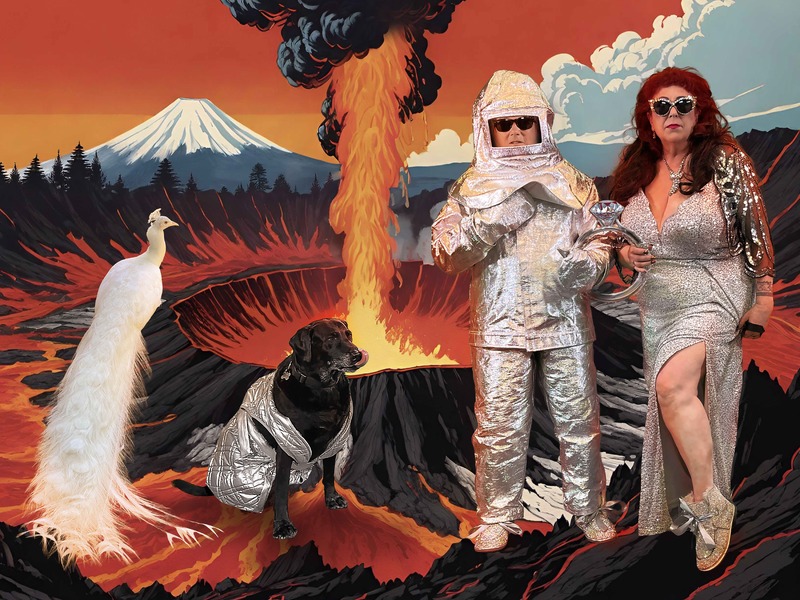
Against a painted sky of orange and black smoke, lava pours down a volcano below a snow-capped peak. In front, a white peacock with a long shaggy tail stands beside a black dog in a silver puffer coat, and two people in shining silver, one in a hooded fire suit holding an oversized diamond ring, the other in a sequined gown and dark glasses, pose amid glowing red lava fields.
Item
Project
Playing with Fire: An Ecosexual Emergency
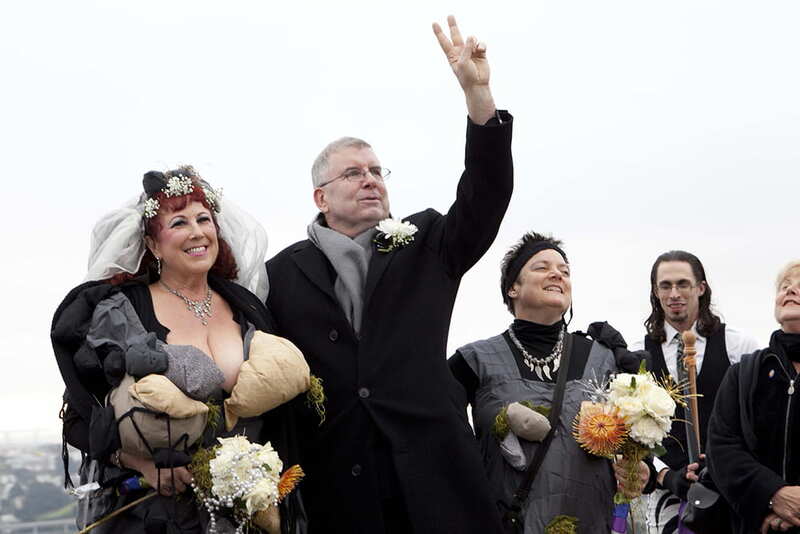
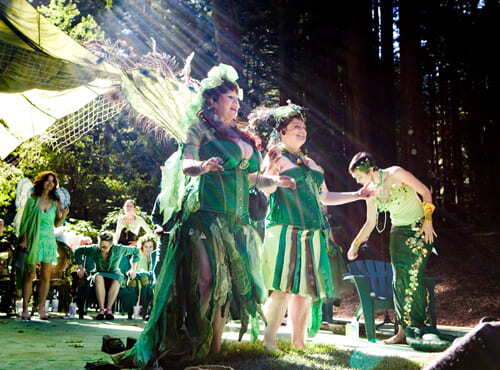
A 71-minute documentary that begins when the 2020 CZU Lightning Complex fires force Annie Sprinkle and Beth Stephens to evacuate their home in the Boulder Creek redwoods. From there, the artists approach fire as an element to relate to and care for rather than only fight. Mixing humor, grief and performance art, the film draws on firefighters (including formerly incarcerated firefighters), Indigenous scholars, ecologists, artists and a witch therapist, and part of the narration is voiced by a mythical white peacock named Albert. It connects California's wildfires and climate change to questions of social justice and ends with a ceremonial wedding to fire in the redwoods. It is the third film in the pair's ecosexual series, after Goodbye Gauley Mountain (2014) and Water Makes Us Wet (2019). It premiered at Frameline49 at the Roxie Theater in San Francisco on June 20, 2025.
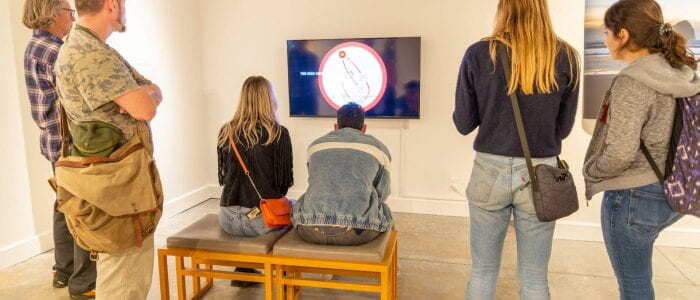
Visitors stand and sit on low wooden benches in a white gallery, their backs to the camera, facing two wall-mounted screens. On each screen a pale circle edged in red holds a faint drawing; a woman in a navy sweater and another with a patterned backpack lean in to look.
Item
Event
Beyond the World’s End
A group exhibition that treated apocalypse as something many communities have already lived through, by way of colonialism, displacement and genocide, rather than as a coming event. It brought together artists whose work traces the roots of present social and environmental injustice and imagines just, ecologically sustainable alternatives. Works included Amy Balkin's People's Archive of Sinking and Melting, Teddy Cruz and Fonna Forman's video proposal for a cross-border environmental commons at the Tijuana River estuary, Laurie Palmer's solar-powered discussion table Public Sun / Arendt's Table, and Newton Harrison's maps of Mediterranean pollution. The exhibition was guest curated by T. J. Demos at the Santa Cruz Museum of Art & History. It was the culminating exhibition of UC Santa Cruz's year-long, Mellon-funded Beyond the End of the World project, organized with The Humanities Institute and the Center for Creative Ecologies.
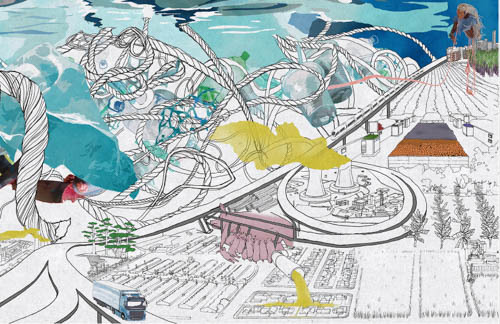
A crowded collage drawn in fine black line and washed with teal, mustard and rose: giant twisted ropes coil through a sky of torn blue paper above a gridded landscape of highways, plantations and fenced fields. A truck rolls along a road, cooling towers stand in a ring, a bucket tips yellow liquid onto rooftops, and a towering figure wades in from the far horizon.
Item
Project
Feral Atlas: The More-than-Human Anthropocene
A free, interactive online atlas that traces the ecologies that arise when nonhuman beings become entangled with human infrastructures, which its editors argue are the substance of the Anthropocene. Readers move through the atlas along routes of "detonators," "tippers" and "feral qualities." Along the way they find nearly 80 field reports by scientists and humanists alongside video, artwork, poetry and music, as well as a reading room and curriculum suggestions. The project was curated and edited by UC Santa Cruz anthropologist Anna Tsing with Jennifer Deger, Alder Keleman Saxena and Feifei Zhou, and published as a digital book by Stanford University Press. ArtReview ranked it 15th on its 2020 Power 100 list.
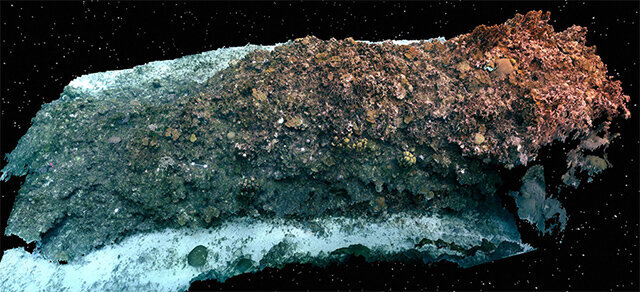
A slab of coral reef floats in black space speckled with tiny white points, as if in a field of stars. Its crusted surface shifts from slate blue to rust and coral pink, rough with knobs and branches, and a pale band of sand runs along its base.
Item
Project
Hearing Seascapes
Led by UC San Diego composer Lei Liang and Qualcomm Institute engineer Falko Kuester, this interdisciplinary initiative brings together music composition students and researchers from Scripps Institution of Oceanography to explore the creative possibilities of marine science. Through a collaborative seminar, participants translate underwater recordings and scientific imaging—including Arctic ice formations, whale echolocation, and coral reef scans—into original musical compositions and immersive experiences. Projects include a virtual reality sound installation presented at the Qualcomm Institute’s SunCAVE in 2018 and a 2019 performance by the Mivos Quartet and students featuring compositions informed by Arctic field recordings.
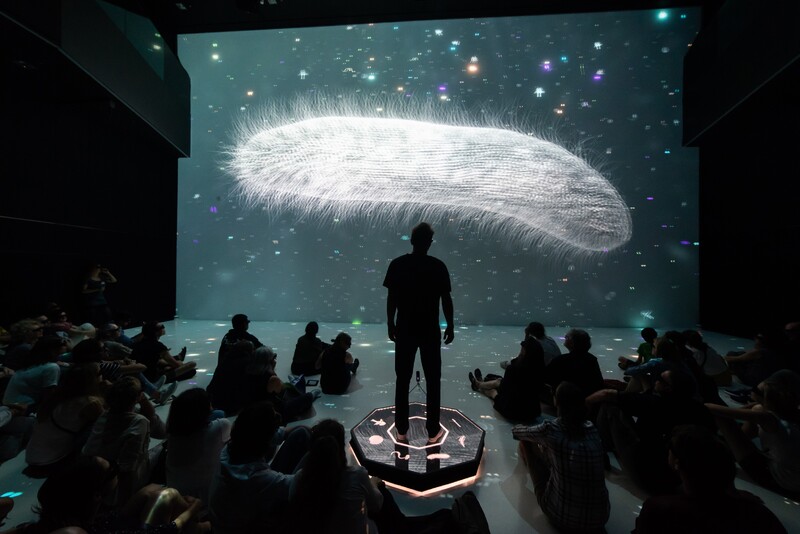
In a dark room a vast screen glows teal and star-flecked, and a pale plankton the size of a whale drifts across it, its body bristling with fine white hairs. A lone figure stands on a lit octagonal platform below, while a crowd sits on the floor in shadow, faces turned up to the light.
Item
Project
Noise Aquarium
Led by UCLA artist Victoria Vesna in collaboration with the Science Visualization Lab at the University of Applied Arts Vienna, this immersive art–science installation explores the effects of human activity on marine ecosystems. Drawing on 3D imaging of plankton and underwater sound recordings, the work transforms microscopic organisms into monumental forms while revealing the acoustic disturbances caused by ships, sonar, and offshore extraction. An interactive balance board allows visitors to influence the underwater environment through their movements, connecting physical balance to ecological vulnerability. First developed as a video in 2017, the project evolved into interactive 3D and virtual reality experiences and was presented at the 2019 SIGGRAPH Art Gallery in Los Angeles, among other international venues.
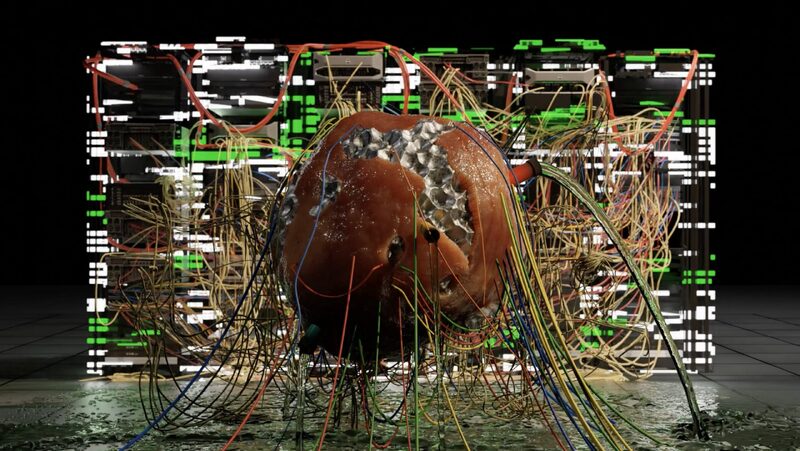
A tower of server racks flickers with white and green bars of light in a dark room. Tangled cables in red, blue, yellow and green spill from it like roots or veins and wrap around a glossy, rust-colored mass studded with silver crystals, all pooled in a glistening slick on the floor.
Item
Project
Carbonivore
A speculative hybrid creature built from roughly 2,000 pounds of e-waste gathered around the Bay Area, staged by Jill Miller and Asma Kazmi, who work together as the Missing Object Library. Cables, server racks, monitors and cooling units recreate the look of a server farm, while animated video traces the materials back to the rare earth mines they came from; smaller 'offspring' forms made of lithium, cobalt and silicon appeared on lobby monitors. The work pushes back on the idea that the cloud, big data and AI are weightless, pointing to their energy demands, extraction and labor. A first version was installed in October 2023; the full installation filled the Gray Area Gallery in San Francisco from April 22 to July 20, 2025, commissioned through Gray Area's C/Change program with Goethe-Institut San Francisco and supported in part by the UC Berkeley Center for New Media and UC Berkeley Surplus.
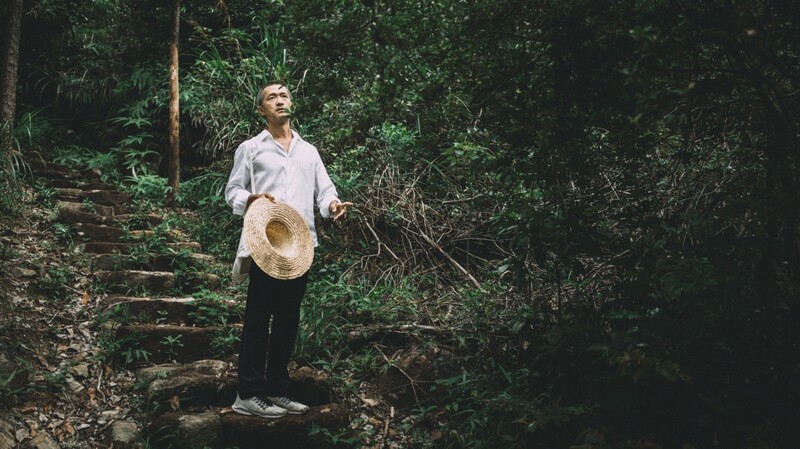
In a dim green forest, a man in a loose white shirt stands on mossy stone steps holding a wide straw hat at his side, looking up into the trees as soft light filters through the leaves.
Item
Project
Ecosensibility Exercises
A series of six guided, embodied exercises by Zheng Bo that invite participants to move beyond a human-centered view of the world and connect with other living things, especially plants. They include Collecting Tree Qi, Drinking Sun Exercise, Drawing Weeds Practice and Sacred Grove Ritual; some are the artist's own, and others draw on practices from other cultures. The series was presented in 2021 in his exhibition Wanwu Council at Gropius Bau, Berlin, and Zheng Bo is among the artists in Actions for the Earth: Art, Care & Ecology at La Galería, UC Merced (2025).
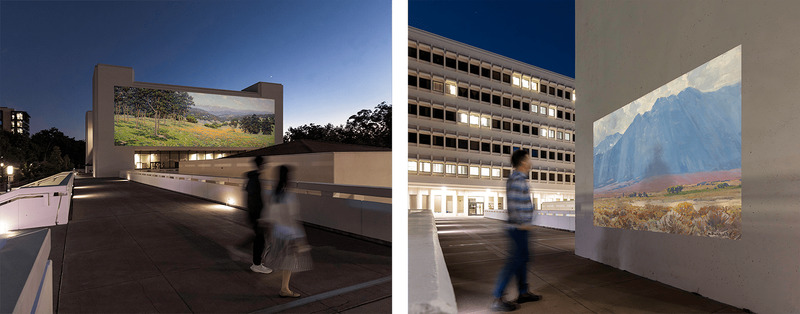
Two dusk renderings. On the left, a pastoral painting of oaks on a green hillside glows across the top of a concrete tower while blurred figures cross a walkway; on the right, blue mountains above a flowering field are cast onto a pale wall beside a lit, many-windowed building.
Item
Project
Plein-Air en Plein Air
This work is an outdoor projection-mapping installation commissioned by the UCI Jack and Shanaz Langson Institute and Museum of California Art. Over two nights in April 2024, images of late 19th- and early 20th-century California landscape paintings from the museum's collection, among them Granville Redmond's California Landscape with Flowers and Hanson Duvall Puthuff's Mystical Hills, were projected onto the buildings of UC Irvine's School of Social Sciences, setting painted light against dusk and night and building to a finale overlooking Aldrich Park. The French title means "outdoors in the outdoors"; the project was presented with the Claire Trevor School of the Arts and the School of Social Sciences. Plein-Air en Plein Air builds on the curatorial activities of another project commissioned by Langson IMCA, Beyond the Frame: Impressions of California, created by the design studio Imaginary Places. This immersive virtual presentation features images of the same 28 California Impressionist paintings and sets them in a stylized digital landscape with associated artists’ biographies, literary and historical texts, archival images, and environmental sound elements. Together, these two very different projects work to catalyze curiosity and foster conversation and exploration of California Art in the public realm.
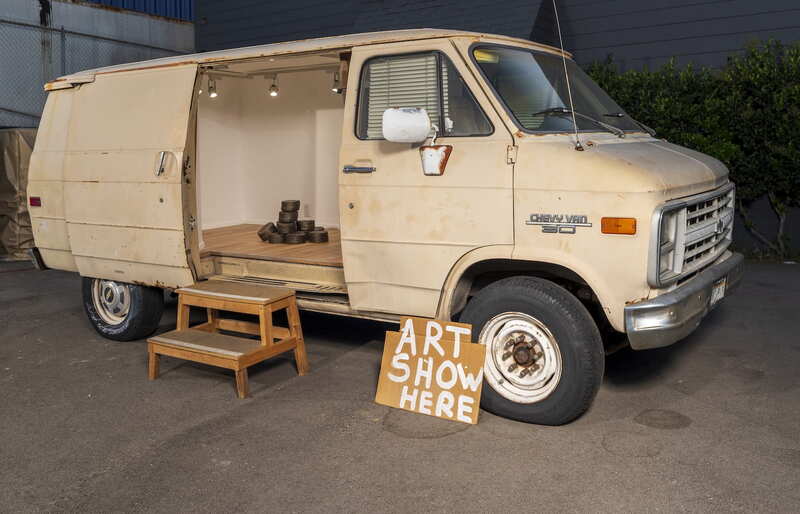
A sun-faded cream van stands with its side door slid open on a tiny white gallery lit by small lamps, a cluster of dark objects on its plywood floor. A wooden step stool leads up to it, and a hand-lettered cardboard sign propped against the front tire reads ART SHOW HERE.
Item
Event
Breakdown/Breakthrough: Art and Infrastructure
A two-part group exhibition at the UC Irvine Langson Orange County Museum of Art, curated by Michaëla Mohrmann, on Southern California's built environment and the policies and power dynamics that shape how the public experiences it, from urban neglect in Los Angeles and freeways that divide neighborhoods to the environmental cost of UC Irvine's Brutalist architecture. Part one paired newly acquired photographs from Ruben Ochoa's ficus series (2007) with works by Carlos Almaraz and Pat Gomez from the museum's collection, tracing how generations of Chicano artists have shown the harm California's infrastructure and urban policies cause to communities of color. Part two, in April 2026, was a pop-up of Ochoa's Class: C (2001), a Chevy van converted into a mobile gallery, showing work by UC Irvine artists Sean Duffy, Beatrice von Rague Schleyer and André Woodward at the Irvine Barclay Theatre Plaza.
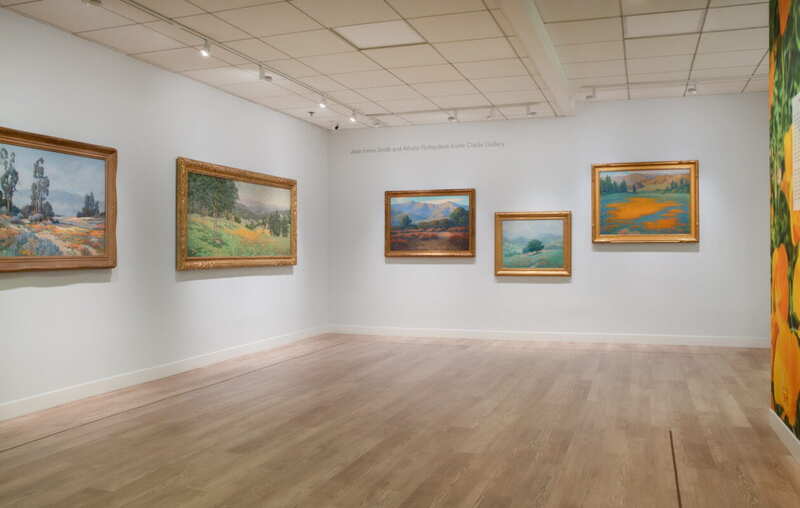
A freestanding white wall holds a large gilt-framed painting of jagged gray peaks above a turquoise lake, while more gold-framed landscapes line the pale walls beyond, across a wide floor of honey-colored wood.
Item
Event
Habitat: Making the California Environment
Curated by James Nisbet at UC Irvine’s Langson Orange County Museum of Art, this exhibition examines California’s changing ecosystems through plein-air landscape paintings from the late nineteenth and early twentieth centuries. Featuring more than 40 works drawn from the museum’s holdings and the James Irvine Swinden Family Collection, the exhibition considers how artists documented landscapes during a period preceding widespread urbanization and environmental transformation. Organized around native wildflowers, Orange County landscapes, California missions, mountain environments, and trees, the exhibition connects historical representations of place with contemporary concerns about invasive species, biodiversity, and habitat loss. California Certified Field Botanist Justin Felder contributed botanical identifications and ecological perspectives, while a newly commissioned sound installation, Landscape Hocket (Orange County) (2025), by Andrew Weathers extends the exhibition’s exploration of landscape through sound.
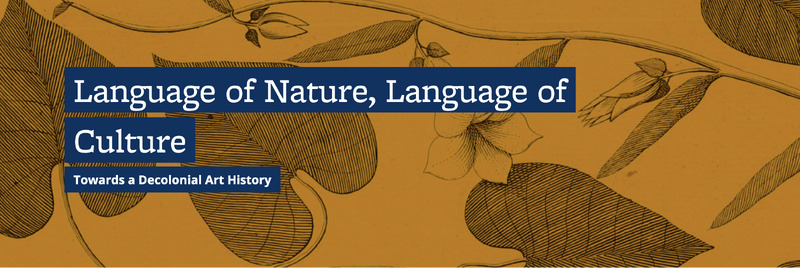
Against a warm golden-orange backdrop, delicate black botanical illustrations weave together leaves, blossoms, and winding branches. Bold white lettering on deep navy-blue panels reads “Language of Nature, Language of Culture,” with the subtitle “Towards a Decolonial Art History,” inviting reflection on the intertwined relationships between nature, culture, and artistic expression.
Item
Organization
Language of Nature, Language of Culture: Towards a Decolonial Art History
A three-year research and pedagogical project of the South Asia Art Initiative at the Institute for South Asia Studies, UC Berkeley, supported by the Getty Foundation's Connecting Art Histories initiative. It reconsiders the relation between nature and culture in art history, treating them not as opposing domains but as categories produced together through histories of matter, mobility, imagination and power. Through public programs, field-based workshops and collaborative research with a global cohort of scholars and practitioners, it aims to build a lexicon for South Asian art histories grounded in climate, decolonization and planetary thought.
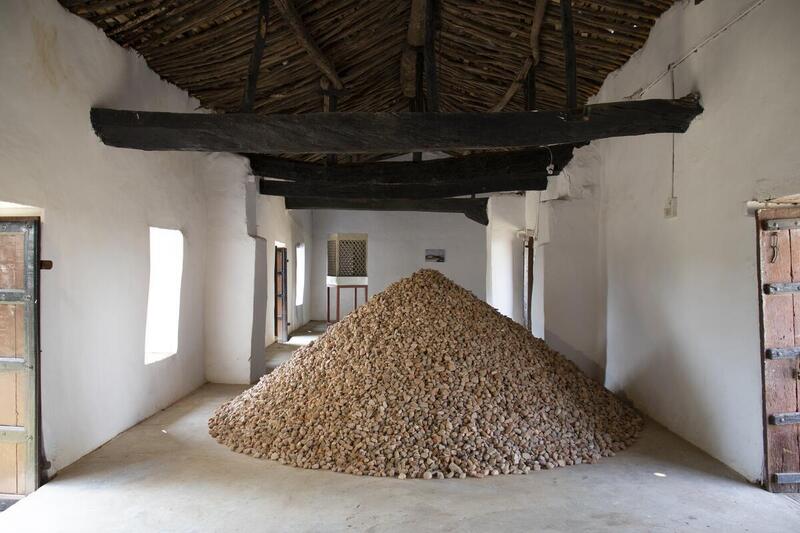
A great heap of broken brick and rubble, the color of baked earth, rises to a soft peak in the middle of a long whitewashed room. Dark timber beams cross under a ceiling of thin wooden poles, and light falls through small windows and weathered doors.
Item
Project
Heap/Hill
A floor sculpture by Anirudh Shaktawat, a heap of rubble (brick, concrete and lime) measuring 66 × 150 inches, from his series Chaumasa: Four Months of Monsoon. It is the featured image of Language of Nature, Language of Culture: Towards a Decolonial Art History, the South Asia Art Initiative's research project at UC Berkeley.
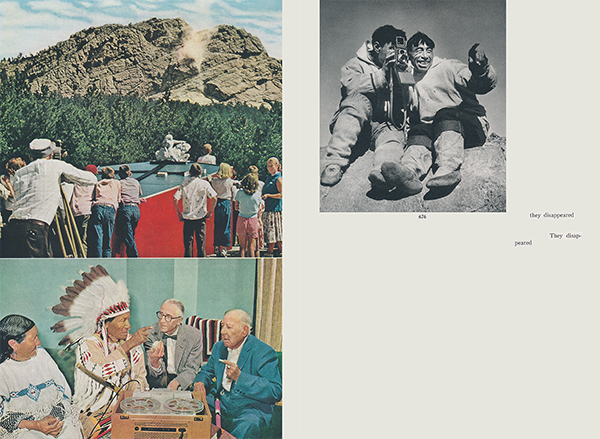
An open book. On the left, a summer crowd gathers by a red-draped platform below a granite mountain where pale dust plumes from a carved slope, and beneath it a man in a feathered headdress sits at a table with men in suits. On the right, two people in fur parkas grin on a rocky slope beside a camera, and the sparse words read: they disappeared / They disap- / peared.
Item
Project
White Gaze
An artist's book and photographic installation by Latipa (Michelle Dizon), with poetry by Việt Lê, made from an archive of National Geographic magazines from the 1960s and earlier. Dizon erased most of the text on each page, leaving fragments that form a decolonial counterpoint to the magazine's imperialist, Western-centric images of people and lands, and Lê added original poetry and a text on the legacies of war and empire. The book was published in 2018 by at land's edge (Los Angeles), Candor Arts (Chicago) and Sming Sming Books (Bay Area), and the work was exhibited at the California Institute of Integral Studies, San Francisco, from March 20 to July 31, 2018.
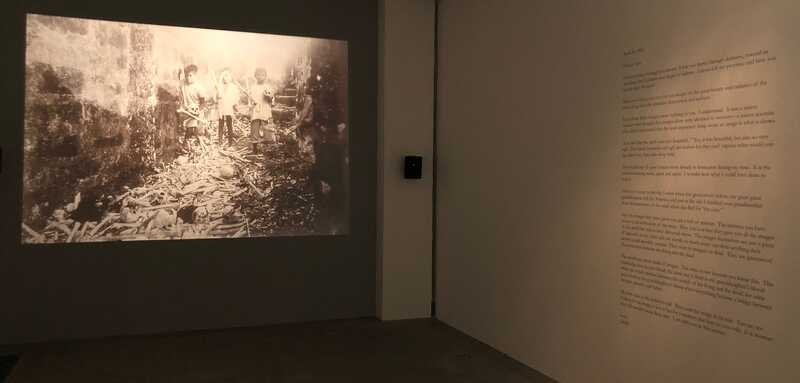
In a dark room a large projected photograph glows sepia, a tangle of figures and debris dissolving into grain. Across the corner a pale wall carries columns of text, too small to read, warmed by the projector's spill.
Item
Project
The Archive's Fold
A multi-image slide installation by Latipa (Michelle Dizon) built from photographs of the U.S. colonial and postcolonial Philippines, drawn from archives in the Philippines and the United States, the artist's family albums and the internet. It takes the form of a conversation between the artist's great-great-grandmother in 1905 and a descendant in 2123, both named Latipa; the future Latipa lives after climate catastrophe has made Earth uninhabitable and is traveling to Proxima B. Setting official archival photographs against intimate family images, the work links colonial harm to people and to the environment and traces how its effects outlast colonial rule. It was shown in the City of Los Angeles (COLA) Individual Artist Fellowships exhibition at the Los Angeles Municipal Art Gallery in 2018 and at the Gothenburg International Biennial for Contemporary Art in 2019.
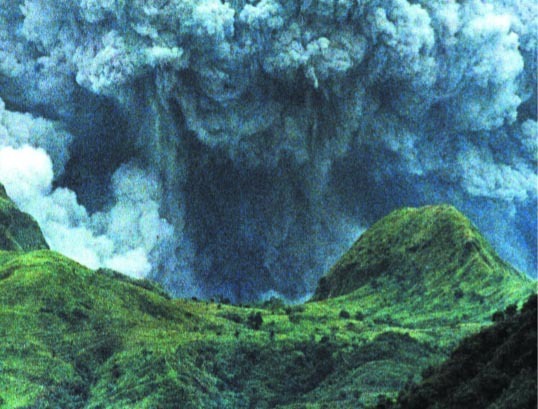
A towering column of blue-gray ash billows up behind two rounded hills furred in bright green, the cloud's underside falling in dark streaks as if the sky were raining stone.
Item
Project
Perpetual Peace
A seven-channel video installation by Latipa, then working as Michelle Dizon, from her ongoing series on imperialism, neocolonialism and globalization in the Philippines. Footage shot over four years in the Philippines is combined with archival film, philosophical, political and literary texts and field recordings, moving through sites near former U.S. military bases, multinational resource extraction, with chapters on mining, fishing and banana plantation labor, and war-torn regions of the southern Philippines. Developed as a Lab Artist project at 18th Street Arts Center, Santa Monica, and curated there by Pilar Tompkins Rivas, it was shown from June 18 to September 7, 2012, and was also presented as a live performance with narration and a live score at the Hammer Museum during Made in L.A. 2012. The artist later founded the Memory and Resistance Laboratory at UC Riverside.
Against a muted sage-green background, bold white and navy letters announce “Human Impacts Bay Area,” surrounded by circles of connection, conversation, and illumination. A microphone, speech bubbles, lightbulb, and human figures evoke collective voices and shared imagination, inviting innovation for a climate breakthrough.
Item
Event
Human Impacts Bay Area: Innovations for the Climate Breakthrough
The eighth Human Impacts Salon, an evening of multimedia conversation and live art on new approaches to climate change, from decision-making apps and video games to algae fuel, organized by the Human Impacts Institute with the Transatlantic Climate Bridge of the German Embassy. Panelists included Greg Niemeyer, Program Director of the Berkeley Center for New Media, a sponsor of the event; Georg Maue of the German Embassy; artist and educator Zakiya Harris; Joshua Sheridan Fouts of Bioneers; Jason Rissman of OpenIDEO; and Ashel Eldridge of Earth Amplified, who also performed live art with Helen Wicks.
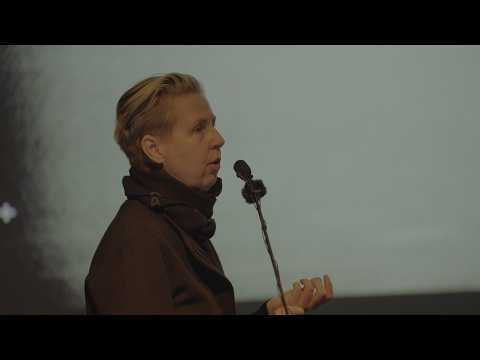
In a darkened hall, a pale screen glows with a drawing of contour lines folding like a landscape, while below it a small figure stands at a lectern washed in red light.
Item
Event
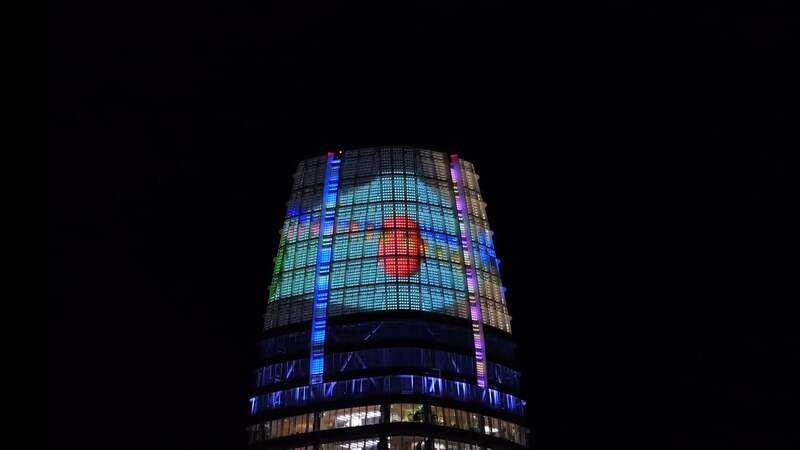
Against a black night sky, the tapered crown of a glass tower glows: a turquoise wave crosses its lit grid around a red sphere, while bars of electric blue and violet run down its sides above rows of warm office windows.
Item
Project
Synchronicity
A data animation by UC Berkeley artist and professor Greg Niemeyer, shown nightly on the crown screen of Salesforce Tower, San Francisco, throughout December 2024, and all night around the winter solstice. Built in Blender with Python, it condenses a year of open data, from the summer solstice of 2023 to that of 2024, into rhythms of the Bay Area: rainfall, wind, tides, sea surface temperature, air quality, foliage, seismic activity, solar radiation and BART ridership. The data came from NASA, NOAA, the Bay Area Air Quality Management District and the Berkeley Seismology Lab, among others, and NASA program scientist Chelle Gentemann advised on the satellite data. The work was invited through the Day for Night Monthly Artist Program.
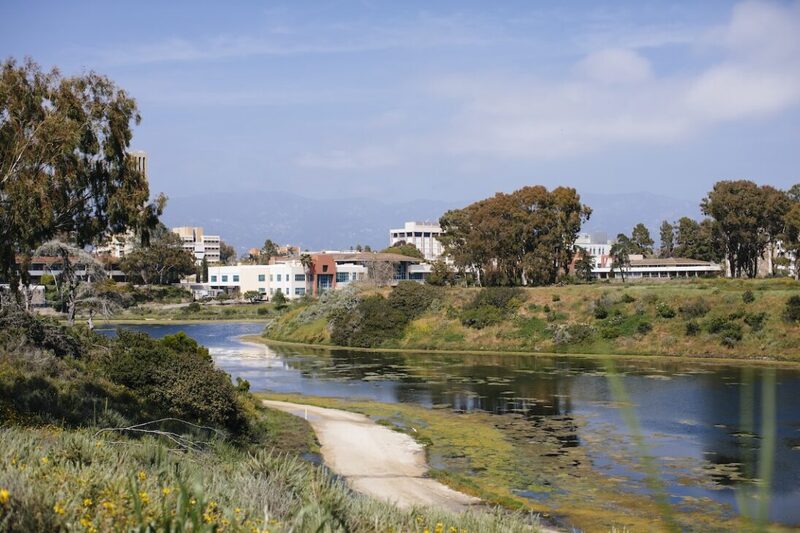
A still blue lagoon curves through coastal scrub toward low campus buildings and a stand of eucalyptus, a pale sandy path running down to the water's edge. Yellow wildflowers blur in the foreground under a soft, cloud-streaked sky.
Item
Event
Campus Lagoon & Exhibition Tour
A public program pairing a walking tour of the UC Santa Barbara Campus Lagoon, led by Katja Seltmann, Katherine Esau Director of the Cheadle Center for Biodiversity and Ecological Restoration, with a walk-through of the exhibition Jackie Amézquita: Gemidos de la Tierra at the Art, Design & Architecture Museum, led by curator Ana Briz. The museum and the Cheadle Center organized the program in conjunction with Amézquita's 2026 residency in ecological practice, which centers on native ecosystems, plant pollination and soil remediation on campus and at the Santa Cruz Island Reserve.
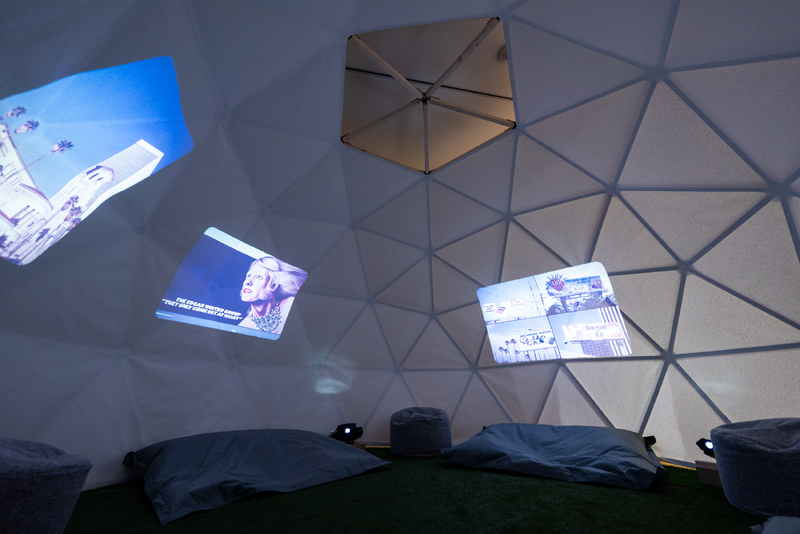
Inside a white geodesic dome, slides glow across the triangular panels: a pale tower against blue sky, a face in profile, a sunlit street. Floor cushions and low stools wait on green carpet in the dim blue light.
Item
Event
Big Bang Beat L.A.
An exhibition at the Art, Design & Architecture Museum, UC Santa Barbara, drawn from the archive of Environmental Communications (EC), a 1970s Venice Beach collective of architects, artists and sociologists who argued for an architecture of whole urban environments rather than single buildings. Through photographic slides, booklets and videos distributed to architecture schools and libraries across the country, EC documented consumer society and the counterculture that resisted it, with Los Angeles, its smog, suburbs, street art and Pop architecture, as a central subject. The exhibition also reflects on the 2025 fires in the Palisades and Altadena.
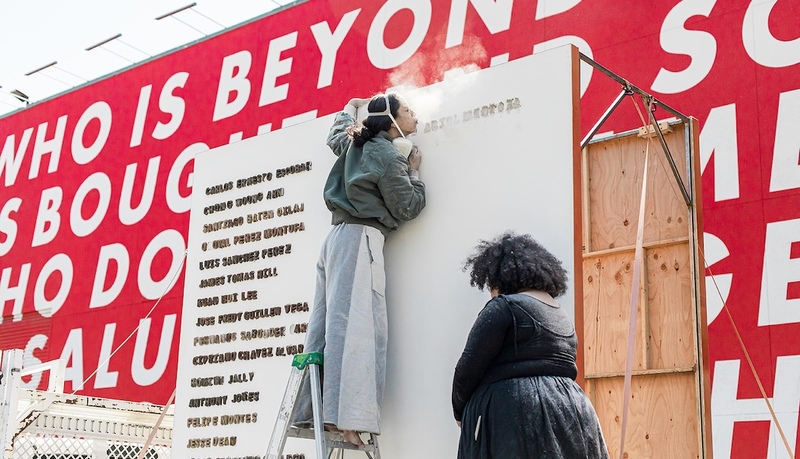
Beneath a red billboard of cropped white letters (WHO IS BEYOND, S BOUGH, HO DO, SALU), a woman on a stepladder leans into a tall white panel, a pale cloud rising at her face as she presses earth-brown letters into place. Columns of soil-cast names, too small to read, run down the panel, and a woman with a halo of dark curls watches from below beside a plywood door.
Item
Event
Gemidos de la Tierra
An exhibition at the Art, Design & Architecture Museum, UC Santa Barbara, of work by Los Angeles–based artist Jackie Amézquita, rooted in land-based methods and ancestral material knowledge. At its center is Gemidos de la Tierra (Wailings of the Land/Soil) (2020–ongoing), in which she hand-casts the names of people who died in U.S. Immigration and Customs Enforcement custody from 2003 to the present, each name made from soil gathered in the state where the person died, combined with masa, salt and rainwater. Amézquita is the 2026 Artist in Residence of Ecological Practice at UCSB's Cheadle Center for Biodiversity and Ecological Restoration, and her fieldwork on campus and at the Santa Cruz Island Reserve, on native ecosystems, plant pollination and soil remediation, informs a newly commissioned work for the exhibition. Names of people who have died in recent years are to be added during a Día de Muertos activation on November 1, 2026.
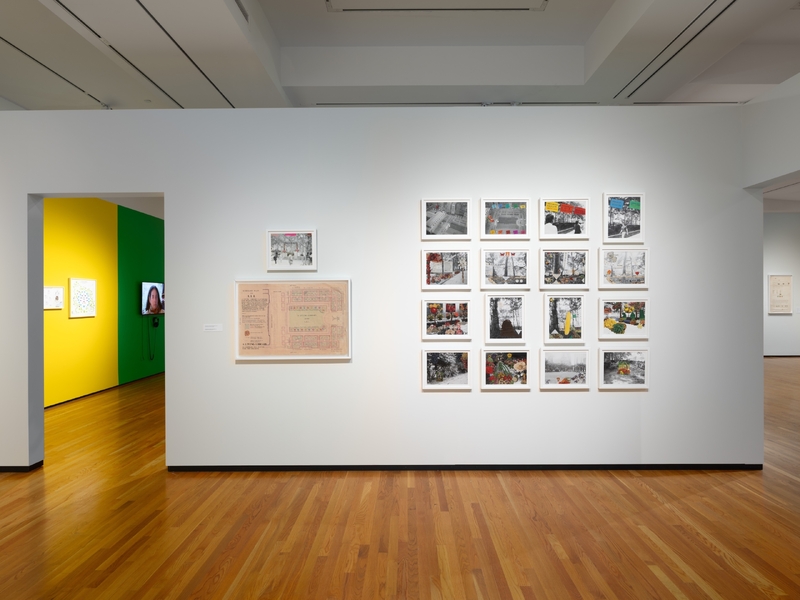
A lime-green wall holds hand-drawn site plans and stacked color photographs of gardens and people at work; beside it a cobalt-blue wall carries three more photographs thick with greenery. A round gray felt stool waits on the honey-colored wood floor, and a band of red and white stripes rises above the wall.
Item
Event
Life Frames since 1970
The first major survey of Bonnie Ora Sherk (1945–2021), an artist, environmental educator and landscape planner in the first generation of California conceptual and performance artists. It traces her work on art and ecology in public space, including Portable Parks I–III (1970, with Howard Levine), which turned San Francisco's urban "dead spaces" into temporary green environments, and The Farm (Crossroads Community), the experimental community art and ecology center she directed from 1974 to 1980 on land fragmented by freeway construction. In this exhibition, newly transferred film and video were shown with photographs, collages, works on paper, artist books and ephemera from the 1970s and 1980s. The exhibition was first organized by Fort Mason Center for Arts & Culture, San Francisco, and took place at the Art, Design & Architecture Museum, UC Santa Barbara.
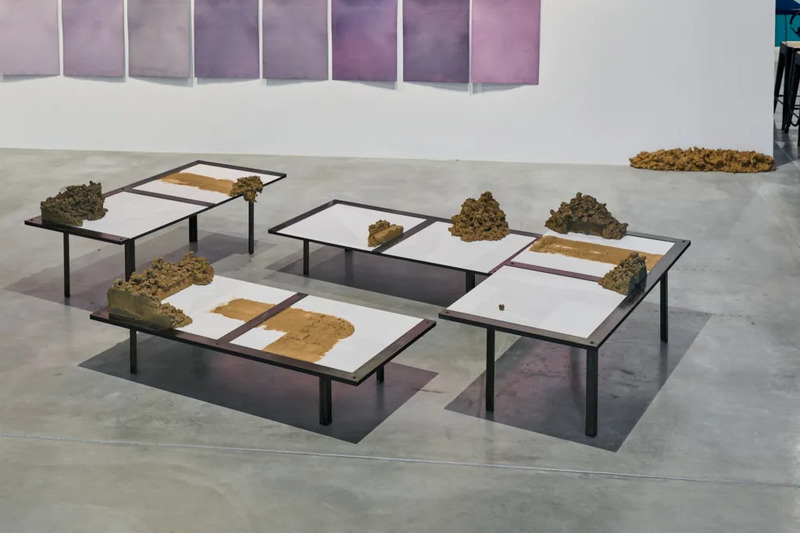
Low steel-legged tables stand in rows, each topped with white sheets and small mounds and rivulets of tan adobe, like land seen from far above. Behind them, a wall of hand-dyed paper glows in faded violet and rose.
Item
Project
Fourth Person Singular
Mounds and rivulets of adobe spread across sheets of paper laid in archival flat files, made by Christine Howard Sandoval, a member of the Chalon Indian Nation. Set out like an archive, the earth asks what records of land and memory can hold. Shown in Weather and the Whale at the Institute of the Arts and Sciences, UC Santa Cruz, alongside her The First Color Is Red.
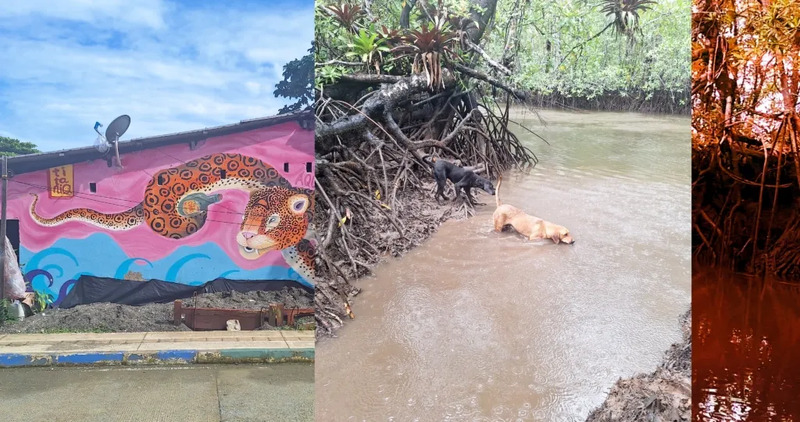
Three images side by side: a pink wall painted with a jaguar and a coiled spotted serpent under a blue sky; dogs wading a muddy brown river beneath a tangle of mangrove roots; a sliver of mangrove glowing deep red and orange.
Item
Project
aquí todo está vivo
A video by Suné Woods made after her 2024 visit to Coquí, on Colombia’s Gulf of Tribugá, where she observed humpback whale biopsies alongside marine ecologist Dr. Natalia Botero-Acosta. Centering the Afro-Colombian and Indigenous knowledge of the region, the work asks what it means to learn from other species. Shown in Weather and the Whale at the Institute of the Arts and Sciences, UC Santa Cruz.
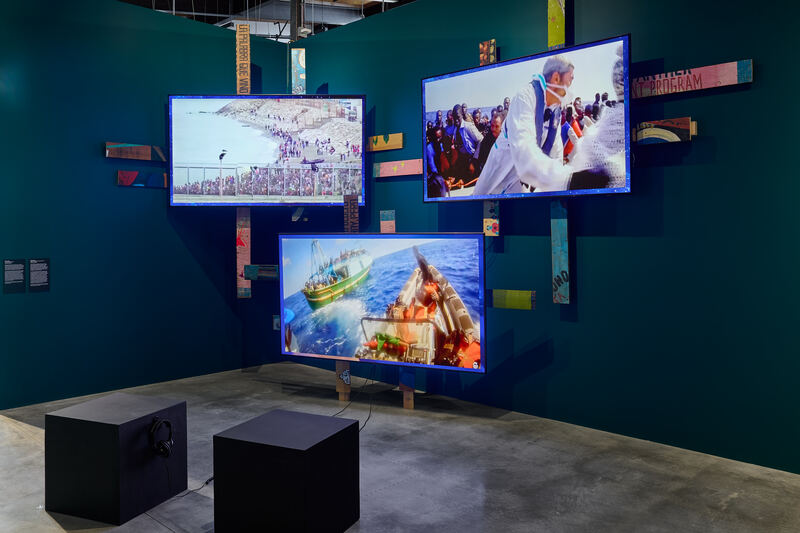
In a dark teal room, three bright screens hang at angles among colored wooden slats: crowds on a shore, a boat crowded with people on blue water, a man in white gazing out. Two black cubes sit on the floor for viewers.
Item
Project
Moontide Divination
A triptych video installation by Mia Eve Rollow that layers new footage, archival images, and news media around the tides and the symbolic life of the sea across cultures to explore ocean ecologies. One passage follows a whale fall, the carcass of a whale sustaining deep-sea life. Shown in Weather and the Whale at the Institute of the Arts and Sciences, UC Santa Cruz.
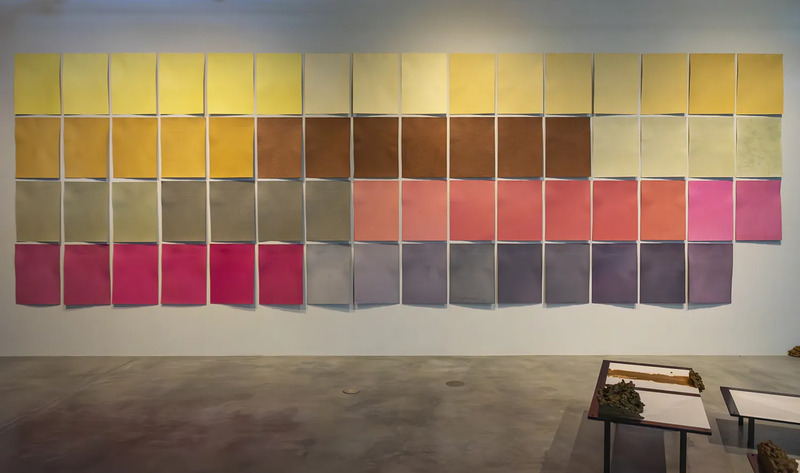
A large-scale abstract artwork fills a gallery wall with a rhythmic grid of rectangular color panels. Soft yellows and earthy browns give way to muted greens, warm corals, vibrant pinks, and smoky purples, creating a flowing tapestry of shifting hues. The gently uneven edges and subtle variations in texture bring an organic warmth to the geometric arrangement, while sculptural works rest on low tables in the foreground.
Item
Project
The First Color Is Red
Sixty-three pages of hand-dyed paper by Christine Howard Sandoval, a member of the Chalon Indian Nation, blind-embossed with faint phrases in her Chalon Ohlone ancestral language. Rising across the wall in bands of color, the pages touch on plant medicine, Indigenous knowledge, and the harms of colonization. Shown in Weather and the Whale at the Institute of the Arts and Sciences, UC Santa Cruz, alongside her Fourth Person Singular.
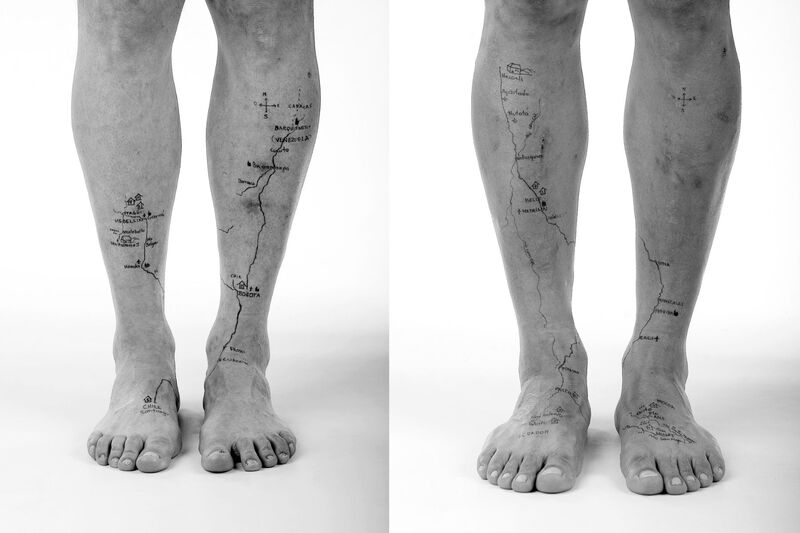
Two black-and-white photographs of bare legs and feet standing on white. Fine ink lines climb the shins like rivers and roads, small marks and words tracing the long way each woman walked.
Item
Project
Signos Cardinales
Photographs of the legs and feet of displaced women in Medellín, Colombia, by Colombian artist and physician Libia Posada, each marked with an inked map of the journey that took the woman from her home. The maps trade compass points for right and left and measure distance in strides, recording displacement as it is carried in the body. Posada first exhibited Signos Cardinales in 2009; this version was shown in Weather and the Whale at the Institute of the Arts and Sciences, UC Santa Cruz.
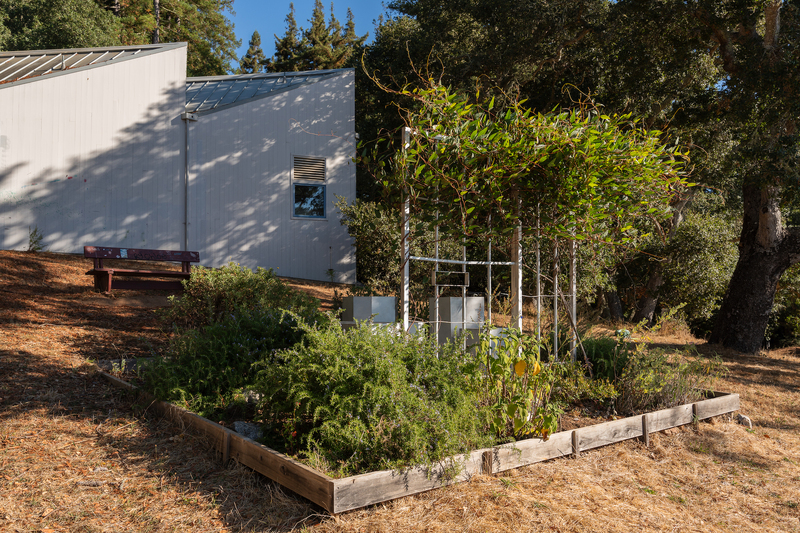
A raised garden bed thick with green herbs and shrubs sits on a ground of dry pine needles, a slender trellis rising from its center. Behind it, a pale gallery building and tall dark trees catch the late afternoon sun.
Item
Project
Solitary Garden
A garden built within the footprint of a solitary confinement cell and planted at the Institute of the Arts and Sciences, UC Santa Cruz, by artist and prison abolitionist Jackie Sumell in collaboration with Tim Young. Part of Sumell’s Solitary Gardens project and the IAS Visualizing Abolition initiative, the work turns the architecture of isolation into a space of growth and care.
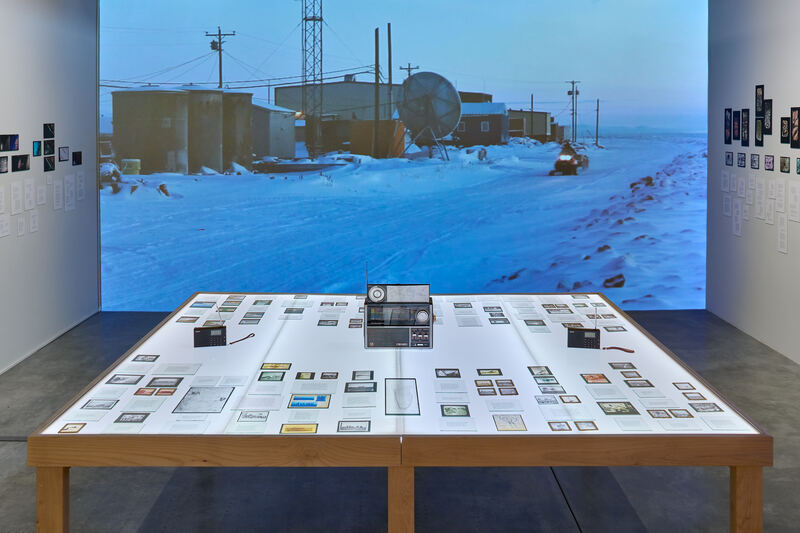
A wall-sized photograph of a snowbound Arctic village fills the gallery: low buildings, a satellite dish, power poles in blue winter light. In front, a long lit table is laid with rows of small photographs and documents, a radio resting among them.
Item
Project
Distant Early Warning
A multimedia installation by Sharon Daniel that traces the climate crisis as lived in Kivalina, an Iñupiat village on a barrier island in northwest Alaska, through oral testimonies, archival images, and ice core scans. A long lit table holds photographs, documents, timelines, and a vintage radio beneath a wall-sized image of the village. Shown in Weather and the Whale at the Institute of the Arts and Sciences, UC Santa Cruz.
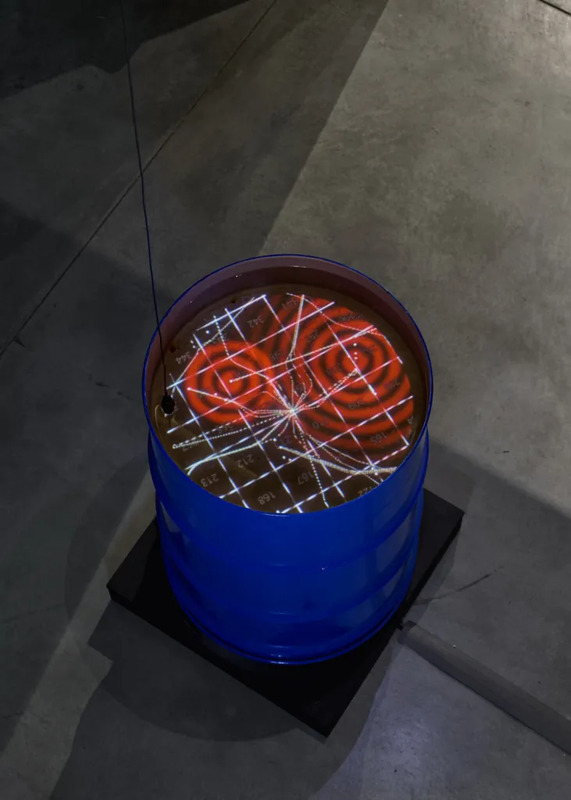
From above, a cobalt-blue oil drum stands open on a black plinth, its skin of water lit with red rings and a white web of crossing lines, like a sonar screen sunk inside it. A thin cable drops from the dark to listen.
Item
Project
Untitled, or, They’ve been singing since the gulf was born
A sound and video installation by the Whale Liberation Front, the collective of Imani Jacqueline Brown, Cory Diane, and Peter J. Bowling, that imagines how whales in the Gulf of Mexico experience the seismic airgun blasts used to search for oil and gas. Water fills an inverted oil drum with images playing across its surface and a hydrophone hanging above it, beside a hand-painted map of the Gulf marked with alternative place names. Members of the collective also performed a live electroacoustic piece with zither, synthesizers, voice, water, and rare recordings of Gulf whale song at the Institute of the Arts and Sciences, UC Santa Cruz.
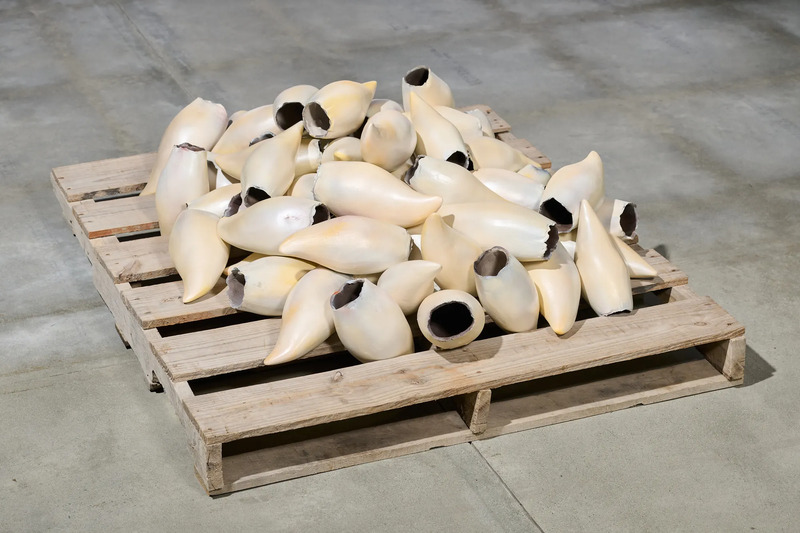
On a bare concrete floor, a weathered wooden pallet carries a heap of pale ceramic teeth, curved and pointed, some hollow and dark at the root, piled like cargo waiting to ship.
Item
Project
BREACH #2
Sixty ceramic sperm whale teeth heaped on a wooden shipping pallet, part of the BREACH series that Shinnecock artist Courtney M. Leonard began in 2014 to explore the many meanings of the word breach. Shown in Weather and the Whale at the Institute of the Arts and Sciences, UC Santa Cruz, the work questions US environmental policy and economics and points to the role of industrial shipping in whale deaths.
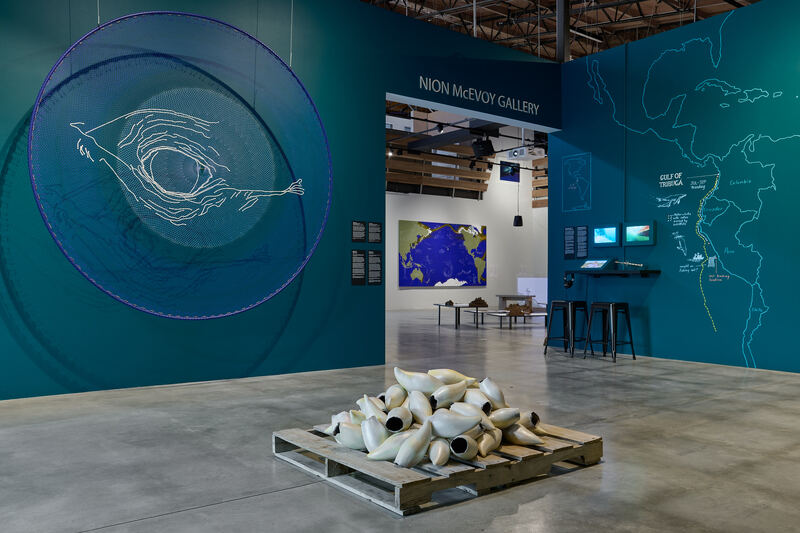
A great circle of netting hangs on a deep teal wall, a whale’s eye stitched into it in fine pale thread, watching. Below, on a shipping pallet, sixty pale ceramic teeth lie heaped like a jaw let go. Beyond the doorway, an ocean map glows blue.
Item
Project
When Whale looks at Human
A handmade fishing net embroidered with the eye of a humpback whale, made by artist Carolina Caycedo for Weather and the Whale at the Institute of the Arts and Sciences, UC Santa Cruz. The net turns the whale’s gaze back on the viewer, pointing to how commercial fishing gear entangles and kills whales while honoring small-scale subsistence fishing as a more sustainable way of living with the sea.
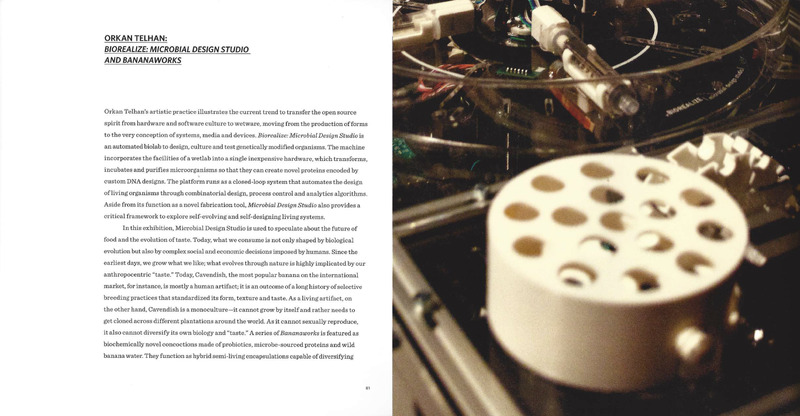
An open catalogue spread. On the left, a page of text headed “Orkan Telhan, Biorealize: Microbial Design Studio and Bananaworks.” On the right, a close photograph of a lab machine glinting in dim light, a nest of clear tubing, clamps, and glass vessels where microbes are grown.
Item
Event
WETWARE: art | agency | animation
An exhibition at the Beall Center for Art + Technology, UC Irvine, curated by David Familian and Jens Hauser, on synthetic biology and wetware, in which artists use laboratory methods to come close to life. The works included synthetic amino acid necklaces, protocells that mimic the movement of phytoplankton, bacteria that generate power for a synthesizer, a desktop gene machine, and an artificially grown brain in a vat, and Evelina Domnitch and Dmitry Gelfand and Anna Dumitriu made new works in residencies developed with UC Irvine research centers. Questioning human-centered views of engineered artificial life and the responsibilities they carry, the show asked how aliveness is defined in terms of components, circuits, and systems.
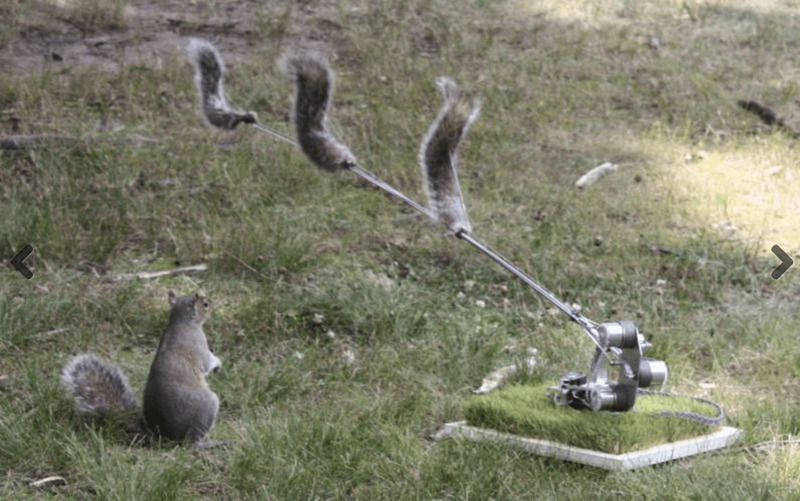
On a sunny lawn, a gray squirrel sits up on its haunches, watching a small robot on a square of turf. The robot’s long metal arm waves a bushy tail, caught in several blurred positions as it flicks, as if trying to speak squirrel.
Item
Event
Ian Ingram
A mid-career survey at the Beall Center for Art + Technology, UC Irvine, curated by David Familian, of Ian Ingram's robotic objects from 1998 to 2021, which borrow the forms and behaviors of animals and are often made to live alongside them and speak with them in their own habitats, from earlier robots built for a raven, a lizard, or a worm to Danger, Squirrel Nutkin! (2009) and Duck, Duck, Goose (2007). New work made during his residency at the Beall's Black Box Projects turned to synanthropic animals, especially rats, that live closest to people, and to how they use built environments in search of facsimiles of ancestral landscapes, probing the boundary between constructed and grown places and the possibilities of interspecies communication and coexistence. During the run, the Beall's 2022 Art + Ecology series brought Ingram into conversation with collaborators Steve Mahler and Charissa Terranova in Just Your Garden Variety Robots, alongside talks by Carolina Caycedo and land artist Hans Baumann.
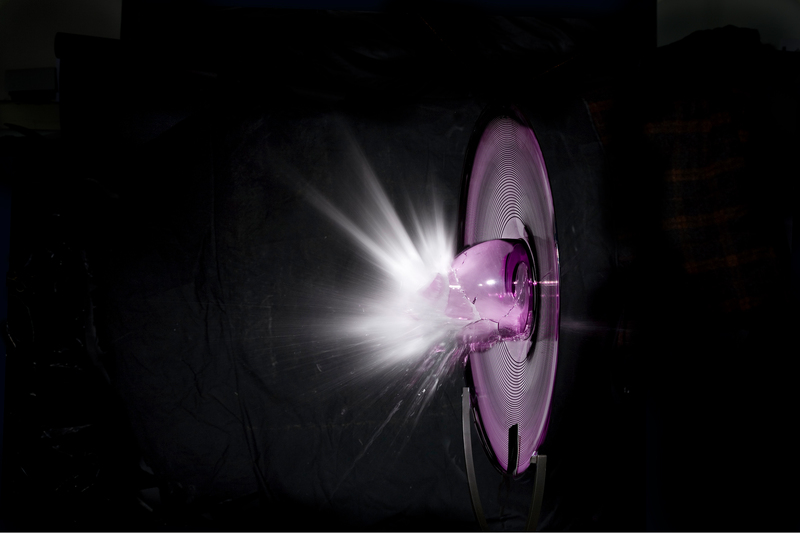
In near darkness, a burst of white light explodes from the edge of a glowing pink-violet disc, shards streaking outward like a star caught in the instant of breaking.
Item
Event
Engaging the Margins
An exhibition at the Beall Center for Art + Technology, UC Irvine, co-curated by Antoinette LaFarge and Jesse Colin Jackson, presenting artists who experiment in the marginal areas where art-making, practice-based research, and scholarship meet. Some stage their work in laboratories, some in studios, and some in wild or abandoned landscapes, and together they question how culture continues to marginalize artists who work across disciplines. Their subjects range across glacial ice, fungal life, nuclear waste, genetics, and settler colonialism. Krista-Leigh Davis's performance video No Claim to the Blue-Green Bloom (2023) follows life-size microbes through the wilderness as they adapt to a toxic environment, and Jennifer Willet's Gentleman Scientist: Microecologies (2023–25) turns to microbial ecologies. The artists were featured in LaFarge and Jackson's anthology Experimental Practices in Interdisciplinary Art: Engaging the Margins (Brill, 2024), which launched with the exhibition.
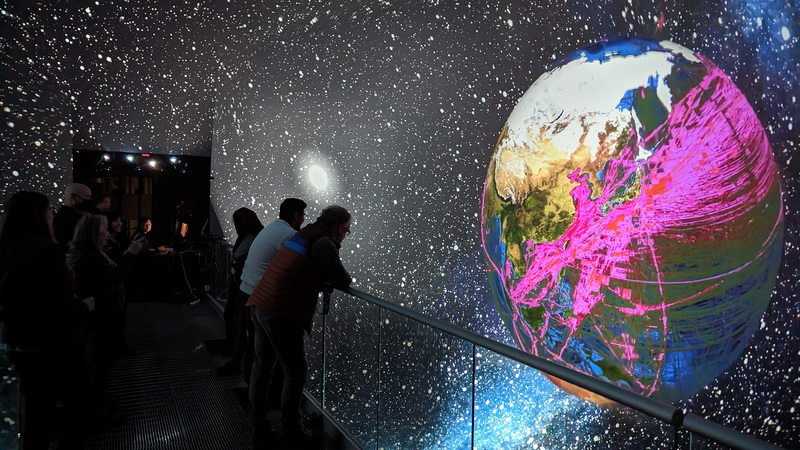
Visitors stand on a narrow bridge inside a dark sphere scattered with stars, facing an enormous glowing Earth whose oceans are streaked with bright magenta data, as if the planet were showing its pulse.
Item
Project
Sketches of Sensorium
An immersive installation built from core elements of Sensorium for the World Ocean, the long-term project of the late environmental artist Newton Harrison (1932–2022), directed by Joshua Harrison with Dr. JoAnn Kuchera-Morin. It premiered in 2024 at the AlloSphere, a three-story spherical research instrument in the California NanoSystems Institute at UC Santa Barbara, as a satellite to the UC Irvine Beall Center's Getty PST ART exhibition Future Tense: Art, Complexity, and Uncertainty, and ran by reservation into April 2025. With an original spatialized composition and an interactive data world, it turns climate and ocean-health data from the Ocean Health Index of the Halpern Lab at UCSB's Bren School of Environmental Science & Management into a multisensory experience, modeling how deepwater fishing, atmospheric particulates, weather, and other natural and human forces interact to shape the ocean, along with the political, economic, and social pressures upon it. True to Harrison's intent, it aims to leave audiences with a sense of hope. A project of the Center for the Study of the Force Majeure with Virtual Planet Technologies, Almost Human Media, and the AlloSphere Research Group.
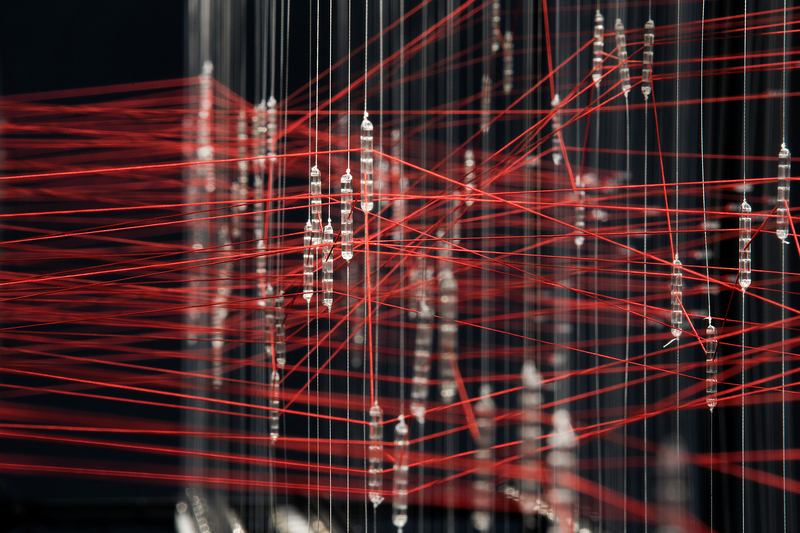
In darkness, taut red lines cross and recross a field of hanging pale threads, each strand weighted and trembling, a mesh of tension that looks like a nervous system or a weather map drawn in string.
Item
Event
Future Tense: Art, Complexity, and Uncertainty
The Beall Center for Art + Technology's exhibition for Getty's PST ART: Art & Science Collide, curated by David Familian, offering artistic frameworks for understanding complex systems, which churn between order and chaos and generate feedback loops, self-organization, and uncertain behavior. From climate change and global warming to evolutionary biology, bacterial intelligence, data surveillance, financial collapse, and immigration politics, the works considered phenomena too entwined to be observed individually. Gail Wight explored how ocean acidification drives rapid evolution in aquatic microbial communities, and Theresa Schubert examined how the expansion of digital infrastructure feeds global temperature rise. Laura Splan, Chico MacMurtrie, Hege Tapio, Gail Wight, and the collective Cesar & Lois created new commissions through the Beall's Black Box Projects residency, which pairs visiting artists with UC Irvine researchers. A satellite installation, Sketches of Sensorium, drawn from Newton Harrison's Sensorium for the World Ocean, was presented at the AlloSphere at UC Santa Barbara.
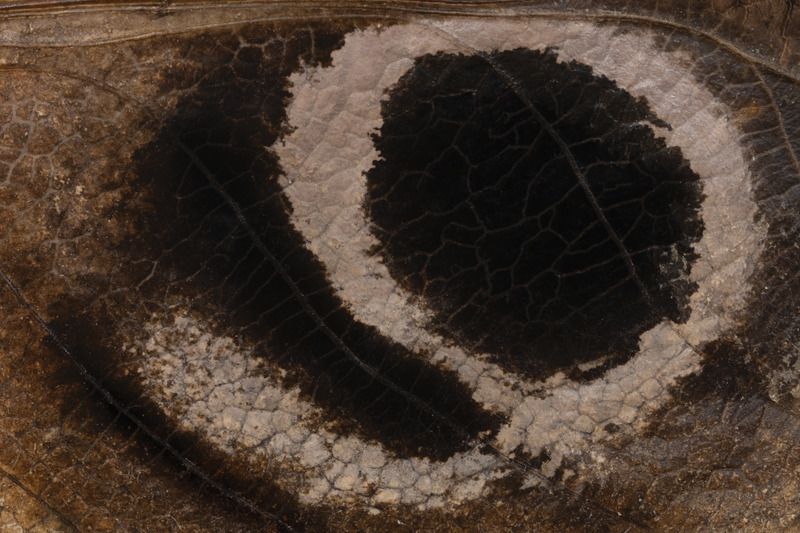
A close view of rough brown rock, cracked and grained, where a pale ring of crusted white mineral circles a dark hollow, like an eye or a footprint pressed into stone long ago.
Item
Event
Ecotechnics
An exhibition at the Beall Center for Art + Technology, UC Irvine, curated by Zachary Korol Gold, that traces a sensibility among contemporary artists who treat ecology not as a settled set of facts but as a system of images. Eleven artists, among them Lauren Bon, Maru García, Sean Raspet, Jeffrey Stuker, and Diana Thater, take divergent paths through the technologies, histories, and fictions by which environments and organisms are known. By turning the technical images and devices used to measure environments back on themselves, their works picture how contemporary society produces its ecological view, and the exhibition asks how people, through technology and as technical beings, sense and represent the living world.
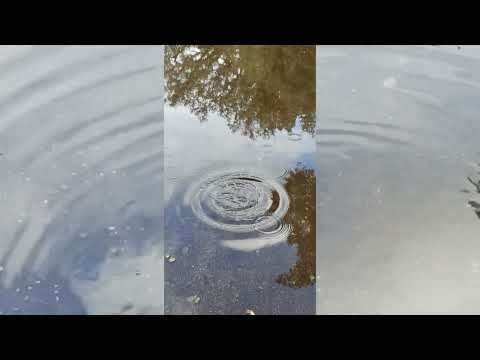
Video still: three panels of still water, rings spreading from a single drop across reflections of sky and dark leaves, as if the surface were breathing.
Item
Event
Breath, Soil, Water, Life
A live performance at the Manetti Shrem Museum of Art, UC Davis, created by students in African American Studies 152: Major Voices in Black World Literature, taught in the museum's galleries by Professor Margaret Laurena Kemp, chair of the Department of Theatre and Dance, during the 2025 run of Breath(e): Toward Climate and Social Justice. Through a multimodal curriculum, students read Tina Campt's Listening to Images, Claudia Rankine's Don't Let Me Be Lonely, and LaToya Ruby Frazier's Flint Is Family in Three Acts, which documents the Flint water crisis, and explored writing, singing, and dance with Professor Bhumi Patel, using breathwork as a way of staying grounded while engaging climate and social justice. The course culminated in a public performance in the galleries alongside Frazier's photographs, a meditation on breath, identity, resistance, and the power of listening that wove poetry, movement, and voice to confront injustice and affirm resilience, agency, and spirit. Students' responses were also added to the exhibition as a soundscape visitors could reach by QR code, and the museum documented the project in a short video.
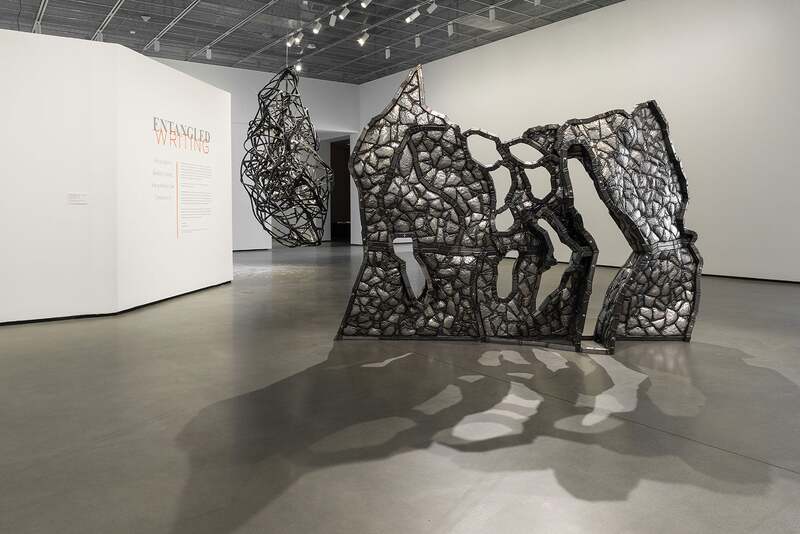
A tall screen of dark steel stands on the gallery floor, its openwork of rounded cells and jagged peaks like the edge of a glacier or a floe breaking apart, throwing a lacework of shadow across the concrete. Behind it a black cocoon of cable hangs from the ceiling, and a white wall reads “Entangled Writing.”
Item
Project
Adrift in a Mirrored Sea (Hansbukta)
A large steel sculpture by Beatriz Cortez, associate professor of art at UC Davis, commissioned for the exhibition Entangled Writing (August 8 – December 29, 2024) at the Manetti Shrem Museum of Art, curated by Susie Kantor. Measuring twelve by eighteen feet, the work belongs to Cortez's exploration of life across different times and possible futures, drawing on whaling history, icebergs, and a volcanic eruption in El Salvador; its title names Hansbukta, a bay on Svalbard in the Norwegian Arctic. The exhibition grew from early conversations between Cortez and Los Angeles artist Phillip Byrne, and in the galleries her sculpture stood in conversation with his Before We Become Spirals, made from salvaged transoceanic cable casings, asking viewers to consider what humans leave behind.
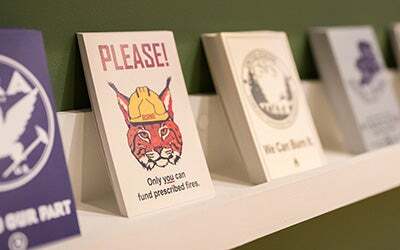
A row of postcards leans on a shelf against an olive-green wall. In front, a bobcat in a yellow firefighter’s helmet looks out from a white card that reads “PLEASE! Only you can fund prescribed fires.” Beside it, cards read “We Can Burn It” and “… our part.”
Item
Event
Pyro Futures
An exhibition at the Manetti Shrem Museum of Art, UC Davis, on how fire and fire stewardship could reshape California's landscapes. It was created by UC Davis landscape architecture and environmental design professors Brett Milligan and Emily Schlickman and grew from their book Design by Fire: Resistance, Co-Creation, and Retreat in the Pyrocene (2023). Built in collaboration with artists and ecologists, it gathered images and objects on the history of wildfire in the western United States, including firefighting helmets and burnt objects, a projected video of prescribed burns, and a large glass case staging three possible fire futures, ranging from Indigenous land stewardship and cultural burning reshaping the U.S. Forest Service to worsening megafires if emissions go unchecked. Visitors pinned their homes on a large map of high fire-risk zones, shared their own experiences of wildfire in journals, and took home fire-themed postcards proposing alternatives to Smokey Bear, among them Burnie the Bobcat, a mascot who would light good fires rather than fight them. A billboard on Interstate 80 between Sacramento and Davis carried the message “Only you can decide our fiery future,” and an online journal at pyrofutures.com extended the conversation beyond the museum.
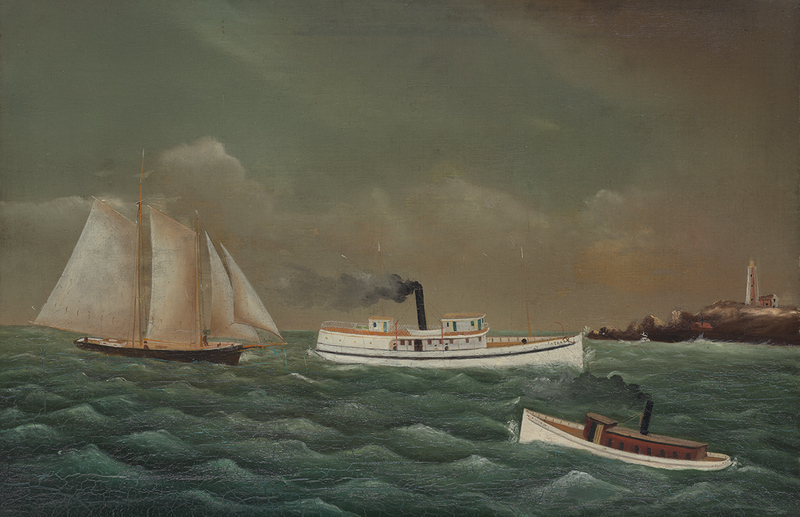
Under a heavy olive-green sky, a tall sailing schooner leans into the wind while a white steamship and a small red-cabined tug push through churning green waves, black smoke trailing from their stacks. Far off on a rocky point, a lighthouse stands watch.
Item
Event
Five Tables of Art & Climate Change
A one-afternoon presentation at BAMPFA curated by first-year students in UC Berkeley Professor Sugata Ray's Fall 2023 College of Letters & Science First-Year Pathways course, Art and Climate Change. Using the museum's Five Tables format, the students set out works from the BAMPFA collection that reflect, mediate, and delve into the interconnected ecologies of life, asking what art, architecture, design, and performance can offer to debates on climate change and environmental justice in a time of nuclear disasters, acid rain, and mass extinction. Moving from early modern landscapes and colonial photography to contemporary art and eco-activism, the selection explored decolonial histories and radical futures attentive to Indigenous epistemologies, interspecies friendships, the desires of nonhuman life forms, and other ways of being marginalized by colonialism, capitalism, and the economies of natural resource extraction. Among the works was Marine Scene (1840), an oil painting by an unknown artist of sailing ships and steamships together on a rough sea.
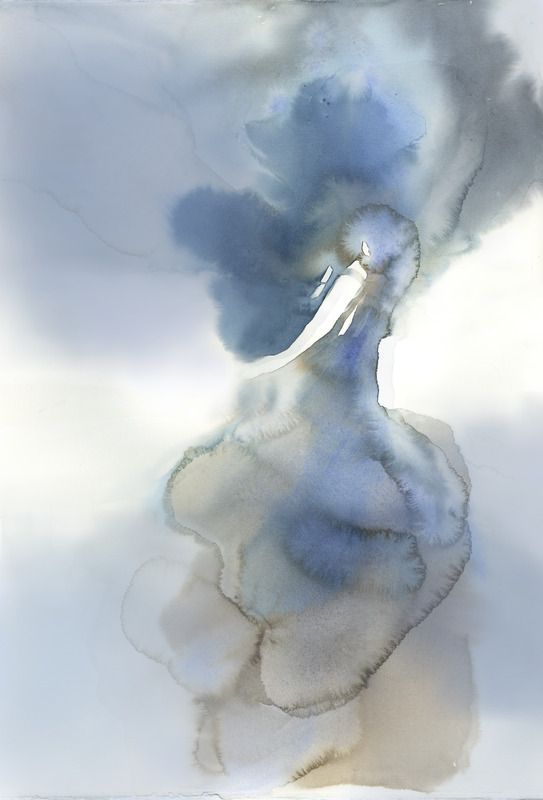
Soft washes of blue, slate gray, and sand bloom and bleed across white paper like water spreading over a riverbed, and somewhere in the drift a small pale figure floats, held by the current.
Item
Project
The LA River Project
The Los Angeles River is one of the most threatened rivers in the United States, much of it confined to a concrete channel in the name of flood control and progress. Juniper Harrower’s LA River Project draws on more than 2,000 environmental DNA experiments and long conversations with people who care for the river, an approach the artist describes as listening more than collecting. Working with museum-held specimens, Harrower took only minimal samples and imaged them under an electron microscope. Those images, gilded and drawn, wind through a 14-foot painted riverscape in which water, willow, and coyote merge into a single body. The work proposes a science practiced in relation to the river rather than through extraction, and gestures toward the rematriation movements of the Gabrielino/Tongva and Tataviam peoples. Two works from the project were shown in the Fifty-Third Annual UC Berkeley Master of Fine Arts Graduate Exhibition at BAMPFA (May 10 – July 23, 2023): the painting Resting and raging through histories of containment, made with Los Angeles River water, watercolor, ink, graphite, California-sourced gold dust, and scanning electron imagery in research collaboration with CALeDNA; and Necklace for a River, a necklace made with Savannah Hunter Jewelry whose beads hold specimens of the river's animals and plants, from red-eared slider turtle and western toad to great blue heron, red willow, and Pacific salmon, strung with Los Angeles River concrete and steel beads used in DNA extraction. The necklace specimens were ethically sourced from the Norris Center for Natural History at UC Santa Cruz, with support from OpenLab and the UC Santa Cruz Genomics Institute.
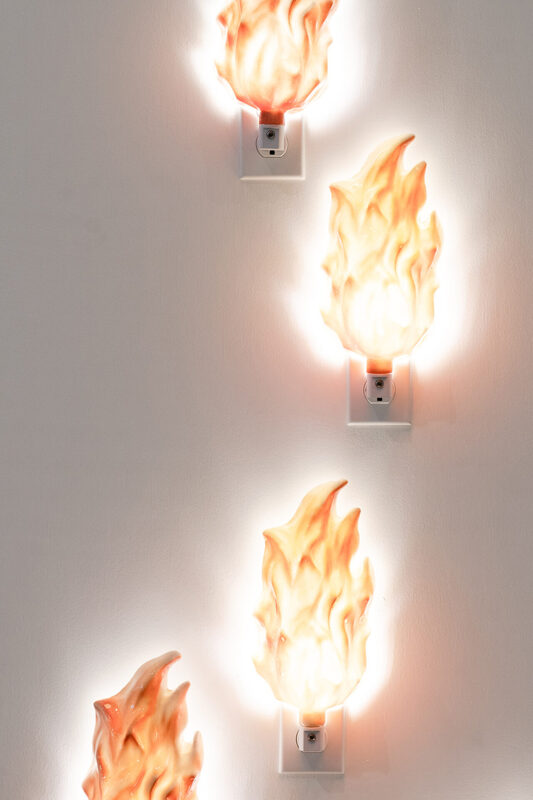
Close up, a porcelain flame plugged into a wall outlet glows like a nightlight, its thin, curling tongues of orange and gold lit from behind. Below it a second flame burns softly on the white wall, a small comfort that is also a warning.
Item
Project
for those that would sleep
An installation by Samuel Wildman that covers a gallery wall with nightlights, each topped with a cast porcelain flame, arranged in the pattern of a map of major California wildfires. Turning a familiar object of comfort into a warning, the work is what Wildman calls an expression of “the affective experience of climate change.” It was shown in the Fifty-Third Annual UC Berkeley Master of Fine Arts Graduate Exhibition at BAMPFA (May 10 – July 23, 2023), alongside his altered tiles and soap dishes on the ties between consumption, comfort, and the policies that govern water and waste.
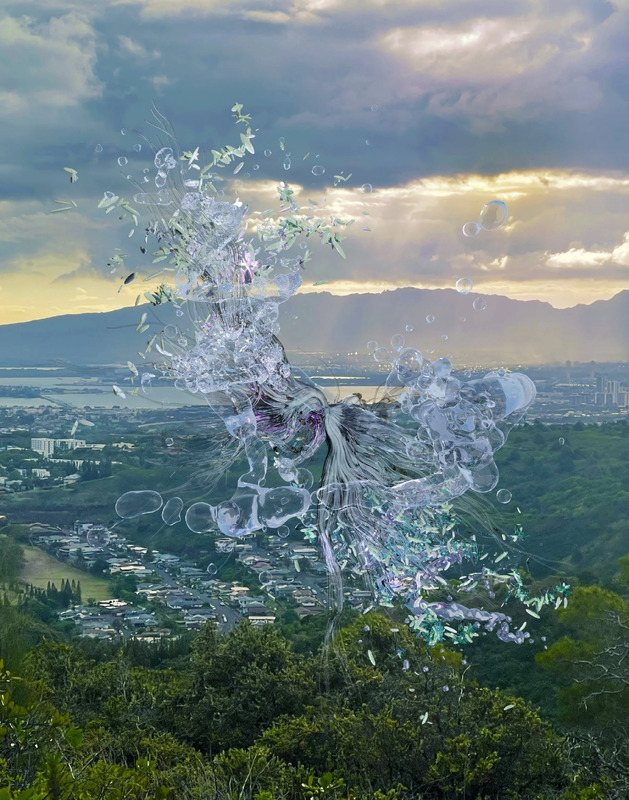
From a green ridge above O‘ahu, the view falls to neighborhoods, the harbor, and far mountains under gold storm light. In the air above it floats a translucent being of water bubbles, silver strands, and drifting leaves, unfurling like a spirit that has come to wash the land clean.
Item
Project
Ka Wai Ola, Ola Hou (Rebirth) / Hānau Hou
An augmented reality work by Tiare Ribeaux and Qianqian Ye, part of their ongoing Kai-Hai series, that imagines the remediation and restoration of water and soil at Kapūkakī (Red Hill) and Pu‘uloa (Pearl Harbor) on O‘ahu as a hopeful alternative to the story of fuel contamination. Made of digital images with 3D renders, it was shown in the Fifty-Third Annual UC Berkeley Master of Fine Arts Graduate Exhibition at BAMPFA (May 10 – July 23, 2023).
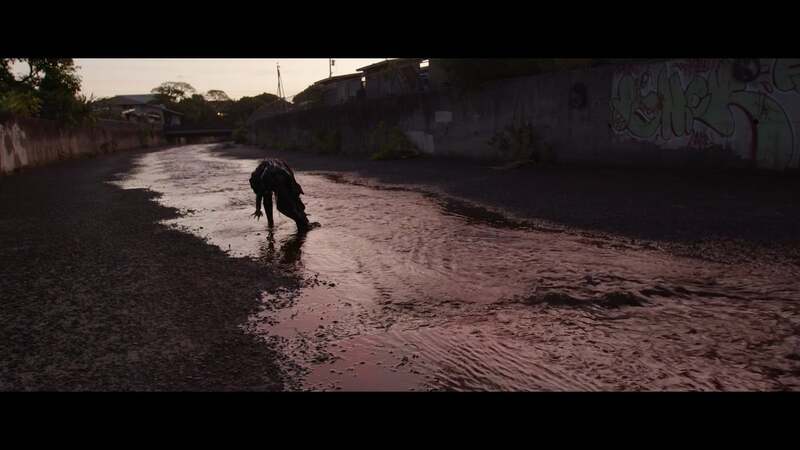
At dusk, a figure bends low in a shallow concrete-lined stream, hand reaching toward the water. The channel glows a dull rose under the fading sky, walls of graffiti and houses above, as if the water itself were holding its breath.
Item
Project
Pō‘ele Wai (As the Water Darkens)
A short fiction film by Tiare Ribeaux, a moving-image artist of Indigenous Hawaiian ancestry, about a weaver who slowly realizes her drinking water has been poisoned after a fuel spill at Kapūkakī (Red Hill) on O‘ahu. Drawing on Indigenous weaving and creation stories, the twelve-minute video traces the interconnectedness of water, bodies, and ancestral land. It was shown in the Fifty-Third Annual UC Berkeley Master of Fine Arts Graduate Exhibition at BAMPFA (May 10 – July 23, 2023).
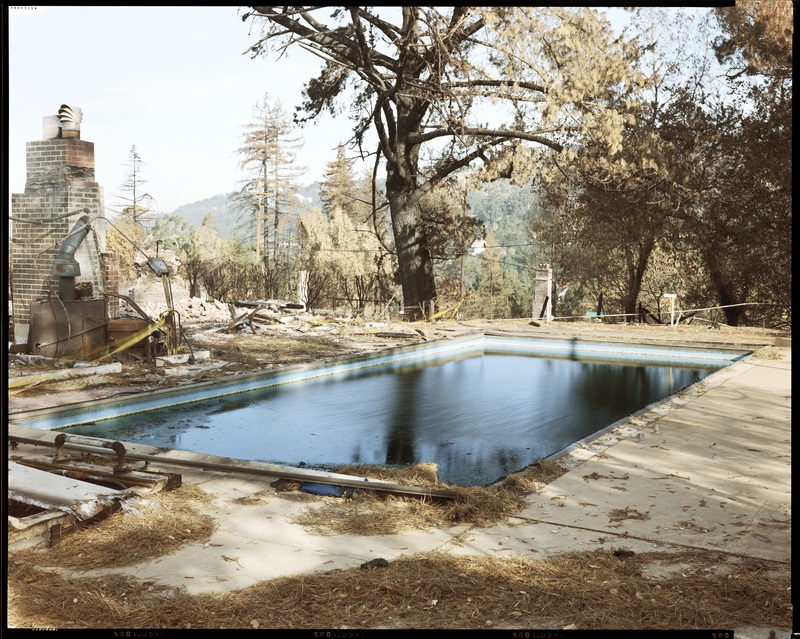
A backyard swimming pool still holds clear blue water, a calm mirror of the sky, while everything around it has burned: a lone chimney standing where a house was, blackened trees with rusted leaves, ash and rubble on the deck.
Item
Event
1991: The Oakland-Berkeley Fire Aftermath, Photographs by Richard Misrach
Photographs Richard Misrach made in the days after the October 1991 firestorm that swept through the Oakland and Berkeley hills, shown at BAM/PFA to mark the fire's twentieth anniversary. The Bay Area photographer entered the fire zone with an eight-by-ten-inch view camera, recording both stark vistas and intimate details of destroyed homes: a melted refrigerator, a mailbox, a stairway, a swimming pool among scorched trees. The forty photographs, unseen in the twenty years since the fire, included fourteen large-scale prints whose immense scale invites viewers into Misrach's quiet elegies, and a grid of twenty-six smaller prints forming an elegy wall. The Oakland Museum of California presented its own forty-photograph selection at the same time, and many of the prints entered BAM/PFA's collection as gifts of the artist. A companion exhibition, Richard Misrach: Photographs from the Collection, drew on series such as Desert Cantos and Bravo 20 Bombing Range that explore the complex relationship between humans and nature.
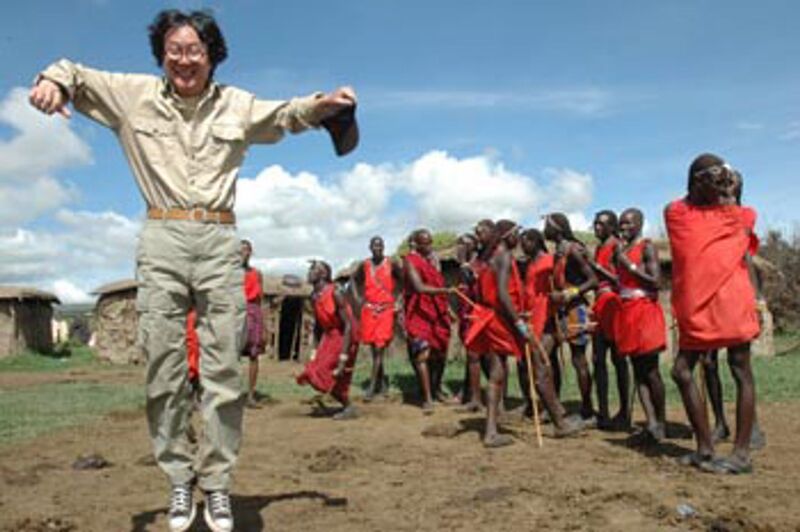
A man in khaki leaps high into a bright blue sky, arms flung wide and sneakers off the ground, grinning. Behind him on the dusty earth, a row of young men in red cloths stands near low round houses, mid-dance, watching.
Item
Event
Human/Nature: Artists Respond to a Changing Planet
A collaborative artist residency and exhibition project that sent eight leading artists to eight threatened UNESCO World Heritage sites to make new work about the relationships between fragile natural environments and the human communities that depend on them. Co-organized by the Berkeley Art Museum and Pacific Film Archive and the Museum of Contemporary Art San Diego with the international conservation organization Rare, it opened in San Diego in 2008 before coming to Berkeley, and each artist completed two or more residencies between 2005 and 2008. Mark Dion built a supply cart for the under-resourced rangers of Komodo National Park in Indonesia. Ann Hamilton created a poetic text performed by Galápagos schoolchildren, heard against footage of a wavering ocean horizon. Iñigo Manglano-Ovalle filmed in Baja California's El Vizcaíno Biosphere Reserve, a gray whale breeding ground threatened by industrial development. Marcos Ramírez ERRE built a wall with residents of Yunnan's Three Parallel Rivers using regional methods, set with video windows onto their lives. Rigo 23 worked with artisans in Brazil's Atlantic Forest to remake a cluster bomb and a nuclear submarine in traditional materials as celebrations of life. Dario Robleto joined a glacier measuring expedition in Waterton Glacier International Peace Park and made sculptures about the disappearance of species and collective mourning. Diana Thater filmed wildlife in South Africa's iSimangaliso Wetland Park, and Xu Bing worked with schoolchildren near Mount Kenya's receding glaciers on artworks built from the Chinese characters for trees, with proceeds supporting reforestation.
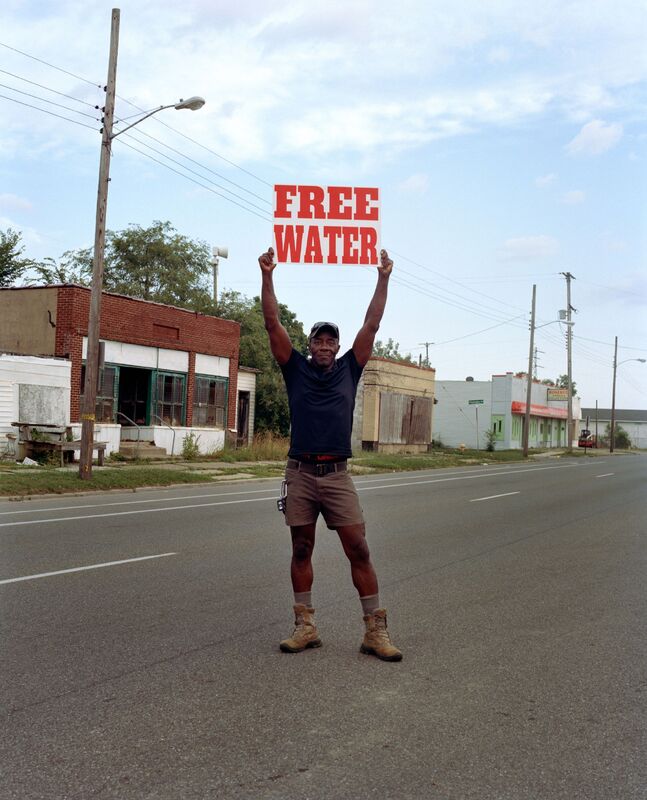
A man stands in the middle of a wide, empty street under a summer sky, arms raised high, holding up a red sign that reads “FREE WATER.” Behind him, low storefronts, power lines, and a faded shopping strip.
Item
Project
Moses West Holding a “Free Water” Sign on North Saginaw Street between East Marengo Avenue and East Pulaski Avenue, Flint, Michigan
A photograph from LaToya Ruby Frazier's series Flint is Family, which documents the water crisis in Flint, Michigan, a predominantly Black city whose residents were exposed to lead-contaminated water. It shows Moses West, a retired Army captain and engineer who builds atmospheric water generators that pull drinking water from the air, holding a “Free Water” sign on North Saginaw Street. Following Flint is Family, Frazier partnered with West and AWG Contracting to bring one of his generators to Flint so residents could make their own clean water. The work is an archival pigment print on Hahnemühle FineArt Baryta, 40 × 30 in. It was shown in Breath(e): Toward Climate and Social Justice at the Hammer Museum, UCLA (2024–25), as an example of what scholar Rob Nixon calls slow violence.
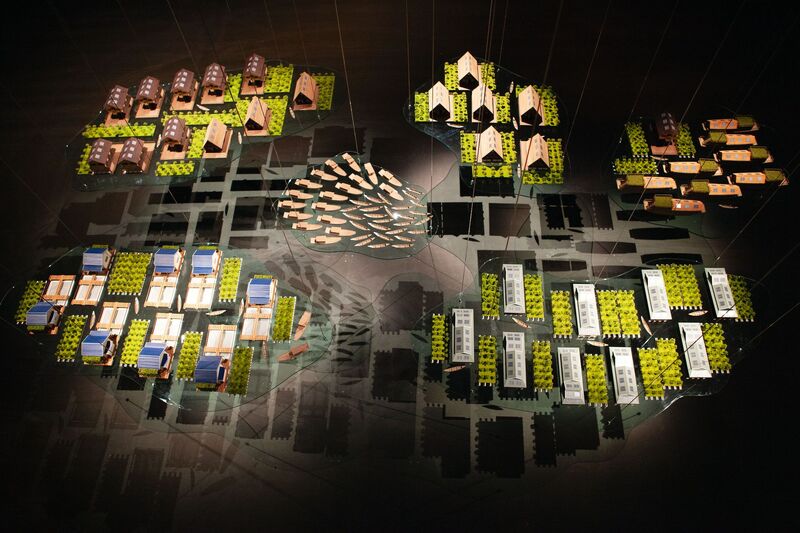
Seen from above in darkness, a floating city of tiny houses on stilts spreads across a black surface like islands, rooftops glowing yellow and copper, a woven dome at its heart, the whole settlement adrift on water that is not there.
Item
Project
stored in a jar: monsoon, drowning fish, color of water, and the floating world
A large-scale architectural model of a floating settlement by Vietnamese American artist Tiffany Chung, herself a political and climate refugee. Built from Plexiglas, wood veneer, plastic, aluminum, paint, steel, cable, foam, and copper wire, and measuring nearly twenty by ten feet, the work imagines vernacular stilt houses and floating communities as a way to consider forced migration and displacement caused by climate change, including projections that parts of Vietnam will be consumed by rising seas by 2050. It was shown in Breath(e): Toward Climate and Social Justice at the Hammer Museum, UCLA (2024–25).
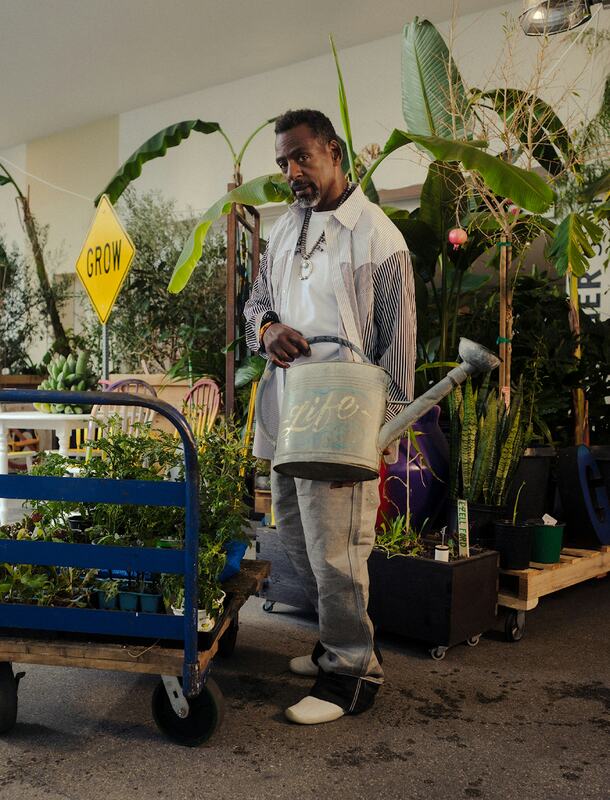
A man in a loose white shirt and wide pale trousers stands among a thicket of banana leaves, palms, and potted greens, a big silver watering can in his hand. Beside him a blue metal cart is crowded with seedlings, and a yellow diamond sign in the leaves reads “GROW.”
Item
Project
Grounded
A large-scale garden installation commissioned for the Hammer Museum exhibition Breath(e): Toward Climate and Social Justice (2024–25), the largest work in the show. South Los Angeles environmental activist Ron Finley, known as the “Gangsta Gardener,” planted a terrace outside the museum's bookstore and galleries with fruit trees, vegetables, and herbs, some growing in salvaged bathtubs and sinks, and set out about two dozen chairs for visitors. A “Redline Realty” sign recalls the housing discrimination that shaped Los Angeles neighborhoods, and plant markers carry the names of people killed by police. The work extends Finley's practice of turning neglected urban ground into food gardens as an act of community care and self-determination. After the exhibition, its soil and materials were returned to the artist.
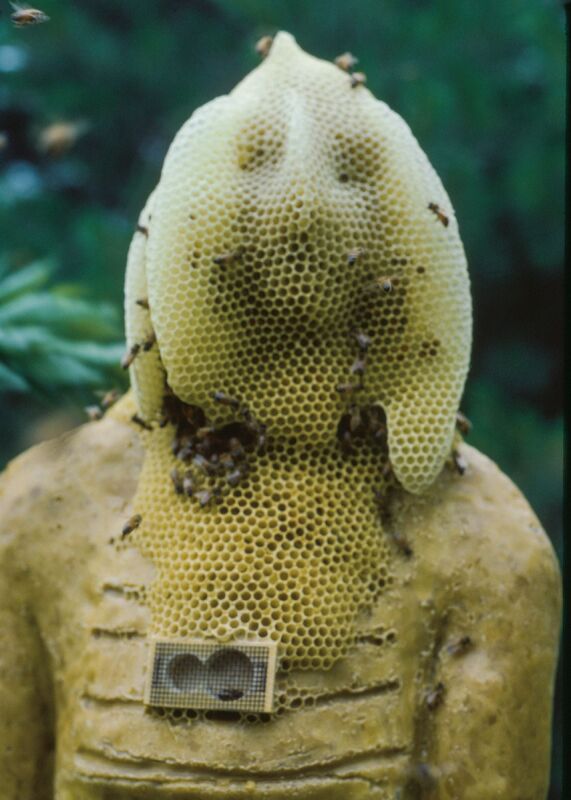
A figure sculpted in pale golden beeswax comb rises from a rough clay-like body, its face half dissolved into hexagonal cells. Bees cling to the comb, still building, against a dark green blur of leaves.
Item
Event
Breath(e): Toward Climate and Social Justice
A major exhibition at the Hammer Museum, UCLA, that centered environmental art addressing the climate crisis and human-caused disasters, and their inescapable intersection with equity and social justice. Curated by artist Glenn Kaino and guest curator Mika Yoshitake, with PST fellow Jennifer Buonocore-Nedrelow, it brought together more than 100 works by 25 intergenerational artists working in photography, multimedia, augmented reality, painting, living organisms, and more, and filled most of the Hammer's galleries and outdoor spaces. Conceived during the COVID-19 pandemic and the racial reckoning of 2020, the exhibition drew on ancestral Indigenous knowledge that treats all elements of nature as one family rather than as resources for human use. New commissions included Cannupa Hanska Luger's multi-part installation Sovereign, a Garnett Puett Apisculpture made in collaboration with a living bee colony, Lan Tuazon's outdoor installation built from plastic waste donated by visitors, Ron Finley's garden installation Grounded, and Mel Chin's IOV (Interpretation of Vision), developed from stories gathered through an open call. Other works traced the slow violence of environmental harm, from LaToya Ruby Frazier's photographs of the Flint water crisis to Tiffany Chung's architectural models of climate displacement in Vietnam. Part of Getty's PST ART: Art & Science Collide and presented in partnership with Conservation International, the exhibition was also documented as a Getty case study in measuring and reducing an exhibition's carbon footprint. After its Los Angeles presentation, the exhibition traveled to the Moody Center for the Arts at Rice University in Houston and to the Jan Shrem and Maria Manetti Shrem Museum of Art at UC Davis (August 7 – November 29, 2025), where a version with fourteen of the artists hosted UC Davis classes in the galleries, including a course whose students created the performance Breath, Soil, Water, Life in response to LaToya Ruby Frazier's Flint is Family in Three Acts.
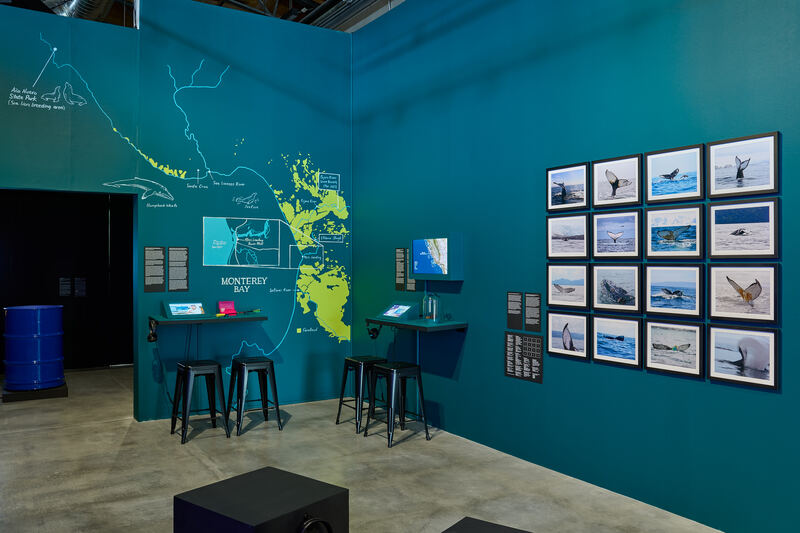
A teal corner of the gallery becomes a field station. A map of the Pacific coast runs across the wall, Monterey Bay picked out in bright chartreuse; two tall tables with stools wait beneath it, and a grid of whale photographs, flukes and backs breaking the water, hangs on the facing wall.
Item
Event
Weather and the Whale
A major exhibition at the Institute of the Arts and Sciences, UC Santa Cruz, that brought internationally acclaimed artists into collaboration with marine ecologists at the Friedlaender Lab. Its title reflects how both weather and whales act as indicators of climate change. Presented across the institute's three galleries and screening room, the exhibition paired new research and data from two years of Friedlaender Lab fieldwork, much of it made public for the first time, with video installations, sculpture, photography, and other works, most of them newly commissioned. The research traces how environmental toxins, sea ice retreat, and other threats affect whales and other large marine mammals, including in Monterey Bay and along California's coast. Together, the science and the artworks explore human and nonhuman experiences of the climate crisis and imagine climate justice across land and ocean. The participating scientists were Natalia Botero Acosta, Ari Friedlaender, Chloe Lew, and Logan Pallin. Organized as part of An Aesthetics of Resilience and funded by a University of California Office of the President California Climate Action Seed Grant, with additional support from the Coha Nowark Art + Science Fund, the exhibition was accompanied by the public program series Intersections of Climate Change, study guides, and a catalog.
Item
Organization
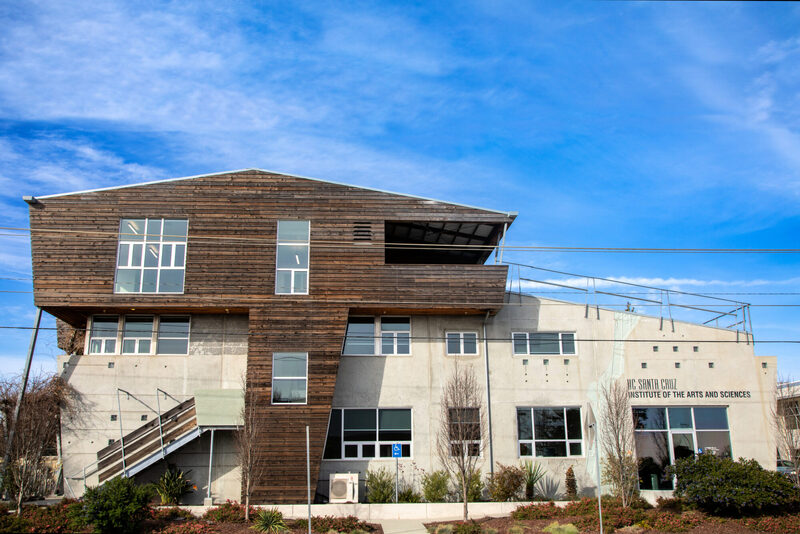
UCSC Institute of the Arts and Sciences
A university art and research center at UC Santa Cruz that uses exhibitions, research, and public programs to engage the critical issues of the present, bringing the arts together with the sciences, social sciences, and humanities. Founded in 2014 to expand the visual arts at UC Santa Cruz, it opened the university's first professional, climate-controlled galleries on the Westside of Santa Cruz in 2023 under director and chief curator Rachel Nelson. Its Art + Science programs focus on climate resilience. Chief among them is An Aesthetics of Resilience, a research initiative with the Friedlaender Lab that brings scientists, artists, humanists, and activists together to examine vulnerability in the face of climate change, and that produced the exhibition and catalog Weather and the Whale (2025–26). Other programs include Visualizing Abolition, LASER Talks, the Coha Nowark Art + Science Pilot Residency, graduate student fellowships, and paid undergraduate internships.
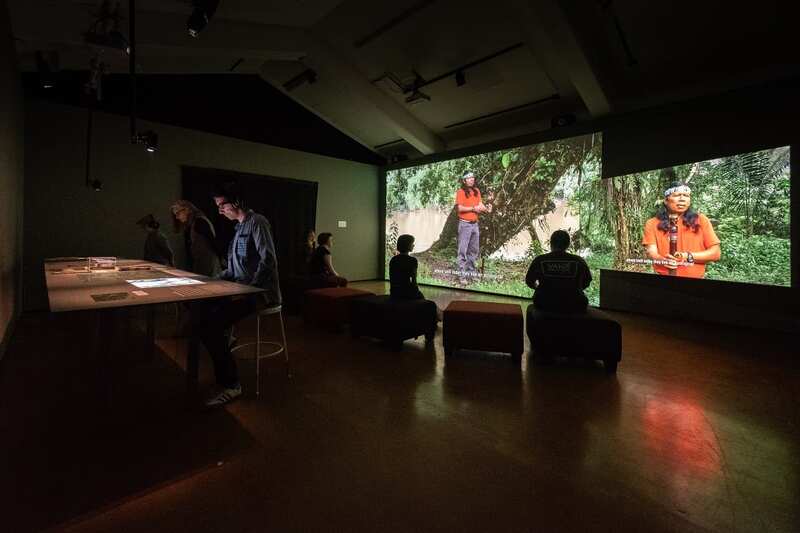
A darkened gallery holds a forest. Two wide screens glow green with the Ecuadorian Amazon, where a man in red speaks among the trees; viewers sit on low cushions in the dark while others lean over a long lit table of documents.
Item
Organization
Center for Creative Ecologies
A research center in the Department of History of Art and Visual Culture at UC Santa Cruz that considers the intersection of culture and environment. Founded and directed by art historian T. J. Demos, it studies how artists, filmmakers, photojournalists, architects, writers, and activists critically address and creatively negotiate climate change, extraction, habitat destruction, and environmental injustice. Drawing on visual culture, political ecology, Earth jurisprudence, Indigenous cosmopolitics, and climate justice activism, the center supports the department's PhD program in Visual Culture and hosts symposia, exhibitions, a reading group, an online journal, and public conversations. Its programs include the Mellon-funded Sawyer Seminar Beyond the End of the World (2019–21), the exhibition Forest Law by Ursula Biemann and Paulo Tavares at the Mary Porter Sesnon Art Gallery (2018), and the online seminar Nuclear Nows: Contemporary Art, Radiation, and Militarized Ecologies (2024).
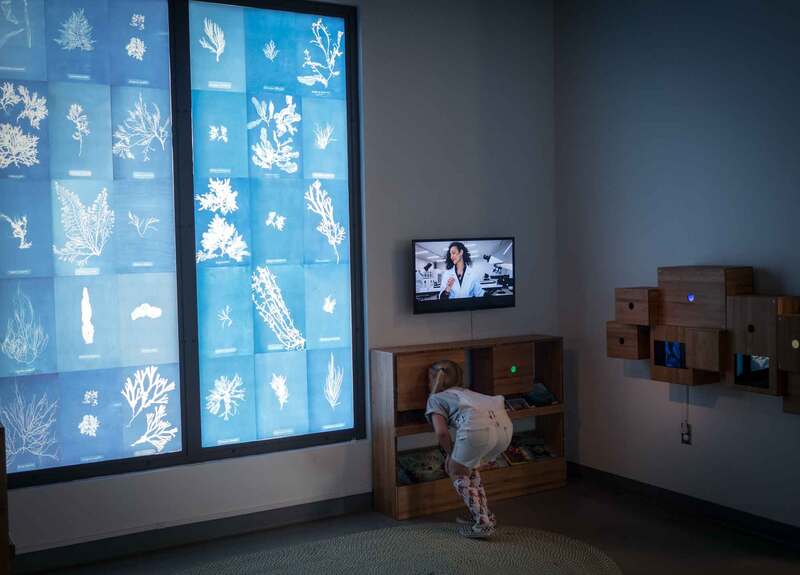
In a dim gallery, a tall lightbox glows with blue cyanotypes of pressed seaweed, white fronds on cyan, while a child bends to peer into a low shelf of books beneath a screen and a cluster of small wooden boxes.
Item
Organization
The Algae Society Bio Art & Design Lab
An international, transdisciplinary collective of artists, scientists, designers, and scholars that invites the public to engage with algae, from the microscopic to the planetary scale. Launched in 2018, the lab approaches algae as companion species, vital to climate resilience and atmospheric balance, and works through artworks, workshops, writing, and exhibitions that cultivate multispecies kinship. Most of its founding members were UC Santa Cruz graduate students who worked with Jennifer Parker in the OpenLab Collaborative Research Center. More than 100 artists, scientists, and scholars on three continents have taken part, with core members at UC Santa Cruz, the University of North Carolina Wilmington, Universidad Complutense de Madrid, Reed College, RMIT University, the University of the Sunshine Coast, and the University of Gothenburg. Exhibitions include CONFLUENCE: Experimentation | Installation | Collaboration at the Cameron Art Museum in Wilmington, North Carolina (2022), with further projects at the MOXI Museum in Santa Barbara and the Madrid Planetarium.
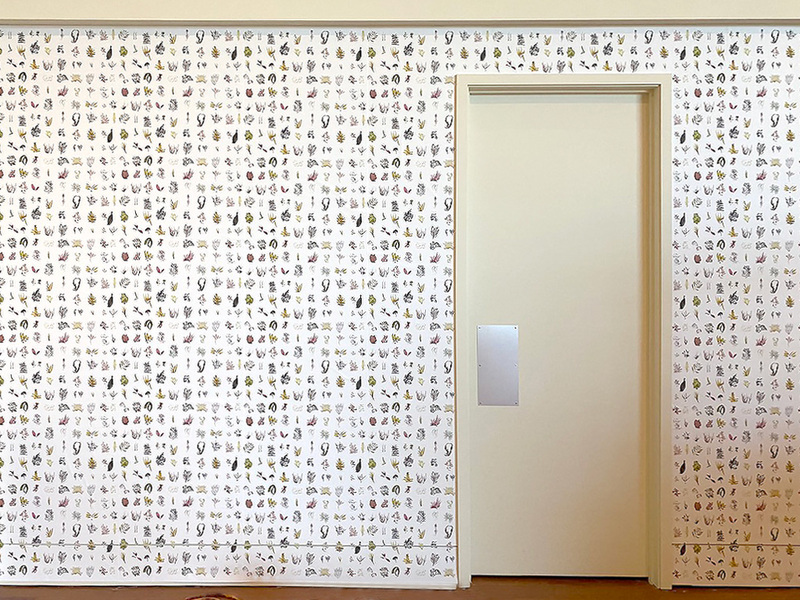
A long gallery wall papered floor to ceiling in a small, repeating grid of seaweed specimens, broken only by a pale door at its center.
Item
Project
100 Years of Seaweed & Kelp
A wallpaper pattern built from a sample of seaweeds and kelp gathered over 100 years and held in the Algae Collection at the University of California, Santa Barbara. Marine algae oxygenate the ocean, create habitat for other organisms, and anchor a vast marine food web; repeated across a wall, a century of collected specimens becomes an immersive record of coastal life and of the scientific care that preserved it. Digital print on archival paper, made in 2022 through The Algae Society Bio Art & Design Lab, with support from Anya Chytrowski, the UCSC Arts Research Institute, and the OpenLab Collaborative Research Center. The wallpaper was shown in CONFLUENCE: Experimentation | Installation | Collaboration at the Cameron Art Museum, Wilmington, North Carolina (January 28 – April 24, 2022) and Seymour Discovery Center at UC Santa Cruz (April – October 2026).
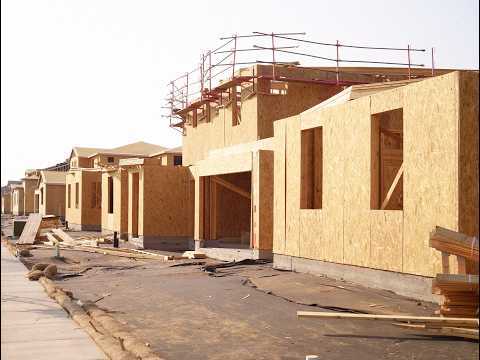
A row of half-built houses in raw plywood sheathing marches down a new street of bare dirt under a washed-out sky, scaffolding perched on one roofline and lumber stacked at the curb.
Item
Event
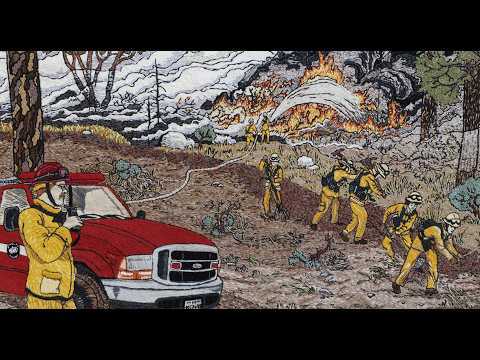
In thick embroidered stitches, a wildfire crew in yellow works a hillside: one man speaks into a radio beside a red truck, others cut a line through the brush, and a hose arcs water toward a wall of orange flame under rolling gray smoke.
Item
Event
Item
Organization
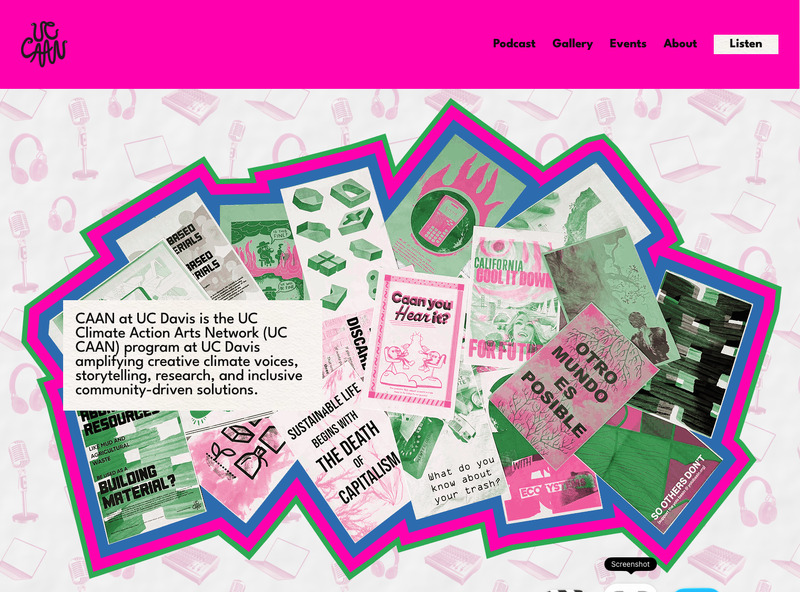
UC Davis CAAN Program
The UC Davis node of the UC Climate Action Arts Network supports creative research at the intersection of art, climate action, and community resilience. Its projects include CAAN You Hear It?, a podcast featuring designers and other creatives working on the front lines of climate action, with a focus on inclusive storytelling and diverse perspectives.
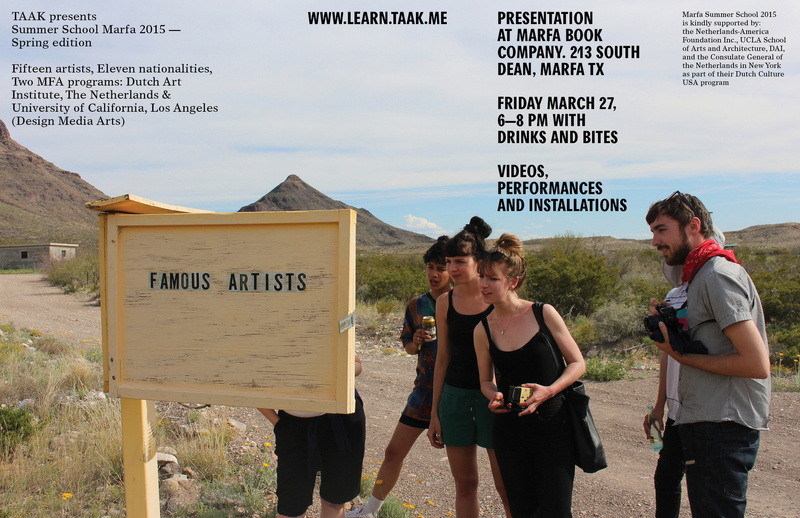
Promotional poster for TAAK's 2015 Marfa Summer School presentation, featuring a group of young artists gathered around a wooden box labeled “Famous Artists” in a desert landscape, with event details printed across the top.
Item
Media Type
fieldwork: marfa 2015
Organized by curator Theo Tegelaers of TAAK Amsterdam, this fieldwork program in Marfa, Texas, was a joint project of art schools including the Sandberg Institute, Amsterdam; the Dutch Art Institute, Arnhem; the Cooper Union School of Art, New York; and UCLA Design Media Arts, Los Angeles.
Item
Organization
UCLA counterforce lab
Artists, designers, scientists, and community partners collaborate in this research studio on place-based fieldwork and storytelling that address the ecological crisis and its links to environmental injustice. Founded by professor rebeca méndez, the studio is part of UCLA’s Design Media Arts department.
Screenshot of the UCLA ArtSci website featuring a banner for “Color Light Motion: Episode 32” by Patricia Olynyk, with abstract white smoke-like forms and wing imagery against a dark background, alongside navigation links and event information.
Item
Organization
UCLA Art|Sci Center
Media artists and bio- and nanoscientists work together through this center, based in UCLA’s Design Media Arts department and the California NanoSystems Institute. It hosts visiting scholars and artists-in-residence, public lectures and symposia, and the Sci|Art NanoLab Summer Institute for high school students. It is also home to the Art|Sci Collective, an international group making projects about the social, ethical, and environmental questions raised by scientific innovation.
Screenshot of the Kenneth S. Norris Center for Natural History's Art + Science webpage, featuring a river winding through a dry landscape, information about interdisciplinary arts and science initiatives, and a botanical illustration of an insect on a green leaf.
Item
Organization
Art + Science, UC Santa Cruz Kenneth Norris Center for Natural History
Natural history collections, field courses, and internships anchor this UC Santa Cruz center’s work with students, faculty, staff, and the wider Santa Cruz community. It builds connections across disciplines, especially between art and science.
Screenshot of the Unseen California website featuring gold text on a black background describing an interdisciplinary arts research initiative. Below are four orange-tinted image tiles labeled Research Mission, Artist Researchers, Teaching & Learning, and Community Engagement.
Item
Organization
Unseen California, UCSC
Artists whose work engages California’s changing landscape are hosted through this UC Santa Cruz research initiative’s artist-in-residence program. In partnership with the UC Natural Reserve System and UCSC’s Norris Center, it supports new work and connects artists with public programs.
Two people work in a creative studio, with one examining a complex, lace-up wearable structure while the other observes. A worktable holds colorful fabric, shoes, tools, and materials for designing and constructing wearable art.
Item
Organization
OpenLab Collaborative Research Center, UCSC
Shifting attention from machines toward people and ecosystems, this faculty-led center at UC Santa Cruz brings the arts, sciences, and technology together through research, exhibitions, talks, and events. Its projects ask how technology can serve the public good and address the planetary costs of unsustainable innovation.
A dancer stands with their back to the camera, arms raised overhead, in front of a large orange-toned projection showing a close-up of a person's face and hands.
Item
Organization
UCSC Arts Research Institute
Since the early 2000s, this institute has supported faculty research and creative practice in UC Santa Cruz’s Arts Division, funding and hosting exhibitions, performances, publications, symposia, field research, and public engagement. It was established under Dean Edward Houghton and led in its early years by Music Professor Leta Miller. It now serves as home to the division’s research centers and initiatives.
Three performers in blue shirts hold up a flowing blue fabric during a lively cultural performance, with a smiling woman in the center. Colorful papel picado decorations, illustrated banners, and an audience surround the stage.
Item
Organization
Community Stations (San Diego & Tijuana), UCSD
Spread across the San Diego–Tijuana border region, this UC San Diego network of community-based sites combines research, teaching, and service. Working with communities of color, it supports research and practice on poverty, along with educational experimentation and shared learning. Support has come from the late UC Regent Richard C. Blum and the Andrew W. Mellon Foundation.
Item
UCSC Climate Action Now
Climate Action; Climate Education; Higher Education
Item
Routledge Handbook of Grassroots Climate Activism
Climate Action; Grassroots Activism; Climate Justice
Item
Not Too Late: Changing the Climate Story from Despair to Possibility
Climate Communication; Climate Action; Climate Emotions
Item
Education and Climate Change: The Role of Universities
Climate Education; Higher Education; Institutional Change
Item
Item
Beginning to End the Climate Crisis: A History of Our Future
Climate Action; Youth Activism; Climate Justice
Item
Item
Item
The Long Heat: Climate Politics When It’s Too Late
Climate Politics; Fossil Fuels; Climate Justice
Item
All We Can Save: Truth, Courage, and Solutions for the Climate Crisis
Climate Justice; Climate Solutions; Climate Communication
Item
What If We Get It Right? Visions of Climate Futures
Climate Futures; Climate Justice; Art, Culture & Climate
Item
Carbon: The Book of Life
Carbon Cycle; Art, Culture & Climate; Climate Communication
Item
Emerging themes in climate obstruction: A PLOS mini-collection
Climate Obstruction; Climate Communication
Item
Life After Fossil Fuels: A Reality Check on Alternative Energy
Energy Transition; Fossil Fuels; Climate Mitigation
Item
More and More and More: An All-Consuming History of Energy
Energy Transition; Fossil Fuels; Environmental History
Item
Climate Obstruction: How Denial, Delay, and Inaction Are Heating the Planet
Climate Obstruction; Misinformation; Policy / Governance
Item
Routledge Handbook of the Climate Change Movement
Climate Action; Social Movements; Climate Justice
Item
Item
The Climate Crisis: Science, Impacts, Policy, Psychology, Justice, Social Movements
Climate Science; Climate Justice; Policy / Governance; Climate Action
Item
Universities on Fire: Higher Education in the Climate Crisis
Higher Education; Climate Crisis; Institutional Change
Item
Scientists have emotional responses to climate change too
Climate Emotions; Climate Research; Well-being
Item
The emotional toll of fieldwork
Climate Research; Well-being; Climate Emotions
Item
Research: Top Scientists Issue Urgent Warning on Fossil Fuels
Fossil Fuels; Climate Action; Climate Communication
Item
Scientists’ warning on fossil fuels
Fossil Fuels; Climate Action; Climate Science
Item
Rethinking academia in a time of crisis
Higher Education; Institutional Change; Climate Action
Item
How and why universities fail to impart environmental literacy to all students
Climate Education; Environmental Literacy; Higher Education
Item
Item
On climate change, are universities part of the problem or part of the solution?
Higher Education; Climate Action; Institutional Change
Item
Climate justice and the university: Shaping a hopeful future for all
Climate Justice; Higher Education; Institutional Change
Item
Degrowth.info — Degrowth resource library
Degrowth; Climate Justice; Political Economy
Item
Degrowth can work: Here’s how science can help
Degrowth; Climate Justice; Planetary Boundaries
Item
Is a new economic system necessary to address climate change?
Political Economy; Climate Mitigation; System Change
Item
Beyond colonial futurities in climate education
Climate Education; Climate Justice; Decolonization
Item
Climate policies that achieved major emissions reductions
Climate Policy; Mitigation; Emissions Reduction
Item
Predicting narratives of obstruction in social media advertising
Climate Obstruction; Climate Communication; Misinformation
Item
The 2024 state of the climate report: Perilous times on planet Earth
Climate Science; Climate Impacts; Climate Indicators
Item
The 2023 state of the climate report: Entering uncharted territory
Climate Science; Climate Impacts; Climate Indicators
Item
The biospheric emergency calls for scientists to change tactics
Climate Action; Scientific Activism; Biodiversity
Item
The misallocation of climate research funding
Climate Research; Funding; Policy / Governance
Item
The wins of the grassroots climate movement in the University of California
Climate Action; Grassroots Activism; Higher Education
Item
The economics and governance of solar geoengineering
Geoengineering; Climate Economics; Policy / Governance
Item
Climate change education at universities: Relevance and strategies for every discipline
Climate Education; Higher Education; Interdisciplinary Teaching
Item
Item
Post-growth: The science of well-being within planetary boundaries
Degrowth; Planetary Boundaries; Climate Justice
Item
A 485-million year history of Earth’s surface temperature
Climate Science; Paleoclimate; Earth Systems
Item
Fossil fuel industry influence in higher education: A review
Fossil Fuels; Higher Education; Climate Obstruction
Item
Understanding and overcoming climate obstruction
Climate Obstruction; Policy / Governance
Item
Item
Climate change engagement of scientists
Climate Action; Climate Communication
Item
Even as climate risks rise, short-term thinking prevails
Climate Economics; Finance; Climate Risk
Item
Fixing the climate: it just ain’t profitable
Climate Economics; Political Economy
Item
The macroeconomic effects of climate change
Climate Economics; Climate Impacts
Item
Paulo Freire Institute
Climate Communication; Art, Culture & Climate
Item
Space and Place: The Perspective of Experience
Climate Communication; Art, Culture & Climate
Item
(1993) The Texts of Paulo Freire, Buckingham: Open University Press
Climate Communication; Art, Culture & Climate
Item
Seeing Power: Art and Activism in the 21st Century
Climate Communication; Art, Culture & Climate
Item
For Space, SAGE Publications, 2005
Climate Communication; Art, Culture & Climate
Item
Teaching to Transgress: Education as the Practice of Freedom
Climate Communication; Art, Culture & Climate
Item
(1972) Pedagogy of the Oppressed, Harmondsworth: Penguin
Climate Communication; Art, Culture & Climate
Item
Energy Plan for the Western Man, Four Walls, 1990
Climate Communication; Art, Culture & Climate
Item
Item
Item
The Poetics of Space Beacon Press;1994
Climate Communication; Art, Culture & Climate
Item
Flam, and Robert Smithson. Robert Smithson: The Collected Writings
Art, Culture & Climate; Biodiversity; Indigenous Knowledge; Climate Justice; Land Use
Item
Art in the Public Interest
Art, Culture & Climate; Biodiversity; Indigenous Knowledge; Climate Justice; Land Use
Item
The Inoperative Community
Art, Culture & Climate; Biodiversity; Indigenous Knowledge; Climate Justice; Land Use
Item
Ecology Without Nature
Art, Culture & Climate; Biodiversity; Indigenous Knowledge; Climate Justice; Land Use
Item
Mapping the Terrain: New Genre Public Art
Art, Culture & Climate; Biodiversity; Indigenous Knowledge; Climate Justice; Land Use
Item
One Place after Another: Site-Specific Art and Locational Identity. 1st MIT press paperback ed
Art, Culture & Climate; Biodiversity; Indigenous Knowledge; Climate Justice; Land Use
Item
Conversation Pieces: Community and Communication in Modern Art
Art, Culture & Climate; Biodiversity; Indigenous Knowledge; Climate Justice; Land Use
Item
Social Works: Performing Art, Supporting Publics
Art, Culture & Climate; Biodiversity; Indigenous Knowledge; Climate Justice; Land Use
Item
Suzanne Lacy: Spaces Between
Art, Culture & Climate; Biodiversity; Indigenous Knowledge; Climate Justice; Land Use
Item
The Time of the Force Majeure: After 45 Years, Counterforce is on the Horizon, New York: Prestel, 2016, Print
Art, Culture & Climate; Biodiversity; Indigenous Knowledge; Climate Justice; Land Use
Item
When Species Meet
Art, Culture & Climate; Biodiversity; Indigenous Knowledge; Climate Justice; Land Use
Item
Situated Knowledges: The Science Question in Feminism and the Privilege of Partial Perspective
Art, Culture & Climate; Biodiversity; Indigenous Knowledge; Climate Justice; Land Use
Item
Anthropocene, Capitalocene, Platationocene, Chthulucene: Making Kin
Art, Culture & Climate; Biodiversity; Indigenous Knowledge; Climate Justice; Land Use
Item
The Third Hand: Collaboration in Art from Conceptualism to Postmodernism
Art, Culture & Climate; Biodiversity; Indigenous Knowledge; Climate Justice; Land Use
Item
Decolonizing Nature: Contemporary Art and the Politics of Ecology
Art, Culture & Climate; Biodiversity; Indigenous Knowledge; Climate Justice; Land Use
Item
A Thousand Plateaus: Capitalism and Schizophrenia
Art, Culture & Climate; Biodiversity; Indigenous Knowledge; Climate Justice; Land Use
Item
Custer died for your sins; an Indian manifesto
Art, Culture & Climate; Biodiversity; Indigenous Knowledge; Climate Justice; Land Use
Item
Silent Spring
Art, Culture & Climate; Biodiversity; Indigenous Knowledge; Climate Justice; Land Use
Item
The Web of Life: A New Scientific Understanding of Living Systems. 1st Anchor Books trade paperback ed
Art, Culture & Climate; Biodiversity; Indigenous Knowledge; Climate Justice; Land Use
Item
Beuys: The Twilight of the Idol
Art, Culture & Climate; Biodiversity; Indigenous Knowledge; Climate Justice; Land Use
Item
Relational Aesthetics
Art, Culture & Climate; Biodiversity; Indigenous Knowledge; Climate Justice; Land Use
Item
Antagonism and Relational Aesthetics
Art, Culture & Climate; Biodiversity; Indigenous Knowledge; Climate Justice; Land Use
Item
Participation
Art, Culture & Climate; Biodiversity; Indigenous Knowledge; Climate Justice; Land Use
Item
Ecofascism Revisited : Lessons from the German Experience
Art, Culture & Climate; Biodiversity; Indigenous Knowledge; Climate Justice; Land Use
Item
Joseph Beuys in America: Energy Plan for the Western Man: Writings by and Interviews with the Artist. 1st ed
Art, Culture & Climate; Biodiversity; Indigenous Knowledge; Climate Justice; Land Use
Item
Steps to an Ecology of Mind
Art, Culture & Climate; Biodiversity; Indigenous Knowledge; Climate Justice; Land Use
Item
Tending the Wild: Native American Knowledge and the Management of California's Natural Resources
Art, Culture & Climate; Biodiversity; Indigenous Knowledge; Climate Justice; Land Use
Item
Matters of Care: Speculative Ethics in More Than Human Worlds
Art, Culture & Climate; Climate Justice; Indigenous Knowledge; Land Use; Biodiversity
Item
The Undercommons
Art, Culture & Climate; Climate Justice; Indigenous Knowledge; Land Use; Biodiversity
Item
Writing Academic Texts Differently: Intersectional Feminist Methodologies and the Playful Art of Writing
Art, Culture & Climate; Climate Justice; Indigenous Knowledge; Land Use; Biodiversity
Item
Immersive Life Practices
Art, Culture & Climate; Climate Justice; Indigenous Knowledge; Land Use; Biodiversity
Item
The Interventionists
Art, Culture & Climate; Climate Justice; Indigenous Knowledge; Land Use; Biodiversity
Item
Disobedient Objects
Art, Culture & Climate; Climate Justice; Indigenous Knowledge; Land Use; Biodiversity
Item
Realizing the Impossible: Art Against Authority
Art, Culture & Climate; Climate Justice; Indigenous Knowledge; Land Use; Biodiversity
Item
Art Against the Law
Art, Culture & Climate; Climate Justice; Indigenous Knowledge; Land Use; Biodiversity
Item
Forensic architecture
Art, Culture & Climate; Climate Justice; Indigenous Knowledge; Land Use; Biodiversity
Item
Making the Geologic Now: Responses to Material Conditions of Contemporary Life
Art, Culture & Climate; Climate Justice; Indigenous Knowledge; Land Use; Biodiversity
Item
The World of Living Things
Art, Culture & Climate; Climate Justice; Indigenous Knowledge; Land Use; Biodiversity
Item
Biopiracy
Art, Culture & Climate; Climate Justice; Indigenous Knowledge; Land Use; Biodiversity
Item
The Invention of Modern Science
Art, Culture & Climate; Climate Justice; Indigenous Knowledge; Land Use; Biodiversity
Item
Meeting the Universe Halfway
Art, Culture & Climate; Climate Justice; Indigenous Knowledge; Land Use; Biodiversity
Item
Living as Form: Socially Engaged Art from 1991–2011
Art, Culture & Climate; Climate Justice; Indigenous Knowledge; Land Use; Biodiversity
Item
FIELD: A Journal of Socially-Engaged Art Criticism
Art, Culture & Climate; Climate Justice; Indigenous Knowledge; Land Use; Biodiversity
Item
Leonardo: Journal of Art, Science and Technology
Art, Culture & Climate; Climate Justice; Indigenous Knowledge; Land Use; Biodiversity
Item
Change the World Without Taking Power
Art, Culture & Climate; Climate Justice; Indigenous Knowledge; Land Use; Biodiversity
Item
Living for Change
Art, Culture & Climate; Climate Justice; Indigenous Knowledge; Land Use; Biodiversity
Item
Art as Social Action
Art, Culture & Climate; Climate Justice; Indigenous Knowledge; Land Use; Biodiversity
Item
Education for Socially Engaged Art: A Materials and Techniques Handbook
Art, Culture & Climate; Climate Justice; Indigenous Knowledge; Land Use; Biodiversity
Item
Companion Species Manifesto
Art, Culture & Climate; Climate Justice; Indigenous Knowledge; Land Use; Biodiversity
Item
The Poetics of Relation
Art, Culture & Climate; Climate Justice; Indigenous Knowledge; Land Use; Biodiversity
Item
The Black Shoals: Offshore Formations of Black and Native Studies
Art, Culture & Climate; Climate Justice; Indigenous Knowledge; Land Use; Biodiversity
Item
Earth Beings: Ecologies of Practice Across Andean Worlds
Art, Culture & Climate; Climate Justice; Indigenous Knowledge; Land Use; Biodiversity
Item
Land Education: Rethinking Pedagogies of Place from Indigenous, Postcolonial, and Decolonizing Perspectives
Art, Culture & Climate; Climate Justice; Indigenous Knowledge; Land Use; Biodiversity
Item
Mapping the Landscape of Socially Engaged Artistic Practice
Art, Culture & Climate; Climate Justice; Indigenous Knowledge; Land Use; Biodiversity
Item
Else/Where: Mapping — New Cartographies of Networks and Territories
Art, Culture & Climate; Climate Justice; Indigenous Knowledge; Land Use; Biodiversity
Item
Giving Ground: The Politics of Propinquity
Art, Culture & Climate; Climate Justice; Indigenous Knowledge; Land Use; Biodiversity
Item
Times Square Red, Times Square Blue
Art, Culture & Climate; Climate Justice; Indigenous Knowledge; Land Use; Biodiversity
Item
The Mushroom at the End of the World
Art, Culture & Climate; Climate Justice; Indigenous Knowledge; Land Use; Biodiversity
Item
The Spell of the Sensuous
Art, Culture & Climate; Climate Justice; Indigenous Knowledge; Land Use; Biodiversity
Item
Citizen
Art, Culture & Climate; Climate Justice; Indigenous Knowledge; Land Use; Biodiversity
Item
Mistaken Identity
Art, Culture & Climate; Climate Justice; Indigenous Knowledge; Land Use; Biodiversity
Item
How Art Can Be Thought
Art, Culture & Climate; Climate Justice; Indigenous Knowledge; Land Use; Biodiversity
Item
Making and Being
Art, Culture & Climate; Climate Justice; Indigenous Knowledge; Land Use; Biodiversity
Item
How Big is Here?
Climate Justice; Extraction / Resource Use; Capitalism / Political Economy; Art, Culture & Climate
Item
Spaces of Hope
Climate Justice; Extraction / Resource Use; Capitalism / Political Economy; Art, Culture & Climate
Item
Petrochemical America
Climate Justice; Extraction / Resource Use; Capitalism / Political Economy; Art, Culture & Climate
Item
Social Works: Performing Art, Supporting Publics
Climate Justice; Extraction / Resource Use; Capitalism / Political Economy; Art, Culture & Climate
Item
Forensic Architecture, Violence at the Threshold of Detectability
Climate Justice; Extraction / Resource Use; Capitalism / Political Economy; Art, Culture & Climate
Item
Slow Violence and the Environmentalism of the Poor
Climate Justice; Extraction / Resource Use; Capitalism / Political Economy; Art, Culture & Climate
Item
Vibrant Matter
Climate Justice; Extraction / Resource Use; Capitalism / Political Economy; Art, Culture & Climate
Item
How Art Can Be Thought: A Handbook for Change
Climate Justice; Extraction / Resource Use; Capitalism / Political Economy; Art, Culture & Climate
Item
Research is Ceremony, Indigenous Research Methods
Water; Climate Adaptation; Indigenous Knowledge; Climate Justice; Art, Culture & Climate
Item
Decolonizing Methodologies: Research and Indigenous Peoples
Water; Climate Adaptation; Indigenous Knowledge; Climate Justice; Art, Culture & Climate
Item
Men, Machines, and the World About.
Water; Climate Adaptation; Indigenous Knowledge; Climate Justice; Art, Culture & Climate
Item
Hidden Messages in Water
Water; Climate Adaptation; Indigenous Knowledge; Climate Justice; Art, Culture & Climate
Item
Black Faces, White Spaces
Water; Climate Adaptation; Indigenous Knowledge; Climate Justice; Art, Culture & Climate
Item
Queer Ecologies
Water; Climate Adaptation; Indigenous Knowledge; Climate Justice; Art, Culture & Climate
Item
Staying with the Trouble
Water; Climate Adaptation; Indigenous Knowledge; Climate Justice; Art, Culture & Climate
Item
Cadillac Desert: The American West and Its Disappearing Water
Water; Climate Adaptation; Indigenous Knowledge; Climate Justice; Art, Culture & Climate
Item
Holy Water
Water; Climate Adaptation; Indigenous Knowledge; Climate Justice; Art, Culture & Climate
Item
Thinking with Water
Water; Climate Adaptation; Indigenous Knowledge; Climate Justice; Art, Culture & Climate
Item
The Web of Life
Water; Climate Adaptation; Indigenous Knowledge; Climate Justice; Art, Culture & Climate
Item
Elsewhere, Within Here: Immigration, Refugeeism and the Boundary Event
Land Use; Biodiversity; Climate Justice; Art, Culture & Climate
Item
Reframing the Colonial Gaze: Photography, Ownership, and Feminist Resistance
Land Use; Biodiversity; Climate Justice; Art, Culture & Climate
Item
Collecting Colonialism: Material Culture and Colonial Change
Land Use; Biodiversity; Climate Justice; Art, Culture & Climate
Item
Colonialist Photography: Imag(in)ing Race and Place
Land Use; Biodiversity; Climate Justice; Art, Culture & Climate
Item
Deep Economy — Chapters 1–2: Aftergrowth; The Year of Eating Locally
Land Use; Biodiversity; Climate Justice; Art, Culture & Climate
Item
The Botany of Desire: A Plant's-Eye View of the World — Chapter 1: Desire: Sweetness / The Apple
Land Use; Biodiversity; Climate Justice; Art, Culture & Climate
Item
Experimental Geography — Chapter 2: From Cultural Production to the Production of Space
Land Use; Biodiversity; Climate Justice; Art, Culture & Climate
Item
Experimental Geography — Chapter 1: Geography as Art, Art as Geography. In Two Directions
Land Use; Biodiversity; Climate Justice; Art, Culture & Climate
Item
Experimental Geography: Radical Approaches to Landscape, Cartography, and Urbanism
Land Use; Biodiversity; Climate Justice; Art, Culture & Climate
Item
Criticizing Photographs 5 th Edition
Land Use; Biodiversity; Climate Justice; Art, Culture & Climate
Item
The Critique Handbook: The Art Student's Sourcebook and Survival Guide
Land Use; Biodiversity; Climate Justice; Art, Culture & Climate
Item
Beauty in Photography, Essays in Defense of Traditional Values
Land Use; Biodiversity; Climate Justice; Art, Culture & Climate
Item
Walden
Land Use; Biodiversity; Climate Justice; Art, Culture & Climate
Item
One Place after Another: Site-Specific Art and Locational Identity — Chapters 1–2
Land Use; Biodiversity; Climate Justice; Art, Culture & Climate
Item
The World Without Us
Land Use; Biodiversity; Climate Justice; Art, Culture & Climate
Item
Touching the Earth
Land Use; Biodiversity; Climate Justice; Art, Culture & Climate
Item
The Decay Manifesto
Biodiversity; Capitalism / Political Economy; Regenerative Practice; Art, Culture & Climate
Item
GUTS — Civic Laboratory for Environmental Action Research (CLEAR)
Environmental Health; Climate Justice; Indigenous Knowledge; Pollution
Item
Petro-masculinity: Fossil Fuels and Authoritarian Desire
Energy; Climate Justice; Capitalism / Political Economy; Climate Communication
Item
Zooniverse
Biodiversity; Climate Communication; Environmental Research
Item
Santa Cruz County GIS
Climate Adaptation; Wildfire; Land Use; Water; Policy / Governance
Item
Our World in Data
Climate Communication; Energy; Mitigation; Environmental Health; Food Systems
Item
Native American Ethnobotany Database
Indigenous Knowledge; Biodiversity; Food Systems; Environmental Health
Item
Long Term Ecological Research (LTER) Network
Biodiversity; Climate Adaptation; Water; Land Use
Item
Indigenous Environmental Network
Climate Justice; Indigenous Knowledge; Energy; Extraction / Resource Use
Item
iNaturalist
Biodiversity; Climate Adaptation; Climate Communication
Item
Global Ecosystems Atlas
Biodiversity; Climate Adaptation; Land Use; Policy / Governance
Item
California Water Boards
Water; Climate Adaptation; Policy / Governance; Environmental Health
Item
California Coastal Commission
Oceans / Coastal Change; Climate Adaptation; Policy / Governance; Land Use
Item
California ISO
Energy; Mitigation; Policy / Governance; Climate Adaptation
Item
Biosphere 2
Climate Adaptation; Biodiversity; Water; Food Systems
Item
Oscar Santillán
Biodiversity; Art, Culture & Climate; Climate Communication; Technology
Item
Reena Saini Kallat
Biodiversity; Borders; Climate Justice; Migration / Displacement; Art, Culture & Climate
Item
Mary Mattingly
Climate Adaptation; Water; Food Systems; Climate Justice; Art, Culture & Climate
Item
Olalekan Jeyifous
Climate Adaptation; Urbanization; Art, Culture & Climate; Environmental Justice
Item
Kathy Jetñil-Kijiner
Climate Justice; Oceans / Coastal Change; Migration / Displacement; Indigenous Knowledge
Item
Allison Janae Hamilton
Climate Justice; Land Use; Environmental Racism; Art, Culture & Climate
Item
Helen and Newton Harrison / The Harrison Studio
Climate Adaptation; Biodiversity; Water; Land Use; Art, Culture & Climate
Item
LaToya Ruby Frazier — Flint Is Family In Three Acts
Water; Environmental Racism; Environmental Health; Climate Justice; Art, Culture & Climate
Item
Futurefarmers
Food Systems; Water; Land Use; Climate Adaptation; Art, Culture & Climate
Item
Torkwase Dyson
Climate Justice; Extraction / Resource Use; Environmental Racism; Art, Culture & Climate
Item
Cooking Sections
Food Systems; Climate Adaptation; Oceans / Coastal Change; Biodiversity; Art, Culture & Climate
Item
Carolina Caycedo
Water; Climate Justice; Policy / Governance; Indigenous Knowledge; Art, Culture & Climate
Item
Edward Burtynsky
Extraction / Resource Use; Climate Communication; Land Use; Environmental Health
Item
Tega Brain
Climate Adaptation; Water; Climate Communication; Art, Culture & Climate; Technology
Item
Amy Balkin
Climate Justice; Policy / Governance; Air; Land Use; Art, Culture & Climate
Item
Rebecca Belmore
Water; Indigenous Knowledge; Climate Justice; Land Use; Art, Culture & Climate
Item
Arahmaiani
Water; Climate Justice; Art, Culture & Climate; Environmental Health
Item
Maria Thereza Alves
Biodiversity; Migration / Displacement; Extraction / Resource Use; Art, Culture & Climate
Item
Art + Environment: Rethinking Ecology Through Visual Culture
Art, Culture & Climate; Water; Climate Justice; Capitalism / Political Economy; Climate Adaptation
Item
Maya Lin: Disappearing Bodies of Water
Water; Art, Culture & Climate; Climate Communication; Environmental Change
Item
Drawings that Show the Beauty and Fragility of Earth
Art, Culture & Climate; Climate Communication; Oceans / Coastal Change
Item
RESILIENCE: The Global Adaptation Podcast
Climate Adaptation; Resilience; Food Systems; Policy / Governance; Climate Communication
Item
Fireline
Wildfire; Climate Adaptation; Resilience; Indigenous Knowledge; Policy / Governance
Item
Threshold
Biodiversity; Climate Justice; Indigenous Knowledge; Art, Culture & Climate; Climate Communication
Item
Sound
Sea Change
Climate Adaptation; Resilience; Climate Justice; Oceans / Coastal Change
Item
Webpage
Soil Assembly
Climate Adaptation; Biodiversity; Food Systems; Art, Culture & Climate
A group of people attends a workshop in a conference room, seated around U-shaped tables with notebooks, food, and drinks while listening to presenters near a projection screen.
Item
Organization
UC Riverside California Center for Native Nations
Bridging the University of California and California’s Tribal Nations, this UC Riverside center works alongside American Indian communities on research for, with, by, and about them. Through reciprocal partnership, it supports Tribal histories, cultures, languages, and sovereignty.
A golden sunset over a calm coastal landscape, with the sun reflecting on the water, distant mountains silhouetted against the horizon, and a rocky shoreline with shallow tide pools in the foreground.
Item
Organization
UC Riverside Salton Sea Task Force
Lake ecology, air and water quality, human health, policy, and community education all fall within this multidisciplinary UC Riverside team’s research on the changing Salton Sea. Its goal is to provide the science needed for sustainable, equitable mitigation in the region and in similarly threatened places.
MEM-RES logo featuring large white and black uppercase lettering arranged across two lines on a bright orange background.
Item
Organization
Memory and Resistance Laboratory
The Memory and Resistance Laboratory (MEM-RES) at UC Riverside is a hub for antiracist, decolonial, and feminist of color artistic research. The lab was founded in 2019 by artist Latipa (Michelle Dizon), whose works recorded in the archive include Perpetual Peace (2012), The Archive's Fold (2018) and White Gaze (2018, with Việt Lê).
Promotional banner for UC Merced UpstART's presentation of LADAMA, featuring four women dressed in dark clothing posing against a textured gray background, with the event title and university branding on a yellow banner below.
Item
Organization
UpstArt Series, UCM
Faculty direct this UC Merced organization, formerly Arts UC Merced Presents, which brings arts programming to campus and the surrounding community.
A green-tinted aerial satellite image of the UC Santa Cruz Digital Arts Research Center and surrounding wooded landscape, overlaid with the title “HERE, HERE” in large white letters. Small text along the bottom credits Rachel Berger and the 2026 Arts and Ecology Festival.
Item
Event
HERE, HERE
Rachel Berger's recorded research talk featuring prompts that encourage uncommon reflections on the past, present, and possible futures. Adapted from a series of creative workshops Rachel Berger and Ri Dym conducted with Berkeley middle school students. In the workshops, students produced diverse statements and drawings responding to Berkeley’s past and imagining speculative future “histories” for themselves and their city.
An audience gathers in an outdoor courtyard for an arts discussion, seated on colorful chairs facing three speakers. A screen displaying “Color Theory,” abstract murals, and string lights decorate the space.
Item
Organization
Platform Artspace, UCB
An art venue that features collaborative, participatory art projects and pop up exhibitions. In addition to these programs, public practices courses are also taught at Platform. Platform Artspace features a large projection screen, two studios for exhibitions and workshops, a large area with artificial turf, and café tables for workshops and gatherings. The space is run collaboratively a faculty director, a student Community Engagement Liaison, and a group of student leaders. Student interns also participate in curating exhibitions and programming events. Platform hosts an internship program where students earn credit while gaining experience planning, curating, maintaining, and publicizing exhibitions and workshops.
Four people kneel in a cultivated garden bed, working together to prepare the soil with hand tools. In the foreground, one person wears a pink sweater and another a light blue hoodie, while two others work farther down the row. Wire fencing, irrigation lines, and trees surround the outdoor garden.
Item
Project
UCSC Greenhouse Project
Founded in 2022 by artists L Gilbert and Dav Bell, the project is an intergenerational educational space that centers art, food, and climate justice. It is rooted in the Farm at UC Santa Cruz, where Gilbert and Bell work alongside farm staff, students, and interns to build a lasting site for programming social and agricultural experiments. The project grew out of Gilbert and Bell’s MFA thesis work in the first graduating cohort of UC Santa Cruz’s Environmental Art and Social Practice program, and was presented in the cohort’s 2023 thesis exhibition, Gently Unbind, at the Mary Porter Sesnon Art Gallery. The greenhouse also hosted the exhibition’s closing gathering, extending the show from the gallery to the farm. Through hands-on growing, shared work, and public programs, the project treats the garden as a place where people of different generations can learn together and imagine more just food systems in a changing climate.
A group of people dressed in elaborate red, orange, and black costumes gather in a wooded outdoor setting for a theatrical performance or ceremonial event. One person kneels in a silver outfit, releasing smoke, while others wear flame-inspired headdresses, colorful accessories, and dramatic makeup.
Item
Event
Wedding to Fire
One ceremony took place privately at Earthlab in Boulder Creek and the other at Sagehen Creek Field Station in the Sierra Nevada. The wedding connects to the artists’ film Playing with Fire!, which links wildfire to climate change and to failures of government care and fossil fuel regulation. It belongs to the artists’ series of weddings to elements of the natural world, including the earth, the moon, the sun, and the fog.
An outdoor artistic performance in a grassy meadow surrounded by tall trees, featuring several performers in elaborate gray, black, and white costumes. A taxidermy wild cat is displayed inside a transparent enclosure, while the performers carry natural materials and wear theatrical accessories inspired by nature.
Item
Event
Fog Wedding
Part of the artists’ ecosex practice, the work questions hierarchies between species and conventional categories of sexuality. It belongs to the artists’ series of weddings to elements of the natural world, including the earth, the moon, the sun, and fire.
 A group of people gathered outdoors for a theatrical wedding-like ceremony, wearing elaborate costumes and holding bouquets of flowers. A smiling man in a black coat raises his hand in a peace sign while two costumed participants beside him smile against an overcast sky.
Item
Event
Wedding to the Sun
Guests carried a long silk ribbon in a procession around the hill, and the ceremony included live music, performances, and a homily by theater director Rudy Ramirez, with Katy Bell as production manager. The work belongs to the artists’ series of weddings to elements of the natural world, including the earth, the moon, and the fog.
Performers dressed in elaborate green, nature-inspired costumes dance outdoors beneath towering redwood trees. Two performers wear flowing green dresses and leafy headpieces, while a third wears a green bodysuit with leaf decorations. Sunlight streams through the trees as other participants and spectators gather in the background.
Item
Event
Wedding to the Earth
Guillermo Gómez-Peña officiated the 2008 ceremony, and twenty-six performance artists took part. Instead of gifts, the artists asked guests to help create the wedding, and 170 people volunteered. The work belongs to a series of weddings in which Sprinkle and Stephens married elements of the natural world, including the sun, the moon, and the fog.
A comparative visual study of three major Asian river systems—the Ganges, Hwang-Ho (Yellow River), and Yang-Tse (Yangtze River). Each row pairs a colorful geographic map with an aerial satellite view of the river's headwaters, highlighting the surrounding terrain, waterways, and mountainous landscapes.
Item
Project
Center for the Study of the Force Majeure
The center grew out of nearly 45 years of the Harrisons’ collaborative ecological art, which proposed ways for ecosystems and communities to adapt to environmental change. Early support included a $220,000 grant from the Metabolic Studio for research on assisted species migration at Sagehen Creek in the Sierra Nevada. Related works include Peninsula Europe, Tibet Is the High Ground, the Sierra Nevada works, and The Bays of San Francisco. Since the founders’ deaths, Joshua Harrison has continued the center’s work.
Item
Event
UCSC Arts & Ecology Festival
Exhibitions, talks, performances, and workshops on climate, ecology, and collective futures filled UC Santa Cruz’s Digital Arts Research Center (DARC) for a full day during Earth Week 2026. In the Black Box, artists, researchers, and community members held short panels on environmental justice and climate action. The Light Lab screened films throughout Earth Week (April 20–25). Visitors moved freely between installations, community tables in the courtyard, and hands-on workshops.